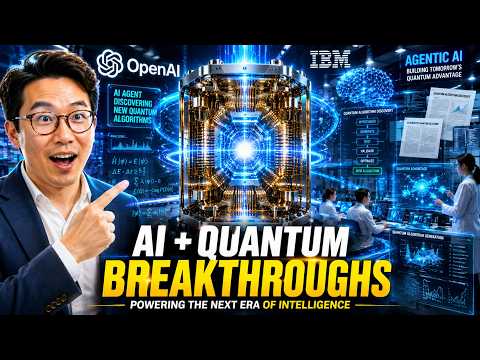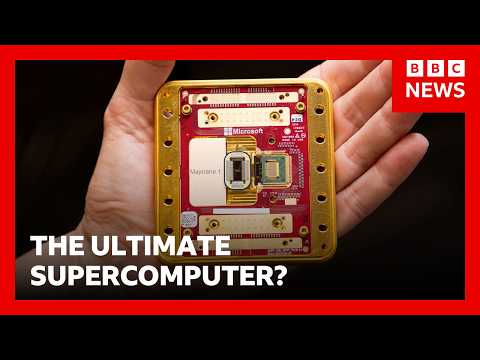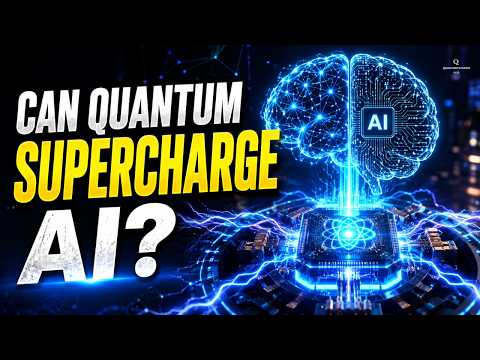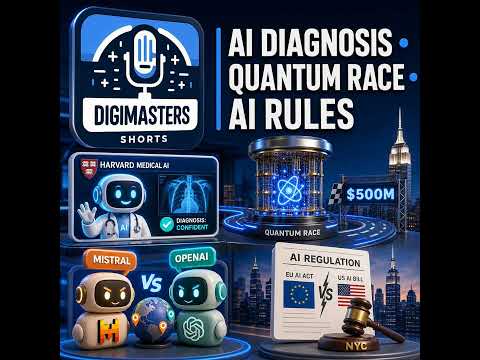
Every once in a while, humanity invents something that feels less like technology and more like a door. Quantum AI is one of those doors. Behind it isn’t just faster computation or sleeker gadgets; it’s a fundamentally new way of thinking. Classical AI is like walking down a road with clear signs. Quantum AI is like stepping into a forest where paths multiply and fold over each other in shimmering layers. The map becomes a landscape of possibility.
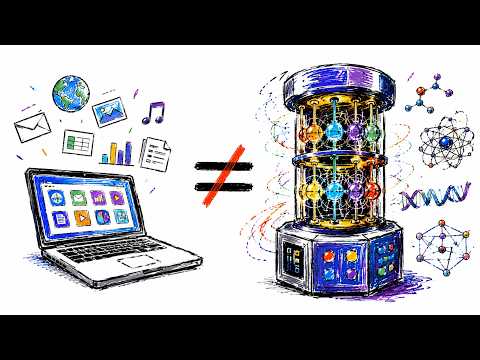
Classical systems work with bits: the comforting, binary rhythm of zero and one. Quantum systems breathe in qubits, which live in superposition—more “both/and” than “either/or.” They link across distance through entanglement, behaving like old friends who finish each other’s sentences even when they’re galaxies apart. When AI rides on this quantum fabric, its thinking expands into a multidimensional orchestra playing multiple melodies simultaneously.
As of late 2025, the orchestra is still tuning its instruments. We’re working with NISQ devices—noisy, unpredictable, like toddler musicians with cosmic violins but even these early proofs of concept in quantum-enhanced machine learning and optimization are enough to make researchers sit up straighter. At IBM, MIT, and elsewhere, researchers regularly describe these first results as hints of “computational advantage,” a phrase that sounds understated until you consider what it implies. Imagine simulating drug interactions at a molecular level in minutes, rather than years, or optimizing planet-scale climate models in real-time. It’s the kind of leap that rearranges what is possible for an entire civilization.
And yet, standing at the threshold of this door, there’s a whisper behind all the excitement. If this power becomes real, what else comes with it? What does it mean to unleash an intelligence that reasons in a language we don’t fully understand? What happens when the shadows grow as quickly as the light?
We ask these questions not to slow the march of progress, but to guide it gently—like a hand on a friend’s shoulder, reminding them to look both ways before crossing.
When Power Moves Faster Than Our Ethics
Technology has always been a mirror. It shows us our creativity, but it also reveals our blind spots. With Quantum AI, those reflections become sharper.
Bias doesn’t disappear just because the mathematics gets fancy. If anything, the risk grows. Quantum systems can sift through oceans of data with terrifying efficiency, finding connections so subtle they’re practically invisible to human reasoning. If the underlying data reflects historic inequalities—and it often does—then quantum systems can accidentally deepen those grooves until they feel like canyons. Debugging that kind of system is almost like trying to explain a dream you didn’t have.
And then there’s the privacy problem, which isn’t really a problem so much as an existential scream. Shor’s algorithm has long warned us that a sufficiently powerful quantum computer could break RSA and ECC encryption like snapping dry twigs. In a world where data is harvested relentlessly and stored forever, a single breakthrough could unlock decades of private messages, financial histories, medical records—an unspooling of our digital lives. Ethics researchers sometimes refer to this as “retroactive privacy loss,” but that phrase seems too gentle. It’s more like waking up one morning to discover that every diary you’ve ever kept has been photocopied and passed around.
Pair that with quantum AI’s capacity to analyze real-time surveillance data, and you have the mechanics of a true panopticon. Not metaphorical. Literal.
And floating above all of this is the larger, stranger question: What does alignment even mean when the system’s reasoning is quantum-native? If classical AI alignment is a complex puzzle, then quantum AI alignment is a puzzle that keeps rearranging itself while you’re trying to solve it.
Building the Guardrails Before We Hit the Gas
The ethical work around Quantum AI can’t be an afterthought. The stakes are too large, and the pace of innovation too quick.
One promising idea gaining traction in global policy circles is the creation of Quantum Ethics Boards—groups that combine the voices of physicists, sociologists, engineers, ethicists, lawyers, and community leaders. The magic happens in the mix. Diverse perspectives act like quantum superposition for wisdom: overlapping viewpoints that reveal possibilities none of us could see alone. UNESCO has been laying early groundwork here, weaving together cultural, legal, and ethical frameworks that feel rooted in humanity rather than industry.
Another emerging priority is explainable Quantum AI, or XQAI. Transparency doesn’t mean dumbing down the math; it means ensuring that humans remain able to ask the most crucial question in any ethical system: “Why?” Without traceability, accountability becomes impossible. If a quantum-enhanced hiring algorithm denies someone a job, that person deserves more than a shrug.
And because quantum capabilities ignore borders, ethical frameworks must do the same. An unregulated quantum arms race would be the stuff of nightmares: nations scrambling to achieve dominance, racing to break encryption, and destabilizing global trust. International treaties and shared governance models feel not just prudent but essential. Think of them as collective seatbelts for a hyper-accelerated future.
The Human Ripples of a Quantum World
Quantum AI won’t only reshape technology. It will bend the arcs of our lives in ways both exhilarating and unsettling.
Entire fields will bloom around quantum literacy: algorithm design, fault-tolerance engineering, and quantum-safe cybersecurity. Jobs will transform, not evaporate, but the transformation will demand large-scale, accessible education initiatives. Governments and institutions that prioritize reskilling will cushion the landing; those that don’t may face profound social upheaval.
Still, the most astonishing potential lies in solving problems that feel mythic in scale. Quantum AI could help optimize fusion reactors, forecast climate patterns with elegant precision, and design personalized medical treatments built on molecular choreography. It’s easy to imagine humanity looking back on this moment as the dawn of a new scientific renaissance.
But with this renaissance comes a softer, more philosophical question: If machines become capable of outthinking us in dimensions we can barely perceive, what becomes of the human mind? I don’t hear this as a fear. I hear it as an invitation. Maybe the role of human intelligence shifts from doing the heavy lifting to asking better questions, nurturing creativity, strengthening connections, and exploring meaning. Maybe quantum AI frees us to become more fully ourselves.
Walking Forward Together
Quantum AI is a threshold technology. It asks us who we want to be as much as what we want to build. It will take courage, imagination, and a gentle kind of wisdom to develop it responsibly.
The work begins now before fault-tolerant machines become mainstream. Before global infrastructures adopt quantum acceleration as the default. Before the door fully opens.
If we move forward with transparency, collaboration, and a fierce commitment to human dignity, quantum AI could help us solve some of the most intricate puzzles our species has ever faced. Not by replacing our humanity, but by expanding it.