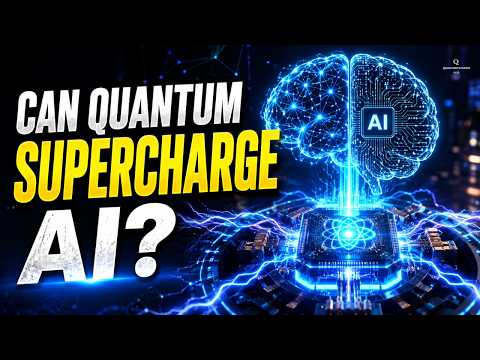
In the quiet battleground of silicon and algorithms, an unassuming yet formidable alliance is forming: quantum computing and Artificial Intelligence (AI). As we traverse the ever-expanding terrain of data complexity, the pressing question emerges—can quantum computing propel AI to new heights of speed, intelligence, and power?
Based on content from Quantum SystemHub
At the heart of this inquiry lies the juxtaposition of qubits against classical bits, entanglement with deterministic sequences, and superposition against linear processing. In these overlooked nuances, a profound transformation can occur, promising to tackle optimization and learning challenges that embroil today’s conventional systems.
To appreciate this fusion, we must first confront a dilemma faced by classical AI—its burgeoning appetite for processing power. Traditional models, steadfast in their demand for accuracy, struggle under the ballooning weight of high-dimensional data. It’s akin to navigating a labyrinth—to find the way out, a simple map isn’t enough; you need an aerial view that sees beyond walls. Enter Quantum AI, which offers just such a perspective.
The Classical AI Bottleneck
Classical AI, powered by deep learning models, has been transformative. Yet, as these models push against the boundary of physics, they reveal a frailty—susceptibility to noise and an unsustainable dependency on intensive tuning. The vast, intricate data spaces present a feast too grand for silicon-based processors to digest efficiently.
The curse of dimensionality traps classical systems, bogging them down in nonlinear mazes. Picture solving a many-dimensional Rubik’s cube, where each twist only amplifies its intricacy. In that entanglement of complexity, classical processing flounders, but quantum methods see a path where traditional ones see an obstacle.
Enter Quantum Machine Learning
Now imagine reimagining computation through the lens of quantum phenomena. Quantum Machine Learning (QML) strides in not with a faster chip, but with a new paradigm. Qubits, embracing the duality of states, offer an expansive canvas where computations are not restricted to sequential zeros and ones, but can unfold in all possible states simultaneously.
This confers an inherent agility to quantum systems—an ability to explore copious configurations concurrently. Superposition and entanglement enable a symbiotic dance of quantum elements. A whisper in one part of the system resonates inexplicably with another removed, invisible dance partners choreographed by the quantum ballet.
How Quantum AI Works
Quantum algorithms thrive on mapping data onto high-dimensional spaces—Hilbert spaces, their playground. Here, patterns and pathways invisible to classical sight become crystal clear. Consider quantum-enhanced SVMs (Support Vector Machines), which transform chaotic data swirls into coherent narratives, discovering separations that elude classical counterparts.
Such potent capabilities yield not just enhancements but exponential leaps—breaking through barricades that classical pipelines barely scratch. Parameterized quantum circuits bring forth quantum neural networks, with Variational Quantum Algorithms (VQAs) acting as heralds of practical quantum prowess, tailored for the noisy NISQ era hardware we possess today.
The Real-World Quantum Impact
Beyond the abstract, quantum’s potential impact is already casting long shadows on diverse fields: in healthcare, unveiling molecular mysteries and fast-tracking drug discovery; in finance, decoding the cryptic dance of markets; in logistics, orchestrating coordination tasks that would otherwise languish in computational purgatory for millennia.
The NISQ Era Reality
We stand at a threshold, grappling with the noisy intermediate-scale quantum (NISQ) era, where imperfections challenge us more than enable us. The fragile nature of qubits, susceptible to environmental whispers and tremors, demands innovations in error correction. True progress lies not in immediate supremacy, but in extracting value from this imperfect milieu.
The Hybrid Future
Thus, the future is not about the demise of classical systems but their synergy with quantum counterparts. Classical processing continues as the backbone, with quantum elements acting as niche accelerators, solving the unsolvable. Classical data prowess melds with quantum curiosity, paving roads laid by visionaries at IBM, HPE, and start-ups like Xanadu.
The true innovators will not be those who wait for futuristic, error-free quantum dream machines. They will be those who wrest art from imperfection today, sculpting a symphony of speeds and scales that subtly whisper, as much as they shout, of untold possibilities.
So, as we edge into this hybrid age where classical AI offers reliable footing, and quantum AI promises boundless creativity, are we ready to embrace this delicate balancing act? This quiet evolution, much like the creeping dawn, may well illuminate a horizon we’ve scarcely imagined.
—