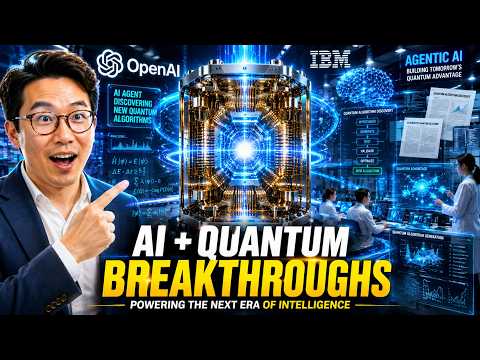
The intersection of agentic AI and quantum computing is quietly redesigning the architecture of technological innovation. While headlines like “OpenAI Reacts to IBM Using Agentic AI to Discover Quantum Algorithms” might guide our focus toward a perceived rivalry, the deeper narrative unfolds in the nuanced methodologies each organization applies toward integrating AI with quantum mechanics. In this article, we delve into IBM’s strategic use of agentic AI to develop quantum algorithms, highlighting how this collaboration could potentially redefine research landscapes.
Based on content from Hardware Grid
The intersection of agentic AI and quantum computing is quietly redesigning the architecture of technological innovation. While headlines like “OpenAI Reacts to IBM Using Agentic AI to Discover Quantum Algorithms” might guide our focus toward a perceived rivalry, the deeper narrative unfolds in the nuanced methodologies each organization applies toward integrating AI with quantum mechanics. In this article, we delve into IBM’s strategic use of agentic AI to develop quantum algorithms, highlighting how this collaboration could potentially redefine research landscapes.
Amidst the digital static that such announcements often generate, it’s crucial to approach these developments with a lens that appreciates the gravity beneath the surface. IBM has committed $50 million in quantum computing access to a U.S. Department of Energy program—supporting the Genesis mission aimed at enhancing scientific discovery through AI. However, this substantial investment is a mere prelude to IBM’s innovative tactical reversal: employing AI not just as a supportive tool for quantum research but as an autonomous discoverer of quantum algorithms.
Historically, the traditional framework of quantum algorithm development follows a linear path. Researchers first identify a scientific problem, then ascertain whether an existing algorithm could provide a solution. IBM, however, flips this formula on its head. Its AI systems begin with pre-existing algorithms and seek out applicable real-world problems by analyzing vast scientific literature. This approach leverages AI’s pattern recognition capabilities, often in ways human researchers, confined by time and expertise, cannot.
Imagine possessing an ability to perceive connections invisible to the naked eye, bridging disciplines like agriculture and quantum chemistry through an algorithmic commonality. IBM’s project embodies this vision. By empowering AI to traverse the ocean of academic publications, IBM facilitates a match-making of sorts—pairing problems within disparate fields to quantum solutions through a lens of mathematical structure rather than disciplinary context.
The potential of IBM’s initiative becomes even more tangible when considering the hardware involved. The company’s 156-qubit Heron processor and the 120-qubit Nighthawk processor represent cutting-edge quantum technology, transitioning beyond mere theoretical or promotional constructs to practical scientific tools ensuring real-time hardware validation of AI discoveries. This prototype-to-practice leap is emblematic of the shift in IBM’s strategy from mere qubit quantities to sustainable computational results.
In a broader sense, IBM’s leap unto agentic AI unveils a compelling divergence in visions between itself and OpenAI—each depicting AI’s role in scientific breakthroughs. While OpenAI centers its ambitions on general-purpose language models like GPT-5, serving as versatile aids across myriad scientific hubs, IBM hints at the transformation unleashed by precise, targeted AI systems emerging from the nexus of quantum computing and mathematics.
This strategic dichotomy—from broadly facilitating exploration to incisively solving the scientific bottleneck—presents two contrasting hypotheses: Will broad, adaptable AI models or narrowly focused, integrative AI systems prove more efficacious in future scientific evolutions? The genuine intrigue rests not on the immediate competitive fronts but in observing how these pathways unfold in conjunction, both challenging and inspiring the paradigm of scientific progress.
Ultimately, IBM’s sustained focus—evidenced by its recent 10-year collaborative initiative with ETH Zurich—indicates a long-term commitment to AI and quantum intersections. As we continue tracing these developments, the question remains for the analytical mind: How might these contrasting strategies converge to enlighten, enrich, and indeed, expand our understanding of computational science?
Stay tuned as we follow the infrastructure of these technological symphonies, exploring not just their disruptions but their convergences, their echoes—and perhaps— their quiet harmonies.
—