
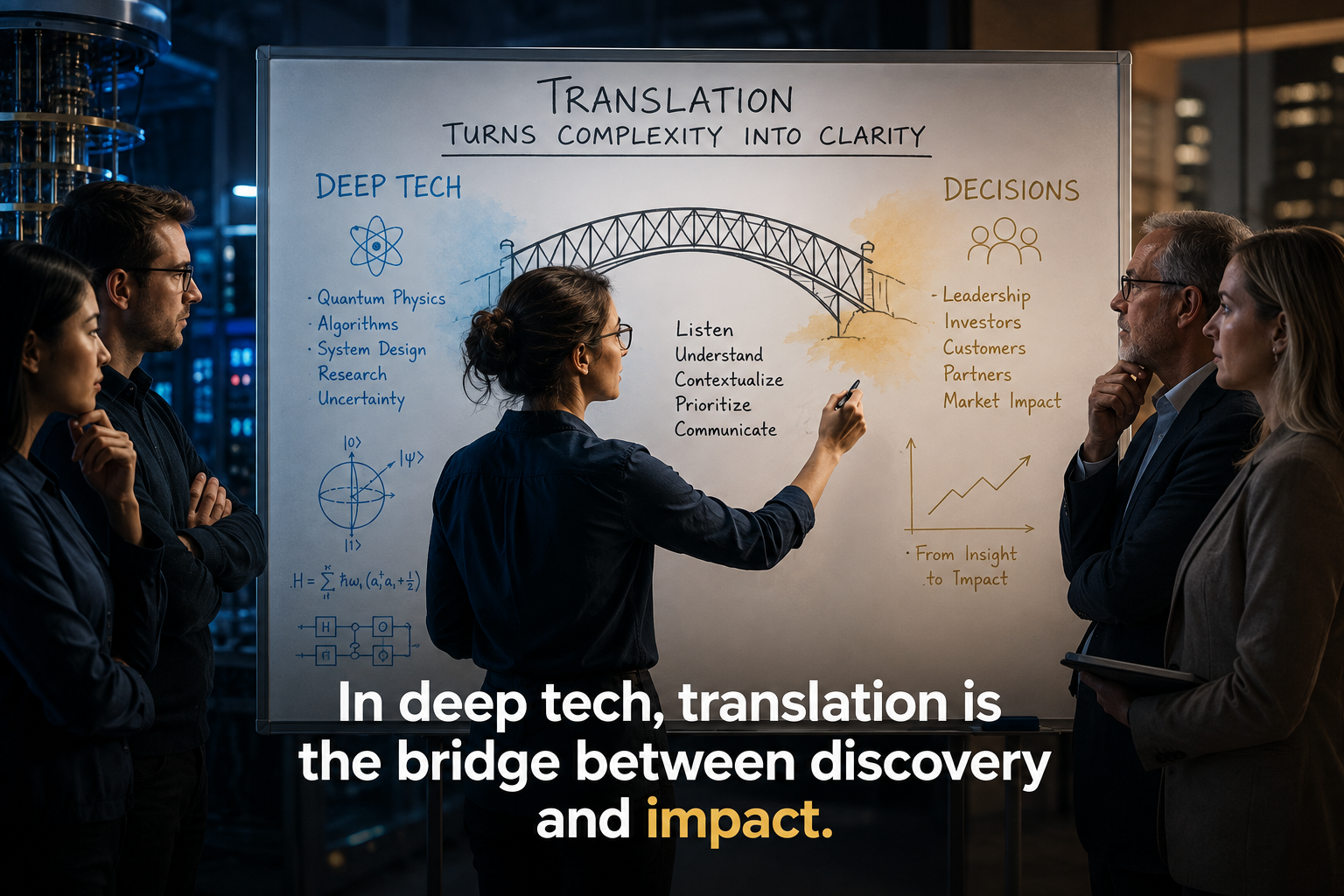
A strange problem is emerging as technology becomes more complex.
The people who understand it best are not always the people responsible for explaining why it matters.
A physicist might spend years studying one specific problem. An engineer knows why a seemingly insignificant design choice can change everything. A founder is considering customers, investors, hiring, and whether the company can deliver what it promised. Everyone is looking at the same technology, but from very different places.
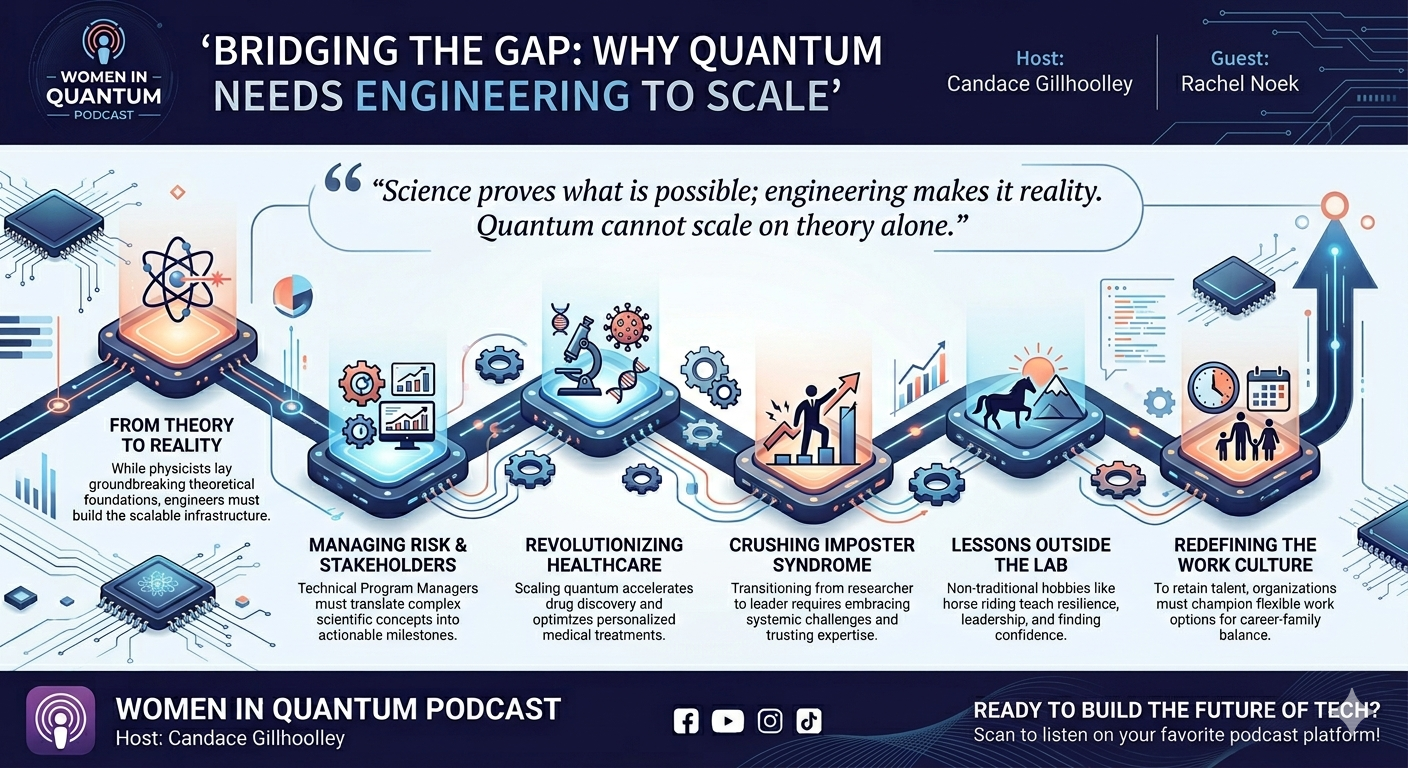
I kept thinking about this after my conversation with Rachel Noek, a researcher and technical program manager who has worked across academia and the quantum industry. What interested me wasn’t simply what Rachel knew about quantum computing. It was the role she often found herself playing between highly technical teams and the people making decisions about their work.
That space in between is easy to overlook. It is one of the most important spaces in deep tech.
Rachel described her industry role as a kind of go-between. Senior leaders needed to understand what was happening inside highly technical programs, but they couldn’t participate in every conversation or follow every detail. Her job was to stay close enough to the work to understand it, then provide leadership with the information they actually needed.
That sounds simple. It isn’t.
Knowing something and knowing what another person needs to understand about it are two completely different skills.
Deep-tech companies are filled with people who have spent years becoming experts. That expertise is their advantage. You don’t want to strip away the complexity or flatten years of research into a catchy sentence that sounds impressive but means very little.
But nobody outside the technical team can absorb everything.
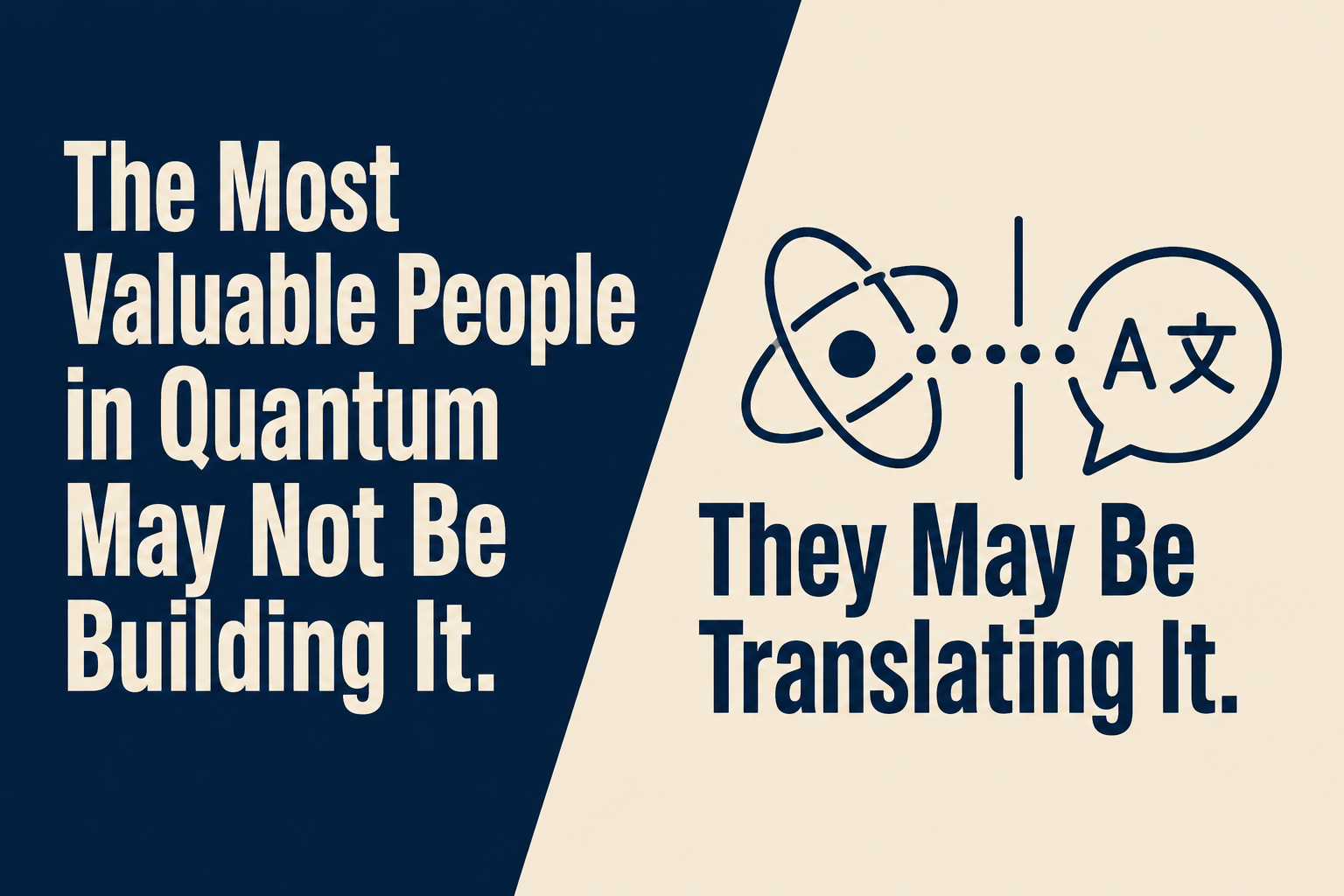
That is where translation becomes important.
Not translation as in making science “easy.” I dislike that framing because some ideas aren’t easy. Pretending they are usually makes the explanation worse. Good technical communication is about finding the part of the complexity that matters to the person standing on the other side.
Rachel’s description of academia and industry made this particularly clear. Academia has room to pursue deep research and fundamentally new ideas. Industry eventually has to take what works and turn it into a product.
A tremendous amount of work happens between those points.
Once researchers establish the physics, engineers still need to make systems stable, repeatable, and usable. In quantum computing, that means immense engineering before these machines resemble the dependable computing systems we’re used to.
The information changes as it moves through that chain.
And uncertainty travels with it.
Rachel talked about managing programs where teams are attempting things nobody has done before. You can create timelines and milestones, but occasionally you genuinely don’t know whether something will work. Eventually, someone has to decide whether to keep pursuing an approach or to move on.
Now imagine communicating that uncertainty to leadership without making the project sound directionless. Or explaining it to an investor while acknowledging the uncertainty. Or talking to a customer without burying them in technical caveats.
That’s not really a writing problem. It’s a thinking problem.
The translator has to understand enough to recognize what cannot be removed. Which detail changes the meaning? Which one can quietly stay behind the curtain? We sometimes underestimate this role because, when done well, it barely registers.
When someone explains an extraordinarily complicated technology clearly, the explanation can feel obvious. Of course that’s what it means. Of course that’s why it matters. What disappears is all the work required to get there.
As deep tech moves from laboratories into startups, products, and broader markets, we’ll need more people comfortable in that middle space. People who can listen to scientists without being intimidated by the terminology. People willing to ask the question that seems obvious but isn’t. People who understand that simplification and clarity are not the same thing.
Deep tech absolutely needs better technology. But technology cannot create an ecosystem by itself. Someone has to help the rest of us understand what has been built, why it matters, and what might become possible because it exists.
That person may never touch the quantum computer.
They may still be essential to what happens next.






Leave a Reply