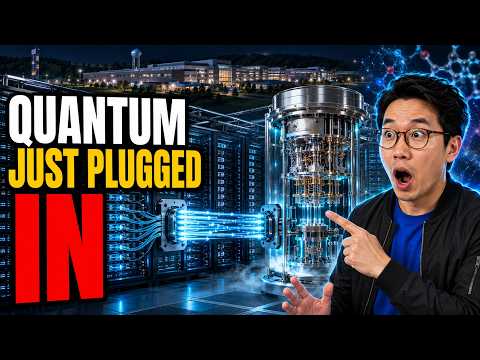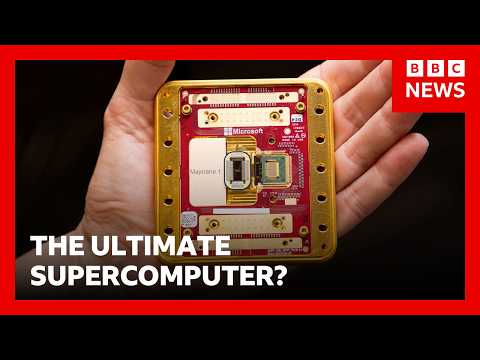
In the quiet surrounds of Lyngby, a short traverse from the vibrant hustle of Copenhagen, Microsoft has nestled one of its most ambitious endeavors—the Quantum Lab. Here, in this unassuming part of Denmark, the race to transcend traditional computation unfolds quietly yet profoundly amid the chilled whisper of groundbreaking tech.
Based on content from BBC News
To the untrained eye, a quantum computer might appear as just another glossy piece of machinery, but to the scientists donning lab coats, it’s a canvas for possibility, painted with brushstrokes of qubits instead of binary bits. Conventional computers think in the simplistic language of zeros and ones. But Microsoft’s quantum reality speaks in a dialect both infinitely richer and wholly other—thanks to qubits, which can embody many states at once. These qubits, however, are fleeting as whispers on a breeze, notoriously unstable in their quantum dance.
The Microsoft Quantum Lab stands as a nexus of collaboration and innovation, layered with the anticipatory energy akin to a deep breath before a leap. In rooms chilled to a temperature shy above absolute zero—colder than the blackened stretch of space itself—quantum machines come to life. It’s here that researchers compete against the tick of the quantum clock and the financial stakes embedded in the circuits they design.
At the heart of Microsoft’s pursuit is the principled ambition of topological quantum computing—a path less traveled amongst tech giants. The lab teems with robotic assistance and AI-accelerated processes, crafting not just chips but legacies. Indeed, the lab’s ambition stretches back two decades, fixated on harnessing elusive particles—the Majoranas—whose very existence invites both intrigue and skepticism in scientific circles. In this realm, conviction mingles with caution, as Microsoft steadfastly defends the validity of their research amidst critiques that suggest shadows of uncertainty might linger over their data.
With Microsoft’s latest chip, the enigmatically christened Majorana 2, the qubits multiply—now at twelve—and more strikingly, they stand robust, prolonging their ephemeral nature into a more stable present. The lab’s collective gaze focuses on scaling, visualizing a quantum hierarchy ascending from hundreds to millions of qubits. Here lies the ambition not just to join the ranks of quantum pioneers, but to leap across them.
In this ongoing symphony of development, each note is critical. The lyres of technology are strung with tension, with potential ripples spreading into fields as diverse as materials science and pharmacology. Where traditional computers might stumble, quantum machines could sprint—opening doors as yet uncarved into reality. And in these halls, as researchers whisper of possibilities, the present hums with the echo of an anticipated future.
The promise of a fully realized quantum computer is both breathtaking and daunting. The potential disruption of entire industries hovers in the margins, leaving enthusiasts in a delicate balance of hope and skepticism. Here, it is not merely about the cold precision of machines, but the warmth of what they may yet herald—a dynamic reshaping of our world.
If the whispers are to be believed, the path forward is measured not in generations, but in years. As transistors revolutionized their analog surroundings, so too could these quantum embryos. The question now unfurls before us: In this race against convention, can quantum computing truly untangle the knots of today’s computational limits? The clock ticks, a silent metronome, counting the cadence of change. A new dawn is whispered on the chill breeze of Lyngby—a cascade of opportunity wrapped in a qubit’s delicate embrace.
—