
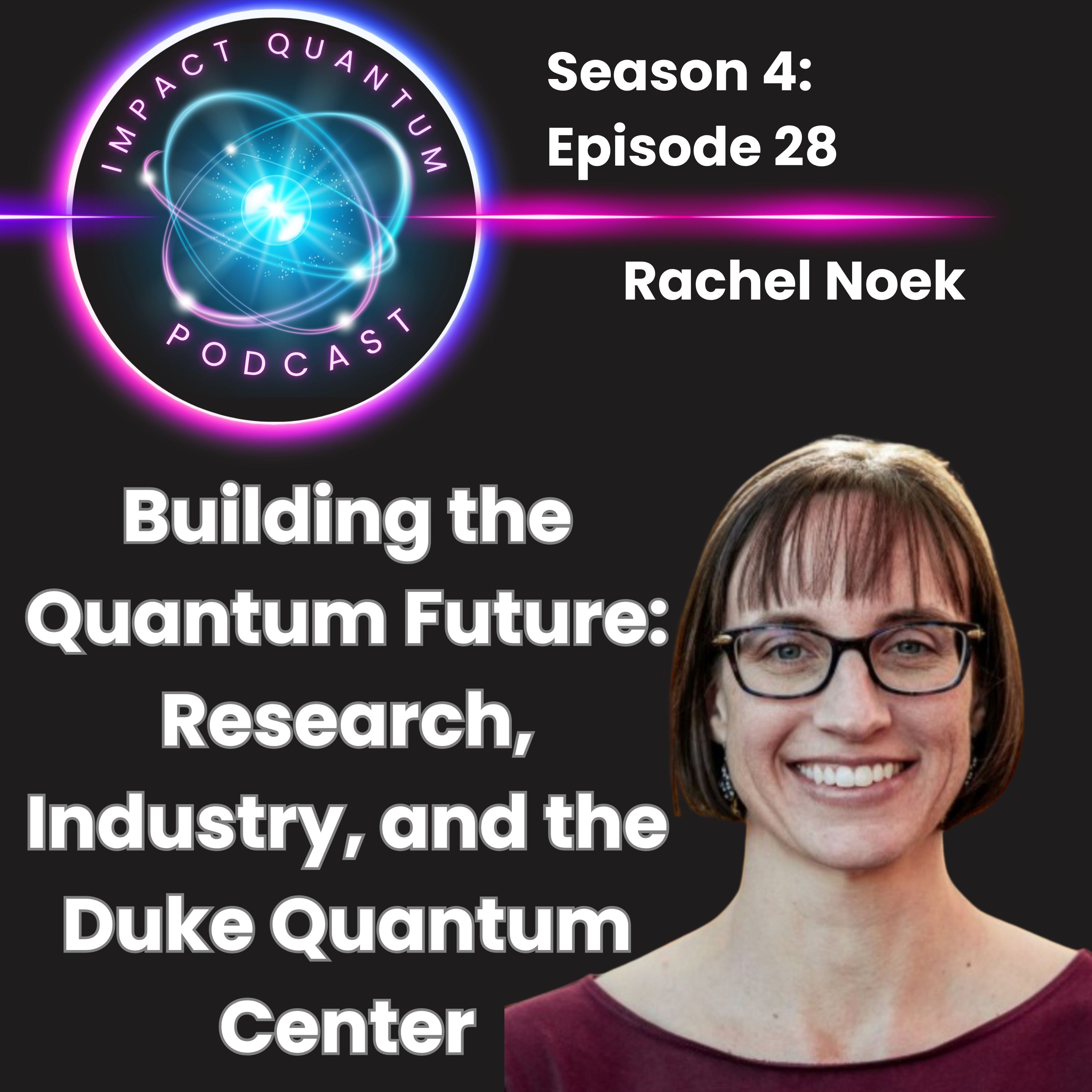
In this episode, we’re joined by Rachel Noek, Senior Research Scientist and Technical Program Manager at the Duke Quantum Center. Rachel shares her journey from industry to academia, her experiences developing photonic kits for inspiring the next generation, and her insights on the rapidly evolving landscape of quantum computing.
We dive into the unique challenges of project management in deep tech environments, the essential collaboration between academia and industry, and what the future holds for quantum technologies. Rachel also discusses how hands-on learning can demystify complex concepts, why the quantum field needs talent beyond physicists, and her vision for a quantum-enabled future.
Whether you’re quantum-curious or an industry veteran, this conversation is packed with inspiration and practical wisdom about the quantum revolution
Links
- Watch on YouTube – https://www.youtube.com/watch?v=VKpbvjPnmT0
- Rachel Noek on LinkedIn – https://www.linkedin.com/in/rachel-noek-qc/
Time Stamps
00:00 Facing unknown challenges
06:53 Funding and goals of Duke Quantum Center
10:44 Explaining light absorption and emission
13:51 Role of academia and industry in quantum computers
15:54 Transition from Software to Data Science
20:56 Role as a technical project manager
23:25 Facing unknown challenges
26:59 Entering the Quantum Industry
30:12 Integrating quantum computing in biology
33:19 Reflecting on early tech experiences
36:16 Decluttering before the big move
40:44 Growth of Quantum Computing Field
45:07 Challenges in shifting to EVs
48:20 Upcoming Trapped Ions Conference
Transcript
You're trying to develop a plan to do
Speaker:something that nobody has ever done before.
Speaker:That is probably the biggest challenge. So you have no idea
Speaker:what challenges you're going to face. You have
Speaker:really no idea how long it even— we try to make guesses
Speaker:at how long things will take us, but nobody knows.
Speaker:Like, we've never done it before. And like I said, we don't even know if
Speaker:it will work. You know, we can make milestones about
Speaker:at this point, we, you know, at this time we have to make a
Speaker:decision to go with it or ditch it, right? Because
Speaker:sometimes you don't have the luxury of just pursuing
Speaker:a thing endlessly. Welcome to
Speaker:Impact Quantum.
Speaker:I have my Earl Grey tea. Oh, nice. Very
Speaker:Picard. I just, uh,
Speaker:coffee leaves an aftertaste that I just can't get over. I love the
Speaker:smell of it. Well, I drank it for a long time, and then my,
Speaker:my husband, when we were dating, switched me to tea, and then I got used
Speaker:to tea, and now I'm like, now I don't want to go back to coffee.
Speaker:It's just so, it's so just intense. Yeah, no,
Speaker:I hear you. Let's see. So where are you
Speaker:based? I am now in
Speaker:Apex, North Carolina. So the Raleigh-Durham area. Okay.
Speaker:I currently work for Red Hat, at least for another week or two. Oh,
Speaker:nice. Almost certainly you've heard of them living in Raleigh.
Speaker:Yes. Akita, my husband, worked for them for
Speaker:a brief period. So he started working for Ansible, which was acquired by Red
Speaker:Hat. That's right. Yeah. And then he just had to go start his own thing,
Speaker:so he quit. And then his— but his friend Matt Jones has still—
Speaker:has been there for a long time. He also came on with Ansible. I still
Speaker:know somebody else that works there too.
Speaker:So I'm just opening up the LinkedIn because I realized I had closed it.
Speaker:So I refer to you, Rachel
Speaker:Nowak, as—
Speaker:Oh, you're at the Duke Quantum Center. I've heard a lot of things about that.
Speaker:Yes. Nice. Very good. And
Speaker:I, I overheard you admiring our production process. Thank you. Yes.
Speaker:Yeah, I know. It just blows my mind. I've been doing podcasting, streaming from one
Speaker:form or the other for maybe like 12 years and kind of like at one,
Speaker:maybe longer, but at each, each stage I did like a 1%
Speaker:better, 1% faster, like over the time. And now it's to the point
Speaker:where we can get a show out within an hour. Like, it's like
Speaker:Ridiculously fast now. So I
Speaker:just want to ask you, are you a senior research scientist at
Speaker:IonQ? No. So I would—
Speaker:I was a senior staff technical program manager
Speaker:at IonQ, and now I am a senior research scientist,
Speaker:but in reality, a technical program manager at Duke. Okay.
Speaker:At Duke. Okay. That's what I needed. Okay. And you made
Speaker:photonic kits for kids. That's so cool. I did.
Speaker:I actually— I have a cool— I have 2. I have one
Speaker:electronic thank you poster, and I have one like
Speaker:written by hand thank you poster from classes that use my thing. Yeah, I
Speaker:got a— right before I moved here, the teacher that was like
Speaker:one of the best that I worked with, he sent me a thing saying like,
Speaker:okay, 3 years ago you loaned us these kits. Can we buy them now?
Speaker:I'm over here like, I quit that a while ago because I just, you know,
Speaker:I needed to make money. Um, yeah, yeah. And I ended up,
Speaker:yeah, giving him all my prototypes. I had like 14 prototypes of these, like these
Speaker:massive 3D prints. They were like this big. And yeah, I gave them to
Speaker:that school because they were going to use them. It was a good experience.
Speaker:Yeah. Let's see. So I'm ready when you
Speaker:are. I'm ready. Awesome.
Speaker:Hello. Oh, sorry. I know I got a
Speaker:cough. Sorry, I had to clear my throat right at the same time as you.
Speaker:It's contagious virtually, right? So
Speaker:what's really funny is that the guy that I interviewed just now
Speaker:runs a company called Impala. So like I had that t-shirt,
Speaker:so I thought that was funny. All right. Hello and
Speaker:welcome to Impact Quantum, the podcast where we explore the emerging industry
Speaker:that is quantum computing, where you don't need to have a PhD, you just need
Speaker:to be a little bit curious. And with me on this journey,
Speaker:into the quantum realm is the most
Speaker:quantum-curious person I know, Candace Cahouli. How's it going, Candace? It's
Speaker:going great. Thank you for asking. I'm really excited about
Speaker:today. We have a guest who I featured on the Women in
Speaker:Quantum podcast, and she just was so fascinating.
Speaker:I really wanted to get her on this podcast as well. So we have
Speaker:Rachel Nowak, and she is the senior research
Speaker:scientist Technical Program Manager
Speaker:at Duke. Hi, Rachel, how are you?
Speaker:I'm good, thank you. Thanks for having me on the show. No problem. And I
Speaker:think you're the first person to be on the Women in Quantum show to come
Speaker:over to Impact Quantum. So we've had a couple of people do
Speaker:things the other way, but you're the first to come in this direction. So,
Speaker:and we were talking in the virtual green room about the
Speaker:Raleigh-Durham area. And I've heard a lot about the Duke
Speaker:Quantum Center. So, so I'm very curious about this. Like, what
Speaker:is the Duke Quantum Center? Obviously, it's attached to Duke University.
Speaker:That's right. It's just basically they formed
Speaker:a center to focus on quantum technologies,
Speaker:quantum computing, quantum sensing.
Speaker:And so they started the center to attract
Speaker:talented faculty. and to concentrate funding
Speaker:for quantum studies at Duke. Interesting. And it
Speaker:makes sense. There's a— that area, Raleigh area,
Speaker:Raleigh-Durham Triangle, has a history of
Speaker:research and semiconductors. I think IBM was there, a
Speaker:couple of game companies were there. Obviously, Red Hat was there.
Speaker:And there's a lot of interesting tech kind of startups in that area.
Speaker:So it's— I'm glad to hear that they're Taking,
Speaker:taking this seriously. That's cool. Yes, I'm hoping to see, now
Speaker:that I'm located here in North Carolina, I am hoping to see even
Speaker:more quantum industry and, you know, more
Speaker:activity in quantum in the area. It's really exciting to watch it grow.
Speaker:Cool. What, what is, what does the Duke
Speaker:Quantum Center do? Like, fundamental, if you had to give like an elevator pitch for
Speaker:what it is, like, what would that be? Promoting
Speaker:research and education in quantum. That is
Speaker:fundamentally like what their core objective is.
Speaker:So when you see funding for the center, it's like,
Speaker:what does it focus on? It focuses on bringing in talented
Speaker:faculty, engaging with the community, the
Speaker:quantum community to promote
Speaker:interactions in the quantum community that are, you know,
Speaker:there's cross-center funding, there's, you know, it's
Speaker:supported by Pratt University or Pratt School of Engineering
Speaker:at Duke University. It's part of Duke Quantum Center, is
Speaker:part of Pratt, I believe. But yes, and while we're interviewing, I should
Speaker:also mention that I rep— you know, I'm not representing
Speaker:Duke Quantum Center or Hyang-Kyu or anyone else. My views
Speaker:are my own. So I don't want to get in trouble with anyone. No,
Speaker:that's good. That's a good thing to point out. You're just here having a conversation.
Speaker:So education, one of the things I saw on your LinkedIn profile that we were
Speaker:talking about, also talking about in the green room, was you made photonic
Speaker:kits for kids to learn. Tell me more about that. I'm curious.
Speaker:I did. I had a few ideas. I went
Speaker:all the way through prototyping one of my ideas. It
Speaker:was basically, what do people not see about lasers in
Speaker:toys and kits and things like that? And I wanted to really expose
Speaker:younger people to lasers besides playing with their cat
Speaker:or their dog. And so I had this idea
Speaker:where you could look at how lasers
Speaker:interact with liquids, because that's not something that most people are
Speaker:exposed to or think about. So I made a kit that has
Speaker:3 different lasers that kind of represent the
Speaker:visible spectrum. So there's like a blue, green, and red. And
Speaker:then I had, you know, you know, I went through and I hired an
Speaker:artist on it just to
Speaker:hire an artist to make like educational pieces.
Speaker:So to talk about the experiments you can do. And I
Speaker:mean, I wrote the content, but the artist made some really nice art. So I
Speaker:have a little card deck that goes with the kit. So it's basically
Speaker:like this little workstation where at the front you have 3 buttons, 1 for each
Speaker:laser. And then you have these different clear cups that you put in that are
Speaker:different shapes. So now you can use the liquids in the cup to act like
Speaker:lenses. And because there's 3 lasers, you can sort of see
Speaker:what happens when those lasers pass through the different cups. Do they
Speaker:focus? Does the laser focus afterwards? Does it diverge?
Speaker:So anyways, it was a cool idea, and I ended up
Speaker:having a few schools test and work with it. And, you
Speaker:know, actually they really enjoyed it. When I started working at INQ is when
Speaker:I kind of shut down the business and decided, you know,
Speaker:to work somewhere else instead of having a business. And at that
Speaker:time, I asked for the kits back, and the schools—
Speaker:one of the schools said, well, wait, can we just use them till the end
Speaker:of the year? Because we're in the middle of teaching with them. And so I
Speaker:thought nobody's using these kits, you know, so it's very exciting. that they were actually
Speaker:using them. And so of course I let them keep them to the end of
Speaker:the year, and then I collected them and I just actually gave them back.
Speaker:Oh, cool. After 3, after 3 years they asked for them and I said, I
Speaker:can, no, no warranty, no guarantees, but you can have the kits. So it
Speaker:was a great experience and they were very kind and encouraging and gave me
Speaker:lots of opportunity to see the kids interact with them. Yeah, so that was
Speaker:in a high school, high school physics classes at Sandia High School in New
Speaker:Mexico. Interesting. So you've been in industry. I'm sorry, Candace, go
Speaker:ahead. Why do you think hands-on learning experiences are so
Speaker:important when teaching complex topics
Speaker:like light, optics, and quantum science?
Speaker:Well, you can say something like the light is absorbed,
Speaker:and then you can see, like, okay, but, you know, if
Speaker:you shine a laser through a liquid that absorbs
Speaker:that frequency and you can see
Speaker:it basically just
Speaker:disappear as it travels through the liquid gradually. You know,
Speaker:that's different. Or how, you know, you
Speaker:could see the laser passing through the liquid, it absorbs that frequency
Speaker:but emits a different frequency. Olive oil or something,
Speaker:you know, you pass a laser through, a blue laser
Speaker:through it, and it emits red. So you can see it changing
Speaker:color, and you have to understand, like, why is it changing color? So
Speaker:there's a lot of experiments that you can talk about, but seeing it is just—
Speaker:it's different. You know, you can remember it a little bit better.
Speaker:Yeah, experiential learning is
Speaker:definitely the best. So I'm sorry, before— I just think it's interesting
Speaker:because you've been in academia, you've been in industry, and now you're back and kind
Speaker:of an academic. capacity. So you have a very unique
Speaker:perspective on, on the quantum
Speaker:ecosystem and kind of the scene, if you will. Yeah, it's very
Speaker:different in academia and industry, I can tell you
Speaker:that. What— I don't want to ask you to pick which one you like more,
Speaker:but what's your take on kind of the current
Speaker:state of academia being, for lack of a better term, invaded
Speaker:by, by, um, by
Speaker:basically the startup world, right? That's— it's an interesting, uh,
Speaker:time in, in this. I think
Speaker:it's important to remember that they serve different
Speaker:core functions. Like, academia is there to
Speaker:educate and to do deep research.
Speaker:Companies are committed to turning out a product.
Speaker:So if I was to say, like, how— now that I've been in both
Speaker:situations, how would I sort of divide things up if I, if I had control
Speaker:everything. I would say academia, let's
Speaker:concentrate focusing on doing new things and trying
Speaker:like fundamentally different things because you can't— it's
Speaker:very hard to find the budget and the time and the personnel at a
Speaker:company to do those things. It's just hard because you have priorities. If you're trying
Speaker:to turn out a product, your people will get sucked in as the
Speaker:product becomes, you know, gets behind delivery schedule or whatever. You're gonna need all
Speaker:your talented people to help. Right. And the core research, it's going to
Speaker:be very hard to not disrupt it. So
Speaker:if I had to pick, I would say core research,
Speaker:keep it going. Have those people that are doing that be learning,
Speaker:be getting PhDs. And then in industry,
Speaker:have these startups or these companies really work on saying
Speaker:like, okay, here is
Speaker:what works fundamentally. Like, here's the physics that
Speaker:we need. Now let's go turn it into a
Speaker:product. Right. And when I say that, there's like all this engineering
Speaker:that needs to happen to make it like this computer that I'm
Speaker:talking to you on, right? There's just a long way to go
Speaker:in terms of stability, consumer operation
Speaker:of the quantum computer, There's just a whole
Speaker:immense amount of work to be able to have it look
Speaker:like the computers that we're all used to. And so I would
Speaker:split the work in that way where you can hire a lot of engineers who
Speaker:are focused on engineering and making things better,
Speaker:more stable, tolerant designs, and
Speaker:focus on that in industry because you can hire engineers and you can focus and
Speaker:spend that time, but no one can get a PhD doing that. And
Speaker:then in academia, push through the PhDs where they're doing this
Speaker:novel research. You know, we have, you know, the Quantum
Speaker:Center, we're doing things that nobody's done before. We're thinking
Speaker:about totally different ways of doing gates or operating quantum
Speaker:computers. And so that is the kind of thing that
Speaker:should stay in academia. That is how people get PhDs, that really
Speaker:novel work. So I don't think there's really There doesn't need to
Speaker:be a lot of, like, contention between the 2. It's
Speaker:just like dividing the work appropriately and funding each, each
Speaker:thing to do the right work, to my way of thinking. No, I
Speaker:agree. I agree. I just— what was interesting was I went to my first
Speaker:conference, was about a year ago, first quantum conference. And it was,
Speaker:um, definitely, it was an interesting mix of
Speaker:humanity, right? Because you had people who were doing pure research. And then
Speaker:you had people who were clearly startup founders. And I wouldn't say it was like
Speaker:oil and water, but it was
Speaker:definitely, you can definitely tell like it was a different, it was a different vibe,
Speaker:right? Because I'm used to like the tech conferences where it's crazy, you know how
Speaker:those can be, right? Like the swag, the people. But this was
Speaker:more kind of low-key in that regard. And I've been to
Speaker:research conferences too, and kind of was an interesting hybrid
Speaker:of the two worlds. Which I had never really seen before, those 2 worlds
Speaker:mix. And you're right, it doesn't have to be confrontational, but I'm old enough to
Speaker:remember when I made the switch into— from software development into
Speaker:data science, there was definitely a kind of, you know,
Speaker:there were people who were old-school math people and there were people who were kind
Speaker:of converts like me kind of coming into the space, and it
Speaker:definitely changed the dynamic. Again, it doesn't have to
Speaker:be adversarial, but it was certainly an interesting time.
Speaker:To go into, and it was, it was interesting,
Speaker:to say the least, right? But I think that just might just be a growing
Speaker:pain of maturing of an industry where it goes from strictly academic
Speaker:to— you need the R and the D, basically, is what I'm saying. Yes,
Speaker:exactly. Exactly.
Speaker:So what lessons from the early research days
Speaker:still influence how you approach quantum today?
Speaker:In early research days is when you learn really
Speaker:fundamentally what research is. And that stays with you,
Speaker:right? That would be things like,
Speaker:we have a task to do a certain thing.
Speaker:And the answer might be, we can't do that.
Speaker:Or we can do that, but. the
Speaker:answer isn't always 100% favorable. So
Speaker:those are definitely things that have stuck with me all the way through.
Speaker:And, and, you know, sometimes they apply to more than just deep
Speaker:research too. Sometimes, sometimes
Speaker:with, uh, it's like almost similar, very similar. I'm a project
Speaker:manager, you know, as a technical project manager, sometimes the
Speaker:answer is you can't. have the program
Speaker:be on time and have all the specs that you want, right? Like, you,
Speaker:you have to— there's some give and take. So yeah, those are
Speaker:probably the key, most fundamental things, if that's what
Speaker:you meant. I'm not sure if you meant that or if you meant like
Speaker:actual, like, quantum research, but— No, no, that was, that was perfect. That was perfect.
Speaker:What do you think is next for quantum, right? You obviously, you're kind
Speaker:of at that— you're really at the cutting edge of— and that is the Duke
Speaker:Quantum Center kind of like a bridge for kind of like
Speaker:the research and kind of the, the R and the D, right? Is that kind
Speaker:of a good way to put it? Duke definitely positions
Speaker:themselves to strongly support startups,
Speaker:even to the point of giving startups space.
Speaker:So the Duke Quantum Center is
Speaker:mostly— I'm actually not positive. I think it's mostly located in
Speaker:the, what's called the Chesterfield Building. on Main Street in Durham,
Speaker:North Carolina. And in the Chesterfield Building, there is
Speaker:also space for startups. So that's, you know,
Speaker:that space is provided by Duke. I don't know all the details about that,
Speaker:but I do know that they have that space reserved for startups to
Speaker:reduce the, like, the cost of initiating a startup.
Speaker:So it's like an incubator of sorts. Exactly. Of sorts, yeah.
Speaker:Well, it's great because, like, you know, eventually one of those startups or more than
Speaker:one of those startups will end up being a big deal and then
Speaker:going on to do great things. And the fact that they're located near Raleigh, I
Speaker:think, is a good— it's good for the local economy too, I would say.
Speaker:Yeah, definitely. So what surprised
Speaker:you the most when you first went into industry from academia,
Speaker:when you began working professionally in the industry?
Speaker:Honestly, probably not just the
Speaker:pace, but the
Speaker:hierarchy and reporting is wildly different.
Speaker:And I had been in government where a lot of that, just based on my
Speaker:position, was kind of obfuscated from me. And then I was in
Speaker:academia for a very long time. So prior to going into industry, I
Speaker:have had no exposure and I wasn't really close with a lot
Speaker:of people that worked in industry, so it was very new for me. But
Speaker:essentially, the hierarchy is such that—
Speaker:and the work that people have to do at each level of the
Speaker:hierarchy is so different, at least it seems to me.
Speaker:I haven't had all those positions, right? But that the demands on
Speaker:them are so different that how much
Speaker:they can be involved in any level of detail is
Speaker:wildly different. So, for example, I
Speaker:now work for Professor Ken Brown, who is now
Speaker:also the director of the Duke Quantum Center. Again, my opinions are my own, you
Speaker:know, don't take this as like I'm ever speaking for Ken, but
Speaker:he is very involved in, you know, the details
Speaker:of what his students are doing at the same time as he's leading
Speaker:the Quantum Center. Right. You can't really,
Speaker:you don't really see that so much in industry. At least I haven't had
Speaker:this vast, wild amount of experience in industry, right? It's somewhat
Speaker:limited, but certainly it was very different when I was there, where there was
Speaker:certainly an interest and a desire to be in the details.
Speaker:However, the bandwidth, there are so many more
Speaker:just miscellaneous things required of those
Speaker:very senior positions that it's difficult for them. So a role like
Speaker:mine as a technical project manager or technical program manager,
Speaker:it looks very different because I was the go-between
Speaker:that provided the key information just for the
Speaker:leadership to be informed about what was going on.
Speaker:And without me, there was no summary version.
Speaker:So At the Duke Quantum Center, it looks a
Speaker:little bit different, right? As a technical project manager there,
Speaker:Ken already knows more or less what's going on, right? He attends all
Speaker:the meetings already, and so he can
Speaker:basically stay on top of things. I worry about all the details for him, but
Speaker:still, in terms of like driving the lower-level things, but
Speaker:he still is very aware. And he talks to the program
Speaker:manager at NSF and things like that, right? Where I would
Speaker:have handled things like that at INQ when I was there.
Speaker:So, yeah, it's just a very different— it's a very different
Speaker:scene. And certainly for my role, it's very different, just
Speaker:interaction and what kind of go-between I provided
Speaker:the team and the leadership. NSF, I assume, is the National Science Foundation?
Speaker:Yes, that's right. Okay, just checking. We like to be acronym-friendly for
Speaker:newbies here. Oh yes, very good. And I have to be very extra
Speaker:cautious of that because I live in the DC metro area, so there's a good
Speaker:overlap not just with technology acronyms but
Speaker:also federal IT acronyms, which get
Speaker:pretty wild too. So FISMA, FIPS, all that sort of thing. So,
Speaker:well, before I use it— I'm sure I will at some point— the DQC stands
Speaker:for Duke Quantum Center. Awesome. Not the Dairy Queen Center, although
Speaker:that sounds tastier. No ice cream today. No ice cream
Speaker:today. So you were talking about being a program
Speaker:manager, and I, I'm just kind of thinking about what makes
Speaker:program management particularly challenging in deep
Speaker:tech environments.
Speaker:You're trying to develop a plan to do
Speaker:something that nobody has ever done before.
Speaker:That is probably the biggest challenge. So you have no idea
Speaker:what challenges you're going to face. You have
Speaker:really no idea how long it even— we try to make guesses
Speaker:at how long things will take us, but nobody knows.
Speaker:Like, we've never done it before. And like I said, we don't even know if
Speaker:it will work. You know, we can make milestones about
Speaker:at this point We, you know, at this time we have to make a
Speaker:decision to go with it or ditch it, right? Because
Speaker:sometimes you don't have the luxury of just pursuing
Speaker:a thing endlessly. For example, you know, in
Speaker:industry, you can't necessarily have the freedom to
Speaker:pursue a new technology to include in a product forever.
Speaker:At some point, the product has to be released and you have to decide, will
Speaker:that be useful for another product, or
Speaker:should you just stop just based on timing? So there's
Speaker:things like that, yeah, that are definitely
Speaker:challenging and unique to research. So that would be like a
Speaker:technical program manager-specific type challenge.
Speaker:Well, and you're in a field where there are no best practices, right?
Speaker:Anyone who's worked in enterprise IT knows, like, well, what are the best practices? Best
Speaker:practice is this. Best practice is this. Let's subscribe to this. consulting
Speaker:service to tell us what the best practices are. But if you're in that
Speaker:situation where it's never been done before,
Speaker:clearly that's not an option. Yeah, for the work, there's
Speaker:no real best practices. There's best practices in the
Speaker:technical program management, right, which you can apply to this unique
Speaker:situation. But yeah, there's no, there's no guidelines. You're
Speaker:kind of just out there and You know, one of the big
Speaker:challenges is having to overcome all the ambiguity.
Speaker:Right. And so that's another thing that, you know, in my role that I help
Speaker:teams with when they get bogged down and they can't decide what to do. Helps
Speaker:either setting up milestones to help them decide or
Speaker:just, you know, walking them through the process of thinking about
Speaker:making the decision and, you know, deciding when to start this work
Speaker:or stop that work because Sometimes it's very hard to tell.
Speaker:You talked about communication and setting up
Speaker:deadlines and priorities. What other types of skills make someone a
Speaker:successful program
Speaker:manager in perhaps the quantum space?
Speaker:Generally, not just in quantum, but it applies in quantum too.
Speaker:And I would say this is probably where the real value comes in, is
Speaker:in one's ability to solve problems.
Speaker:And ideally solve problems before people even realize there are problems.
Speaker:If everything seems to be going smoothly, then
Speaker:probably a program manager somewhere is doing a very good job.
Speaker:Because it seems like not a big deal because the program manager
Speaker:saw it coming and started dealing with it before it really became a big thing,
Speaker:or as soon as something did happen, was
Speaker:on top of it and came up with numerous
Speaker:potential solutions and worked with the team to decide the best and just
Speaker:move forward. So those are the, those are the
Speaker:key things. Okay, interesting. Thank you.
Speaker:What, what would you say to
Speaker:someone who's starting their career or they're starting in
Speaker:university, say, and they want to get into Quantum,
Speaker:right? Obviously it depends on what, you know, are they scientific or are they— because
Speaker:one of our thesis for this show— thesis, one of our
Speaker:working principles for this, this show is,
Speaker:um, the idea that the quantum industry is going to need people who
Speaker:can rack and stack stuff. They're going to need people who can market it. They're
Speaker:going to need— it's not just going to be about the physicists, right? There's going
Speaker:to be a lot of, uh, obviously right now You know, you
Speaker:really have to kind of know, understand the quantum nature of these things to develop
Speaker:software for it. But at some point, there's going to be abstraction layers
Speaker:that are going to, you know, there's going to be a whole new type of
Speaker:software engineering discipline, right? So you're going to need a whole spectrum. You're going to
Speaker:need a village, if I may use that analogy
Speaker:to sell this. Like, what would be your advice to someone who's just
Speaker:starting university and being, well, what should I study?
Speaker:I would say think about what is the most interesting part to you,
Speaker:because if you're interested in doing the math
Speaker:and being in the lab, maybe you belong in the research
Speaker:section. Right. If you really love talking
Speaker:to people about it, there's a few places you can be.
Speaker:And if you really, you know, if you're
Speaker:very organized and you're very on top of things, and you like
Speaker:leading things, then being a project manager may be your
Speaker:thing. It really depends what your skills are and what you love doing.
Speaker:And, you know, things like, like there is no
Speaker:Bachelor of Science in technical project management.
Speaker:That's not something people study. That's something people
Speaker:train on later, right? You go focus on something technical and you have
Speaker:a deep— develop a technical understanding of how
Speaker:technical work is done and then you go develop those
Speaker:skills later. But so I would say
Speaker:focus on what you enjoy and then think
Speaker:about, as you develop those skills, how they can apply to
Speaker:quantum. And watch it, watch for
Speaker:positions, because you will see all kinds of positions open
Speaker:already.
Speaker:Right, we're pretty early on this— in this revolution, right? You know,
Speaker:we're kind of in the transistor days, I think. I think I like to say
Speaker:that I was born too late to, you know, be there when
Speaker:transistors started becoming a thing and you had some Fairchild
Speaker:Semiconductor and all that lore. And I'm definitely born too soon
Speaker:to go and explore the solar system, but I am just on time for this
Speaker:quantum revolution. Yeah, sounds about right.
Speaker:What research areas in academia do you believe are
Speaker:currently underappreciated but could have a major
Speaker:impact on the future of quantum technologies?
Speaker:You mean outside of quantum
Speaker:or physics?
Speaker:Yes. That would be— that you could— Interesting question.
Speaker:You know, I think I mentioned
Speaker:this in our other podcast, Candace, and this is something that's
Speaker:just near and dear to my heart and that I want to see.
Speaker:So that's maybe biasing me a little bit, but I would really
Speaker:think that biology and some of these
Speaker:other health sciences type backgrounds
Speaker:they need to start learning quantum too, to
Speaker:understand how to use quantum
Speaker:computers as they become available to solve their specific kinds of problems.
Speaker:Now, that might just happen inherently, like,
Speaker:as just like we have started using GPUs
Speaker:for miscellaneous computing tasks, and
Speaker:some people understand and know that they're using a GPU for those tasks,
Speaker:and other times they're blind to it. And the computer is deciding,
Speaker:but I am sure that there will be
Speaker:problems, many problems that can be more
Speaker:better solved using a quantum computer. And
Speaker:so right now it's like a very specific deliberate thing to use a quantum
Speaker:computer to solve anything. But someday, you know, those quantum computers
Speaker:will be available and tied in with classical computers. And you could say like, use
Speaker:the quantum computer for this part of the calculation.
Speaker:So that could be all over though, especially
Speaker:anytime you get into complex or especially any kind of quantum
Speaker:systems.
Speaker:Yeah, I think eventually we're going to see a QPU, right?
Speaker:Like, it may be a while before we see that kind
Speaker:of being very mainstream, but I think it's—
Speaker:I can easily see this. Definitely. I mean,
Speaker:I envision that. That's what I want to see happen in the next 10,
Speaker:20 years is those reasonably
Speaker:sized, powerful,
Speaker:smallish, independently operating
Speaker:quantum computers, right? Those QPUs like you're talking about. Right now we call
Speaker:it a QPU, but it's the size of a room, right? Right.
Speaker:It's literally like the '70s, the '70s to classical computers.
Speaker:Well, that's what's exciting though, right? Because you can just imagine what's going to— you
Speaker:know, we know we do have— it's not going to follow exactly the same
Speaker:track, but we do kind of have a rough idea of how
Speaker:miniaturization could change this. And even though
Speaker:it may take a while before this becomes a full-on, you know, quote-unquote thing,
Speaker:we do kind of have a rough idea of what this could be for the
Speaker:future. Yes, exactly. Yeah, I think
Speaker:that's something we learned from the computers that we've lived through, right?
Speaker:Everything to having these cute little phones in our hands. All of
Speaker:us that have seen that miniaturization happen, it's just so phenomenal. And we
Speaker:now understand that that can really happen for something like a quantum computer too.
Speaker:Right. I look at my kids and they
Speaker:just can't fathom the idea that getting an LCD screen
Speaker:in color was very expensive.
Speaker:I mean, I remember when I first saw my first color laptop and it was
Speaker:just blew my mind. You know, we would laugh at that today
Speaker:because it was, you know, very thick. I think it might've been an early MacBook
Speaker:or I don't know if it was called a MacBook, but whatever it was, it
Speaker:was just, it blew my mind that it was just
Speaker:color on a flat screen or even just seeing a flat screen TV
Speaker:compared to the old CRTs. That's a simple
Speaker:example, right? Obviously, there's plenty of, you know,
Speaker:more profound examples. Kids today— and I'm old enough now I can say kids
Speaker:today, you know. Get off my lawn. Get off
Speaker:my lawn. We were looking at getting a used car and
Speaker:it had the built-in TV screens, which at one point was
Speaker:like a big deal. But when my 11-year-old saw it, he's
Speaker:like, oh, it has no HDMI input. Like, oh man,
Speaker:you know, he was just like, what is this? We'll have to replace this, rip
Speaker:and replace this. And I'm looking at him like, with whose money there, pal?
Speaker:Right, right. He's re-optimizing himself. That's
Speaker:fantastic. Honestly, I see those built-in technologies in the
Speaker:car and it— I'd rather have one that
Speaker:connects and displays my technology
Speaker:so that in 10 years I keep my cars forever. So, in 10
Speaker:years, it's not so clunky and outdated because it's
Speaker:using my modern technology. Yeah. Well,
Speaker:Apple CarPlay or Android Auto, I think, has done a really good job of solving
Speaker:that problem where your car is a monitor, so to speak,
Speaker:right? Exactly. Yeah. But, no, it's funny how
Speaker:quickly technology goes. This was some years ago,
Speaker:it might have been almost 10 years ago when I said to my—
Speaker:I had to burn a CD, right? And
Speaker:my— now he's a teenager, but at the time he might have been like 10
Speaker:or 11. And he was like, whoa, cool, can I help you?
Speaker:And I was like, I don't think it's gonna be as
Speaker:cool as you think it is. And he's like, no, I want to help you
Speaker:burn a CD. And then we go down, you know, we go to my office
Speaker:and he's like, what's a CD? And that hurt. That really
Speaker:hurt. Because it's them. It's just totally different. What's a
Speaker:CD? Yeah, I have to tell you, you know what hurt the other day is
Speaker:we— so we just relocated, my family, from New Mexico to
Speaker:North Carolina. Literally, like, I'm in this new office. I
Speaker:don't have any furniture yet. The reason my computer is shaking is because I'm
Speaker:using a card table, waiting for
Speaker:my desk to arrive. But now I forget what I was going
Speaker:to say. We relocated and we had— what did you say
Speaker:before that? I can't remember. Burning CDs. Oh, burning CDs. So
Speaker:before we left, we were trying to just dispose of,
Speaker:get rid of everything we could right before the big move.
Speaker:And so my husband, you know, we just kept finding things and he's trying to
Speaker:scan in all our photos so we can just get rid of the paper photos
Speaker:that just are fading anyways. And so all the things we're finding, all
Speaker:the data, we're trying to condense it and put it on our servers. All these
Speaker:photos, we're trying to scan them in. And I come across this, like,
Speaker:so I have a stack of CDs, right, and DVDs, and
Speaker:he goes to burn them and he's like, I wasn't able to get all of
Speaker:it because they're so old. The
Speaker:data is no longer good on several of them. So
Speaker:That was an experience that made me feel a little bit old since CDs were
Speaker:the hot new thing, you know. They were. When I was younger. But I will
Speaker:say the cassettes from when I was 11 years old were still good.
Speaker:Interesting. Yeah. But what did you have to play it in?
Speaker:Uh, we, we actually had to buy a—
Speaker:we had to buy a cassette reader converter. Right.
Speaker:So basically plays it, it plays it out loud and then records it.
Speaker:I remember when— I remember when I got a boombox, you know what I'm saying,
Speaker:for university, and I was so excited that it would play a
Speaker:CD and also would play cassettes, right?
Speaker:Like, that was big living then. Or if you had a double tape deck, you
Speaker:can copy. I mean, that was a big deal. I had one of those. I
Speaker:had one of those boomboxes that had the CD on top and the 2
Speaker:cassettes. Yes, yes. And it was, it was a thing. It was very exciting.
Speaker:People don't appreciate kind of like— it was funny, you know, you look back and
Speaker:now, the iPad came out, what,:Speaker:Um,:Speaker:out in '07, '08, and my kids were
Speaker:born in '09 and after. Like, there is no—
Speaker:the iPad's always been a thing, right? Mm-hmm. Um, one of my favorite
Speaker:stories— favoritest, I don't know if that's a word— One of my most favorite
Speaker:stories is when my now teenager was a toddler,
Speaker:he'd go up to the flat-screen TV and he would
Speaker:try to touch the screen like it was supposed to be a touchscreen.
Speaker:And he, you know, he turned and said, it's broken, broken,
Speaker:broken. Like it's supposed to be a touchscreen. It's
Speaker:fascinating how things like that shape your
Speaker:perspective of the world, right? So, you know, it's going to be a generation of
Speaker:kids at some point in the future where quantum computing will have always been a
Speaker:thing. Right. I
Speaker:know, right? It blows my mind. But, um,
Speaker:no, it, you know, the march of technology, I think, is something that— I
Speaker:also think that there's enormous opportunity for quantum computing. Right now they can only
Speaker:solve certain types of problems, but I think that
Speaker:with creativity and engineering, it'll probably be more, right? And then
Speaker:we'll be able to maybe not pave over every
Speaker:undeveloped piece of land and turn it into a data center. Right. Maybe
Speaker:that would be nice. Let's hope. Let's hope. Right on. Let's
Speaker:hope. Yeah. Um, you know, and even, even if the data center isn't where
Speaker:I live is, um, basically between Three Mile
Speaker:Island and Data Center Alley over in Ashburn, Virginia,
Speaker:which Dulles Airport for those, if you're flying into Dulles Airport, if you
Speaker:see a window, you see a building without any windows, it's a data center. It's
Speaker:not a warehouse. And they have to run these extra
Speaker:power lines to power all of that, right? And that's a, that's gonna rip up
Speaker:a lot of farmland. It's gonna disrupt a lot of family farms and things like
Speaker:that. So we really do need a new paradigm for
Speaker:computers, right? One of the things Jensen Huang talks about is
Speaker:he's, you know, how GPUs are a completely new paradigm. And he's not
Speaker:wrong, but I think we can do better.
Speaker:Yeah. I mean, quantum computing, I think we still
Speaker:don't fully know how it will impact computing as a
Speaker:whole. And I think we won't really until they become
Speaker:available for everyone and all those brilliant minds
Speaker:have free access all the time to go figure
Speaker:out how best to use. No, I think that's a great way to put
Speaker:it. Right. And think back to Bell Labs when they came up with the transistor,
Speaker:did they really have TikTok in mind? Probably not.
Speaker:Exactly. They may not have invented it if they had.
Speaker:Yes, I think that— I think
Speaker:there's so much opportunity and that
Speaker:right now, I mean, when I was in grad school,
Speaker:all— I feel like all the people in trapped ion quantum computing knew each other.
Speaker:It wasn't completely true, but it was mostly true. Like, you know,
Speaker:I'd look at the name on the paper and I'd recognize all the names. Um,
Speaker:and that is not true now. It has exploded. It's in the— yeah,
Speaker:I started grad school in:Speaker:2013, and it has just
Speaker:exploded in the decade, 15 years, you know.
Speaker:Um, and that's awesome, but also it's
Speaker:exponential and it's still going exponential. And so
Speaker:we just have more and more brilliant people working in the area
Speaker:and It will just continue to grow and blossom and it's super exciting.
Speaker:ah, it's, it's, you know, and:Speaker:No, thank you. Yes, no, it was not that long ago.
Speaker:Like, and it really, it's just fascinating
Speaker:how quickly things have moved. But like, I think back to what I was doing
Speaker:in:Speaker:These are all punchlines to jokes now. Right,
Speaker:knows what we'll be doing in:Speaker:2030, which is only 4 years away, which sounds really scary.
Speaker:There's a lot of exciting plans from a lot of quantum computing companies in
Speaker:that kind of horizon. I've noticed
Speaker:that. I've noticed that, you know, yesterday there was some kind of executive order.
Speaker:I try not to watch the news, but I have noticed that there is definitely
Speaker:a A lot of people, a lot of things
Speaker:are gonna happen in quantum computing by the end of the decade, right?
Speaker:ey're gonna have something by:Speaker:rder had something to do with:Speaker:pivotal year for federal systems to be inoculated
Speaker:against this. So it's very fascinating how this is
Speaker:all coming together and how quickly it's coming together. Definitely,
Speaker:definitely. Now that we have industry playing a
Speaker:role, certain aspects can really accelerate. And
Speaker:that's exciting. And, you know, having a few start it
Speaker:and showing that there is— start that momentum, start bringing that momentum there.
Speaker:Now there's just a lot of momentum and a lot of voice for
Speaker:supporting quantum computing and the expansion. And then therefore
Speaker:also a lot of dollars, which really helps.
Speaker:And there's basically every industry can benefit from quantum in some way,
Speaker:whether it's finance, whether it's, you know, obviously encryption, national security, that does
Speaker:affect everybody, but I'll put that in one box for now. But material
Speaker:science, biopharma, all sorts of things. Climate.
Speaker:Yeah, climate. Yeah. I mean, if we had better— if you—
Speaker:I live in a very windy place, and, um, I would love nothing
Speaker:more than to put up a couple of smaller turbines because the There's actually some
Speaker:interesting stuff. I was, I was doing some Prime Day shopping, Candace, I didn't tell
Speaker:you about yet. Um, but like one of the, one of the
Speaker:challenges is the battery, the energy storage, right? Like the, the
Speaker:turbines will cost— solar panels are a great example of this, right? You know, the
Speaker:solar panels are relatively cheap now, but the battery storage, if you wanted
Speaker:to kind of store the data— store, not store the data, store the energy—
Speaker:it costs way more than that, right? And even then, battery technology is
Speaker:not I wouldn't say it's a solved problem just yet.
Speaker:I would say it's going to be a solved problem when it's
Speaker:not all day or 30 minutes. 30— what is it? I was
Speaker:thinking about EVs, right? Electric vehicles. And
Speaker:I would love to have an electric vehicle,
Speaker:but one, I'm waiting to buy a new car.
Speaker:And 2, I still think about driving it
Speaker:cross-country and it's more planning than a gas vehicle right now.
Speaker:Right. I would say battery technology is there when you're not worried about that anymore,
Speaker:considering that EVs ultimately, my understanding
Speaker:at least, is that EVs are more fuel
Speaker:efficient than gas vehicles. So they
Speaker:should be able to go further. So I'm looking
Speaker:forward to that day. And I hope by the time I'm ready to afford my
Speaker:next car, it can have further mileage. It's the
Speaker:battery technology, I think, is really what— if you look at— I know a lot
Speaker:of people that own Teslas and the battery technology is there. The
Speaker:larger carmakers are realizing, hey, wait a minute, because they have
Speaker:this— This is kind of the interesting thing when you talk about the switch to
Speaker:EV is it's all well and good to say you want to do it by
Speaker:a certain timeframe inside of 10 years. But the
Speaker:infrastructure around petroleum products and delivery
Speaker:of petroleum products and all the downwind supply
Speaker:chain of that has had 100-plus years to develop.
Speaker:It's ridiculous to think you can replace it in 10 years.
Speaker:It's noble, good on you.
Speaker:However— I forget what I was listening to, but it was a podcast about how
Speaker:gasoline, whether you love it or hate it, is the
Speaker:fuel and the energy storage for the fuel. Right?
Speaker:Whereas with electricity, you really have— it was a— they
Speaker:said it way more eloquently than I could, but it was basically like the idea
Speaker:that, that you can fill up your gas tank, even if it's a big gas
Speaker:tank, you could do that in minutes. Whereas if you're charging something, there are
Speaker:very real barriers right now, right? You know, and until there's
Speaker:a— until we solve that problem, you know, that's why you see a
Speaker:lot of restaurants have car chargers, right? Mm-hmm. It's not because
Speaker:they care about the environment. They just know that if you are driving cross-country,
Speaker:You have to wait 40 minutes to fill up, right? So what are
Speaker:you going to do in those 40 minutes, right? I will say this.
Speaker:So I'm in Montreal and the West Island
Speaker:flooded on the 20th, 4 days ago,
Speaker:and thousands of homes all have flooded
Speaker:basements and flooded garages. But interestingly
Speaker:enough, I live next door to a really great guy who owns a car
Speaker:dealership. He had someone drive over their electric
Speaker:drive over an electric vehicle and then hooked up his water
Speaker:pump to the electric vehicle. And
Speaker:he was pumping out water before everybody else was doing it. And then when they
Speaker:turned off power for safety, he could still go because he had the electric
Speaker:vehicle in his driveway. It made me look at electric vehicle a little
Speaker:bit differently now. Yeah, no, for sure. It's a,
Speaker:it's a generator on— it's a giant battery on wheels. So that was kind of
Speaker:interesting, right? I was like, Right. Interesting.
Speaker:And they look really cool on the inside. I was in one when I came
Speaker:back from the airport like a month ago, and the whole thing is a gigantic
Speaker:monitor. It's just so pretty. It's just very pretty
Speaker:and soothing. So I don't know, I liked it. It was very, very nice. So
Speaker:we're coming towards the top of the hour. We could probably talk all day, but
Speaker:what— where can people find out more about you, more about DQC?
Speaker:They do Quantum Center, not Dairy Queen Center. I'm going to reuse that joke a
Speaker:lot, Candace. Okay, my apologies, Rachel. Let's
Speaker:see, for the Quantum Center, people can go
Speaker:to quantum.duke.edu. Okay. Or just search for the
Speaker:Duke Quantum Center. And for— oh, now I've
Speaker:lost you guys. For me, I am on LinkedIn, Rachel
Speaker:Nowak. And yeah, feel free to reach out.
Speaker:I love talking. I love meeting people, talking to new people.
Speaker:Awesome. Cool. Well, there's definitely a lot of cool stuff on that Duke Quantum Center
Speaker:website, and, um, there's actually a conference
Speaker:coming up in July about the 5th North American Conference on Trapped
Speaker:Ions. Oh no, it's at MIT, but it's on your— it's on the Duke
Speaker:calendar, so I would imagine that you're involved somehow.
Speaker:Cool. Awesome. Yeah, Duke Quantum Center is definitely involved
Speaker:in that, I'm sure. Cool. Well, awesome. And with that, we'll play
Speaker:the outro music. Thank you so much for having me on the show. No problem.
Speaker:Thanks for coming on and We appreciate it,
Speaker:and um.
Speaker:Skanking, skanking in time. Black holes are wailing in a horn line
Speaker:so fine. From Planck scales to planets, they're connecting the dots.
Speaker:Candace and Frank, they're the cosmic
Speaker:hotshots!
Speaker:Quantum Podcast, turn it up fast. Candace and Frank
Speaker:blowing my mind at last. Quantum Podcast, they're breaking
Speaker:the mold. Science has got beats.
Speaker:Bold and it's gold.
Speaker:Gold.






Leave a Reply