Photons Instead of Electrons: Why Photonic Computing Matters in AI Data Centers
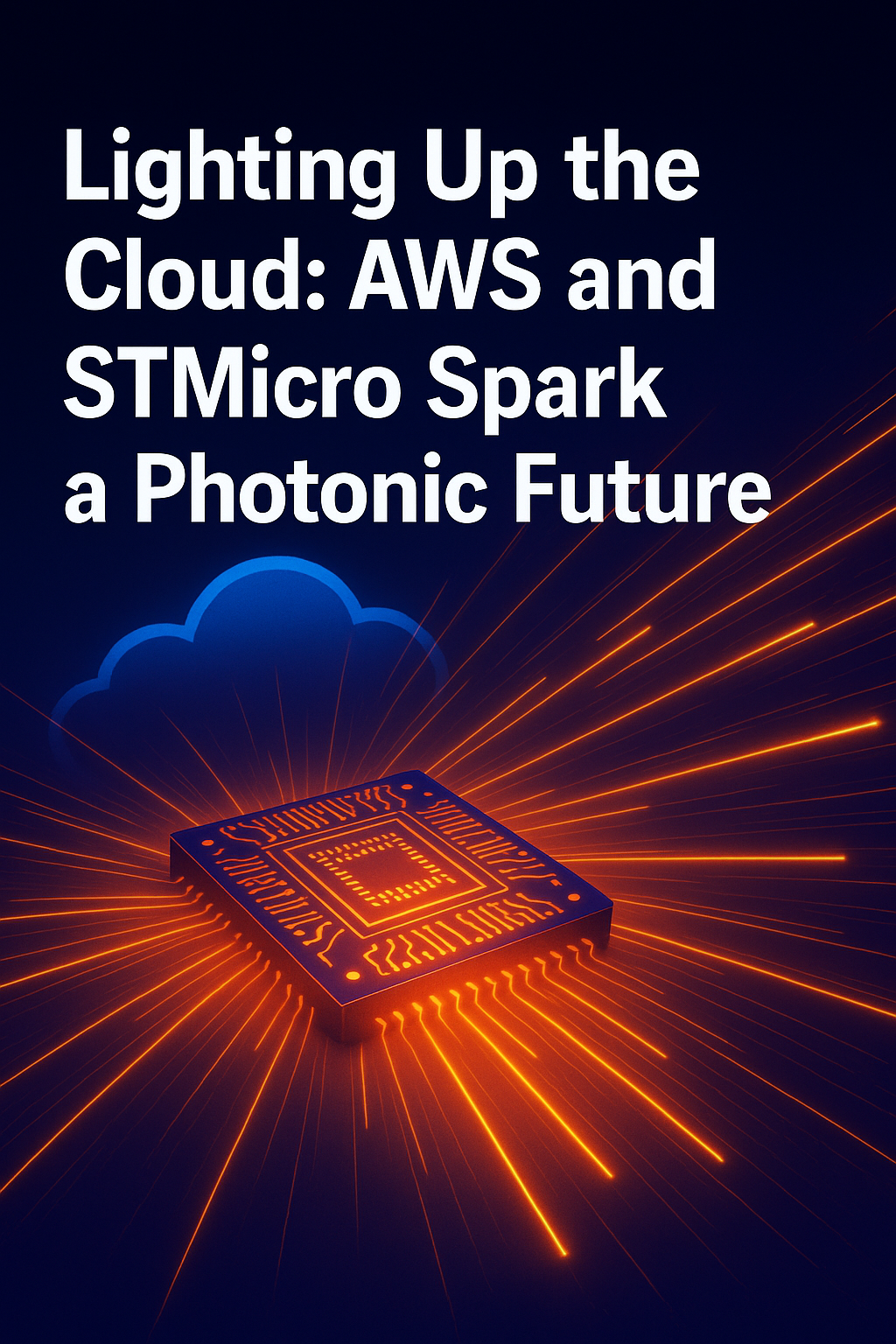
For years, photonics technology has been a promising concept on the edge of mainstream computing—always “five years away.” But with the recent collaboration between STMicroelectronics and AWS, the horizon has arrived. This partnership marks a significant shift to light-based computing infrastructure in the real world.
Why does it matter? Traditional electronic data transmission faces inherent limitations: heat generation, electrical resistance, latency, and significant power consumption. These become critical bottlenecks in AI-driven workloads that demand massive throughput and efficiency.
Photons, unlike electrons, bypass these constraints. Photonic interconnects offer ultra-fast communication speeds and minimal energy loss, making them essential for the next generation of cloud computing and artificial intelligence systems.
The Strategic Beauty of Silence in Photonic Data Centers
One of the most underrated but influential aspects of photonic computing is its quiet operation. No sizzling electrons through copper wires. No roaring fans or overheated processors. Just light—silent, fast, and precise.
This transformation isn’t just technical; it’s sensory. The optical data centers of the future might hum quietly with incredible, glowing efficiency. In a world used to the chaos of server noise, silence becomes a new benchmark of performance and sustainability.
AI, Quantum Computing, and the Universal Language of Light
Light as a medium isn’t just metaphorically beautiful—it’s strategically aligned with both AI infrastructure and quantum technologies. While artificial intelligence thrives on rapid communication and massive parallelism, quantum computing speaks natively through photons—via entangled states, photonic qubits, and quantum encryption protocols.
The convergence of photonic hardware in classical systems with the needs of quantum computing opens the door to accurate hybrid quantum–classical architectures. These systems won’t be cobbled together; they will be designed to communicate fluently—through light itself.
Crolles, France: A Strategic Move for Semiconductor Sovereignty
The decision to scale photonic chip production at STMicro’s Crolles fabrication plant in France is more than logistical—it’s geopolitical. It highlights Europe’s push for semiconductor independence and decentralization in next-gen chip manufacturing.
As global powers vie for control over advanced chipmaking, regional photonics production in Europe signals a shift away from reliance on East Asian and U.S. facilities. This could pave the way for more resilient and diversified global technology supply chains.
The Future of Cloud Computing: What Comes Next in Photonics
Here’s what we’re likely to see soon:
- Edge Photonics: Delivering light-speed performance to edge computing environments where latency is mission-critical.
- Photonic-Native Architectures: Entire systems built around optical communication, not just enhanced with it.
- Beyond Silicon: As we stretch silicon’s limits, new photonic substrates and materials may emerge as the standard.
This shift isn’t about upheaval—it’s a natural evolution of computing. A redirection. A current changing course. One where AI systems, quantum platforms, and cloud infrastructure converge through elegant, nearly invisible waveguides of light—silent, powerful, and strategically essential.