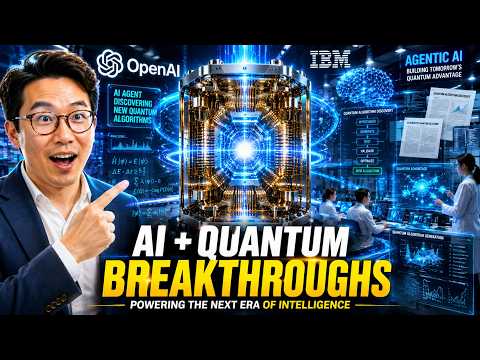
In the hushed corridors of technological evolution, where the whirring of processors often drowns out the subtle advancements of computation, a new frontier emerges—quantum computing. It’s an arena not just for the technically versed but also for the discerning investor looking against the backdrop of what might feel like the shadow of NVIDIA’s sprawling branches.
Quantum computing, though not a usurper of AI, offers a parallel universe—a space for computations that are uniquely complex and demand a different kind of cognitive architecture. Consider it, if you will, not a successor grappling with AI, but rather a kindred spirit, another iteration of innovation poised to redefine the boundaries within which our digital futures are crafted.
Based on content from Austin Talks Investing
Let us peer into this less trodden path, where four notable stocks hover above the nascent ground. They are whispers amidst the roar of the usual AI giants, yet their potential speaks in codes that could convert into significant investment returns. With the right perception and timing, these could well be your futuristic tickets to something akin to NVIDIA’s meteoric rise.
IonQ: The Trapped Beam of Potential
At the helm of speculative opportunity sits IonQ, a company exploring the ambitious realm of trapped ion technology. With alliances like AWS under its belt, IonQ crafts a narrative of potential scalability and precision, a tale interrupted but not defined by temporal market turbulence. As volatility waltzes through its present, investors may catch a glimmer of a future where trillion-dollar valuations dance in the haze.
The numbers tease: year-to-date returns oscillating but an overall ascent of 72% over the past year. Yet, these are mere fragments of data in what could be a much grander design, should the momentum persist.
Rigetti: Bridging the Quantum Divide
Moving with a strategy that mirrors the titans of IBM and Google, Rigetti navigates the full-stack approach to quantum computing. Beyond the surface numbers lies a structured ambition, already inked with government and enterprise contracts. It’s a higher risk endeavor than IonQ, a speculation perhaps built on the pillars of turnaround anticipation. Year to date, the stock offers a 6.5% discount, setting the stage for those believing in the proverbial play of buying low for a long-term idyllic gain.
D-Wave: Solving Today’s Problems
In contrast to the speculative nature of IonQ and Rigetti, D-Wave directs its focus on commercial applications through quantum annealing. It targets optimization problems, laying pathways for immediate impacts rather than wrestling with future speculations. Less hyped certainly, yet its utility speaks volumes more. Down by 9% year-to-date, D-Wave provides an investment perspective rooted in practicality over hyperbolic dreams.
IBM: The Seasoned Prodigy
Lastly, in the quartet is IBM, an emblem of maturity amongst its contemporaries. Its significant R&D endeavors into superconducting quantum technology plant it securely in this realm, albeit its stock dances through a wave of current underperformance. Down 18% this year, IBM remains a less risky sanctuary for investors, an entity capable of bridging speculative possibilities with grounded realities.
Therefore, in approaching quantum computing investments, the key lies in how one balances the risk-reward spectrum: an aggressive portfolio featuring IonQ and Rigetti, or a conservative one centered on IBM’s stability. In tapping into these stocks, one plays not just against the tides of market sentiment but alongside a parallel evolution in AI computation.
Still, the conversation must gently remind us that while quantum advances do not replace AI, they curiously augment it—much like a new color added to the palette of technology that redefines possibilities nonetheless. As the market continues to evolve, the insights are yours to draw, letting you stand alongside both those who watched NVIDIA’s rise and those who chart the mist-laden paths of quantum AI.
And so, with possibilities unspooling like silk from the shuttles of ancient looms, we are left to consider our place within this narrative. Where might one best fit into this arc? The choice, delicate yet transformative, beckons with the allure of the vast, unpredictable theatre of the future.
In the end, is this narrative a pithy retelling of past glories or the forging of a new chapter? Only the passage of time holds the answers, waiting in the wings of an unfolding technological symphony.
—