If you’ve spent any time following quantum computing lately, you’ve probably noticed two very different stories unfolding at the same time.
The first story lives in headlines.
New funding rounds. New qubit records. New claims that quantum computing is about to transform everything from medicine to finance. Depending on which article you read, practical quantum computers are either right around the corner or perpetually five years away.
The second story is quieter.
It’s the story happening inside research labs, engineering teams, government agencies, and startups trying to build something that has never existed before. It is slower, messier, and far more complicated than most public conversations suggest.
That tension sat at the center of a recent conversation on the Impact Quantum podcast with André Konig, CEO of Data Quantum Intelligence (DQI). Having spent years tracking quantum investments, supply chains, policy developments, and commercial adoption, Koenig offered a perspective that felt refreshingly grounded.
The takeaway wasn’t that quantum computing is overhyped.
It was that we may be asking the wrong questions about it.
The Industry Is Still Looking for Its Killer Application
One of the most interesting observations from the discussion was the idea that quantum computing is, in many ways, a solution still searching for its biggest problem. That might sound strange given the billions of dollars flowing into the sector, but history offers plenty of examples. When the internet first emerged, few people could predict social media, streaming video, or cloud computing. When the transistor was invented, nobody was envisioning smartphones or global digital platforms.
Quantum technology may be in a similar stage today.
Researchers can demonstrate extraordinary scientific capabilities. They can model molecular interactions, explore optimization challenges, and investigate entirely new computational approaches. What remains uncertain is exactly which applications will become indispensable. The temptation is to demand immediate ROI. Businesses naturally want to know when quantum will deliver measurable value.
But Konig argues that this mindset can be limiting. The organizations positioning themselves best for the future are often the ones willing to experiment before all the answers exist. In many ways, the current phase of quantum resembles strength training. Nobody walks into a gym expecting results after a single workout. The value comes from consistent investment over time.
Quantum may require a similar mindset.
Quantum Is Not an Invention
One of the ideas from the conversation that lingered with me afterward was André Konig’s description of quantum as a discovery rather than an invention. At first, the distinction sounds almost academic, but it fundamentally changes how we think about the technology and its timeline.
Most of the technologies that shape our daily lives were invented to solve specific human problems. Software, websites, smartphones, cloud platforms, and even artificial intelligence are products of deliberate engineering. People identified a need and built systems to address it. Quantum mechanics is different. Scientists did not invent quantum behavior; they discovered it. The strange and often counterintuitive rules that govern particles at the smallest scales have always existed. What researchers are trying to do today is build reliable, scalable technologies on top of those natural phenomena.
That reality makes the path forward far less predictable than many people assume. We are not simply improving an existing product or adding new features to a mature technology stack. We are learning how to harness aspects of nature that we are still working to fully understand. As a result, progress often comes in unexpected ways, and timelines can be difficult to forecast with confidence.
History offers a useful parallel. During the early days of the transistor, no one at Bell Labs could have predicted smartphones, social media, cloud computing, or the modern digital economy. The transistor became the foundation for innovations that were unimaginable at the time. Quantum technology may be following a similar trajectory. Many of the applications that eventually define the quantum era may not yet exist as ideas, let alone products.
This perspective shifts the conversation away from asking when quantum computers will replace classical computers. A more interesting question may be what entirely new categories of problems quantum systems will eventually allow us to solve. The honest answer is that we don’t know yet. And that uncertainty isn’t a weakness of the field—it’s a reminder that we are still standing at the very beginning of a technological journey that could take decades to fully unfold.
Where AI Is Already Making a Difference
Whenever quantum computing and artificial intelligence are discussed together, the conversation often jumps straight to futuristic possibilities. It’s easy to imagine powerful quantum computers one day supercharging AI models, unlocking capabilities far beyond what today’s systems can achieve. While those possibilities are exciting, André Koenig argues that the most meaningful intersection between the two technologies is happening much closer to the present.
Koenig breaks the relationship into three distinct categories: Quantum and AI, Quantum for AI, and AI for Quantum. While all three areas are attracting research and investment, AI for Quantum is where organizations are seeing the most tangible results today.
One of the biggest obstacles facing quantum computing is the fragile nature of the hardware itself. Quantum systems are highly sensitive to their environment, making them vulnerable to noise, instability, and errors that can quickly degrade performance. Building reliable quantum computers isn’t simply a matter of adding more qubits; it’s about finding ways to manage and correct these errors while maintaining stability at scale.
This is where artificial intelligence is proving valuable. Researchers are increasingly using machine learning techniques to identify patterns in quantum errors, optimize system performance, and improve the efficiency of experimental design. AI can help scientists analyze vast amounts of hardware data, detect anomalies more quickly, and accelerate the process of refining quantum systems. In many cases, it acts as a powerful tool that helps researchers navigate the complexity of quantum engineering more effectively than traditional methods alone.
Rather than waiting for a future where quantum computers dramatically enhance artificial intelligence, the more immediate story is that artificial intelligence is already helping quantum computing advance. It’s a subtle but important distinction. The relationship between these technologies isn’t confined to future breakthroughs and theoretical possibilities. Today, AI is helping researchers solve practical problems, shorten development cycles, and move quantum hardware closer to real-world utility.
The Emerging Quantum Divide
One of the more thought-provoking parts of the conversation focused on a topic that often receives less attention than technical breakthroughs or investment announcements: national security. While much of the public discussion around quantum computing centers on commercial applications, governments around the world increasingly view quantum technology through a strategic and geopolitical lens.
Today, more than 30 countries have launched national quantum initiatives, investing billions of dollars in research, talent development, infrastructure, and commercialization. For many governments, quantum technology now sits alongside artificial intelligence, biotechnology, and cybersecurity as a critical area of national interest. The motivation is not simply economic competitiveness. It is also about maintaining technological leadership and protecting national security in an increasingly digital world.
A major concern is the long-term impact quantum computing could have on modern encryption systems. Much of today’s digital infrastructure depends on cryptographic methods that secure financial transactions, healthcare records, government communications, and critical infrastructure networks. While current quantum computers are not capable of breaking these systems, researchers continue to explore how future fault-tolerant quantum machines could challenge some of the encryption standards that underpin modern cybersecurity.
The potential consequences are significant. A breakthrough in quantum computing would not merely represent a scientific achievement; it could reshape the balance of power in cybersecurity and intelligence. This is one reason governments are investing in both quantum computing and post-quantum cryptography, preparing for a future in which existing security models may need to evolve.
During the discussion, André Koenig introduced the idea of a future “quantum curtain”—a world in which nations with advanced quantum capabilities become increasingly separated from those without them. Whether such a divide fully emerges remains to be seen, but the concept highlights a growing reality: quantum technology is no longer confined to laboratories and research institutions. It is becoming part of a broader geopolitical strategy.
That shift is already influencing how governments fund research, structure international partnerships, regulate technology transfers, and protect intellectual property. As the field continues to mature, the intersection of quantum technology and national security will likely become one of the most important forces shaping the industry’s future. The quantum race is not solely about scientific discovery anymore. It is increasingly about economic resilience, technological sovereignty, and strategic advantage in a rapidly changing world.
You Don’t Need a Physics Degree to Participate
Perhaps the most encouraging part of the discussion centered on careers. Quantum conversations often create the impression that only physicists belong in the room. The equations can be intimidating, the science can feel inaccessible, and the field is often portrayed as a playground reserved for researchers and academics. But the reality is far different.
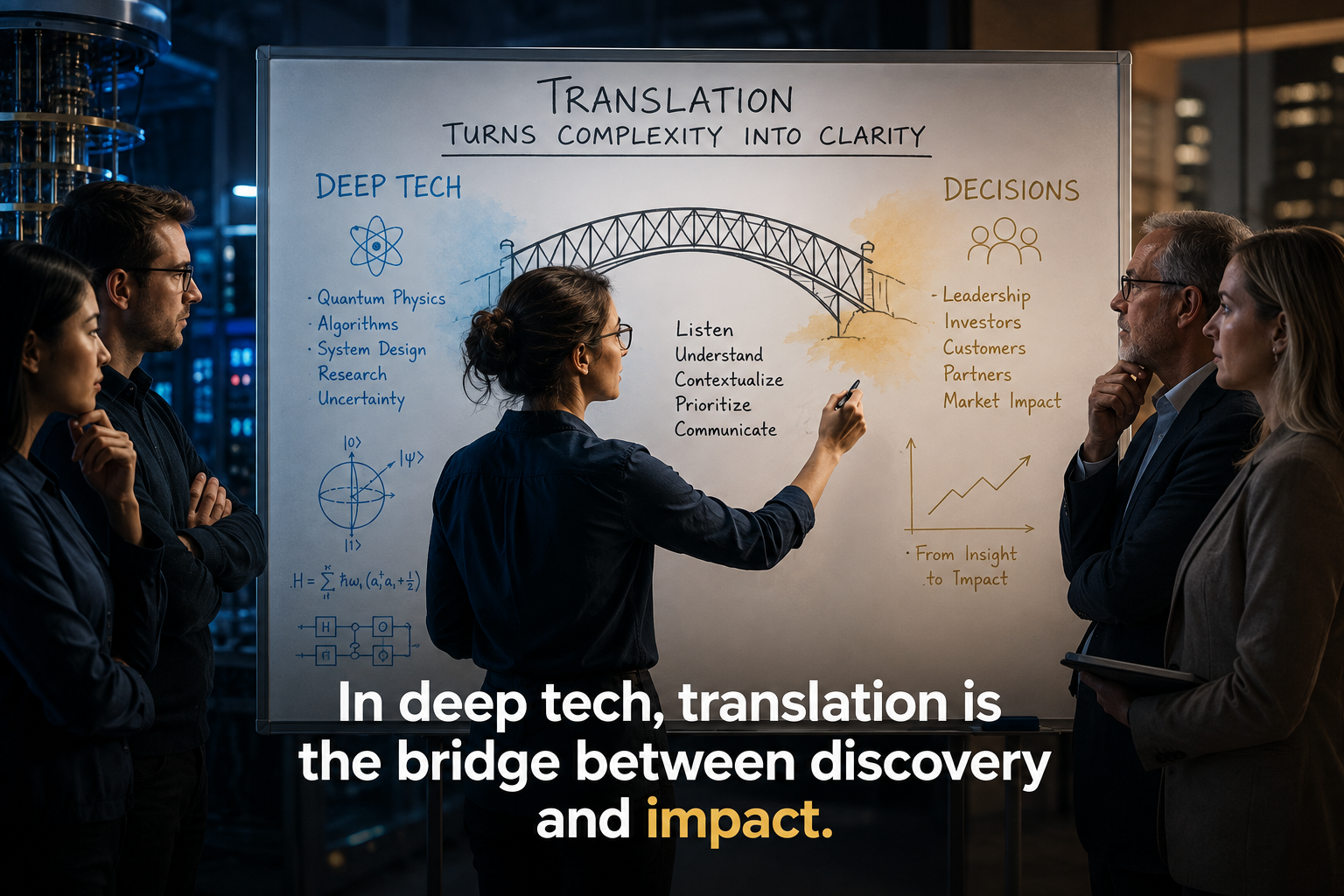
As the industry grows, it increasingly needs people who can connect science with business, policy, communication, education, operations, and product development. Building a successful quantum ecosystem requires far more than technical breakthroughs. It requires people who can translate complex ideas into practical applications, connect researchers with customers, and help organizations understand where quantum technology may eventually fit into their strategies.
In fact, one of the industry’s biggest challenges may not be technical at all. It may be communication. Too often, quantum technology is explained through exaggerated promises or oversimplified narratives that leave audiences either confused or skeptical. This creates a growing need for translators—people who understand enough of the science to communicate it honestly and accurately without resorting to hype.
The ecosystem needs marketers who respect the complexity of the technology while making it accessible. It needs writers who can tell compelling stories about what is actually happening in the field. It needs product managers who can bridge the gap between technical teams and customer needs, legal experts who understand emerging regulatory frameworks, and educators who can help prepare the next generation of talent.
For professionals willing to learn, there may be more opportunities than many realize. Unlike more mature technology sectors that are dominated by established incumbents, the quantum industry is still being shaped. Organizations are building teams, defining new roles, and exploring how this technology will move from research labs into the real world.
That means the doors remain surprisingly open. You do not need a doctorate in quantum physics to contribute. Curiosity, adaptability, and a willingness to learn may be just as valuable. As the industry evolves, many of the people who have the greatest impact may not be the scientists building the hardware, but the communicators, strategists, educators, and business leaders helping the rest of the world understand what quantum technology can realistically achieve.
The Long View
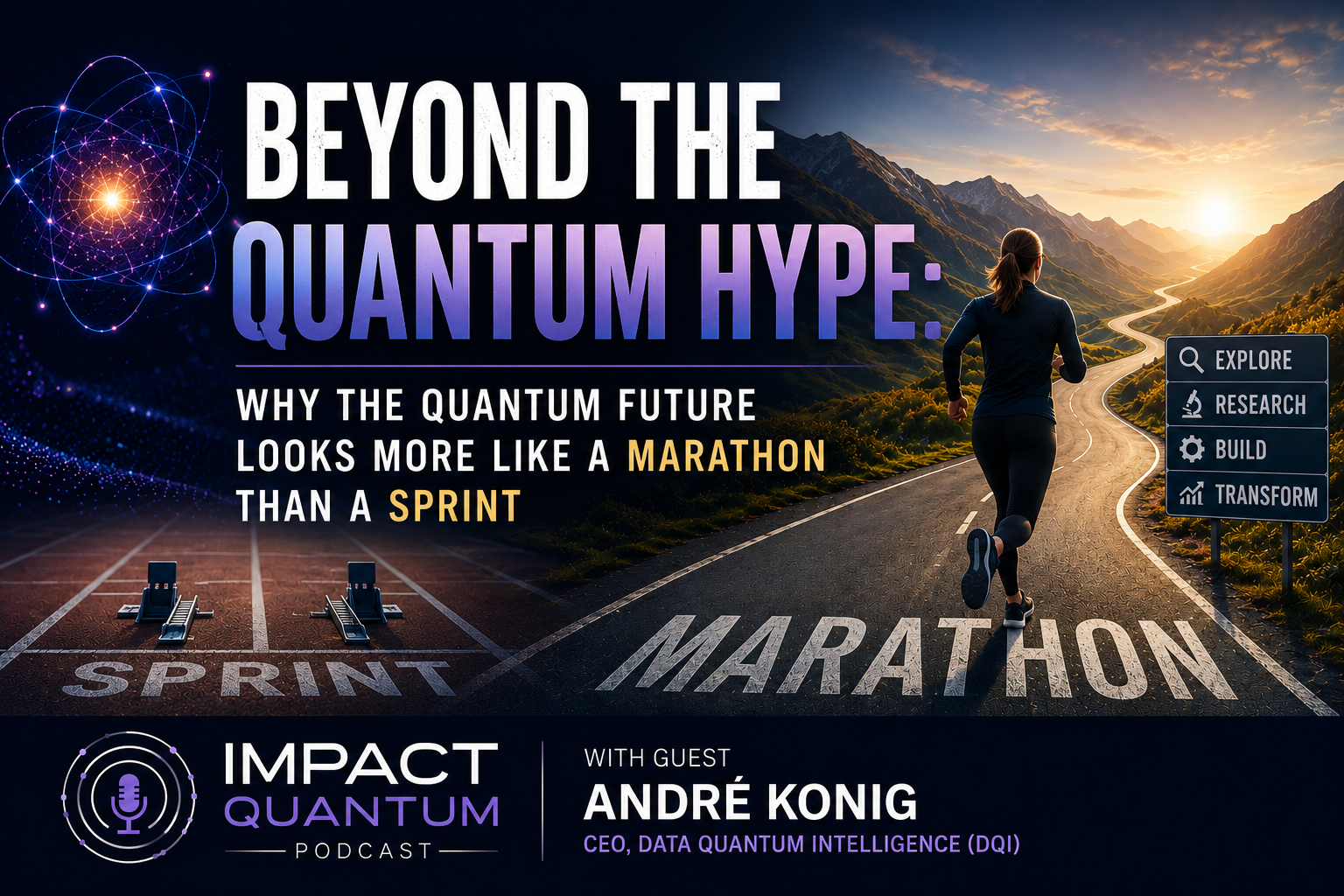
Perhaps the most important lesson from the conversation is that quantum computing should not be evaluated through the lens of weekly headlines. While the news cycle often focuses on the latest funding round, hardware milestone, or breakthrough announcement, those moments represent only small pieces of a much larger story. The technology is advancing, meaningful progress is being made, and investment continues to flow into the sector. But none of that suggests a sudden leap from today’s systems to a fully realized quantum future.
Instead, quantum computing appears to be following the path of many transformative technologies before it—a long-term evolution that unfolds over years and decades rather than months. Some breakthroughs will arrive faster than expected. Others will take significantly longer than researchers, investors, or policymakers hope. That is not a sign of failure; it is the natural rhythm of building something fundamentally new.
History offers plenty of examples. The internet did not emerge fully formed from its earliest research projects. Artificial intelligence experienced multiple cycles of enthusiasm, disappointment, and renewal before reaching its current moment. The technologies that ultimately reshape society rarely develop in a straight line. They progress through periods of rapid advancement, unexpected obstacles, and gradual refinement.
Quantum will likely be no different. The challenge for all of us—whether we are investors, business leaders, researchers, or simply observers—is to look beyond the immediate excitement and focus on the longer horizon. While headlines tend to emphasize what quantum computing might accomplish next year, the more compelling question is what it could become twenty years from now.
That future remains uncertain, but perhaps that is what makes this moment so fascinating. We are watching the foundations of a new technological era being laid in real time. The destination is not yet fully visible, and many of the most important applications may not have been imagined. What is clear, however, is that the journey is still in its early stages, and we are only beginning to understand where it might lead.