When pondering the mammoth potential of quantum computing, it’s easy to get swept up in a tidal wave of excitement and expectation. But as with all great innovations, the devil is in the details—or in this case, the qubits. Recently, I dove into the intricacies of how quantum computing stands to interface with artificial intelligence, particularly in the realm of training AI models like Meta’s Llama 3.1. This exploration unearthed not just the raw potential of quantum computers but also the looming questions about their practical application in current AI paradigms.
This video is from Caleb Writes Code.
To set the stage, imagine trying to train a model like Llama 3.1, with its 405 billion parameters, using a single GPU. It would take about 4,486 years—a timeframe that stretches our patience just a tad too far. Naturally, the workaround has been parallel computing, a strategy where tasks are distributed across several GPUs (up to 16,000 in our hypothetical), bringing the training time down to something more palatable, like three months.
Here’s where it gets interesting. The efficacy of parallel computing in handling such complex AI models begs the question: what unique advantage could quantum computing possibly offer that classical computing paradigms can’t already achieve, especially when they seem to be handling the workload quite effectively?
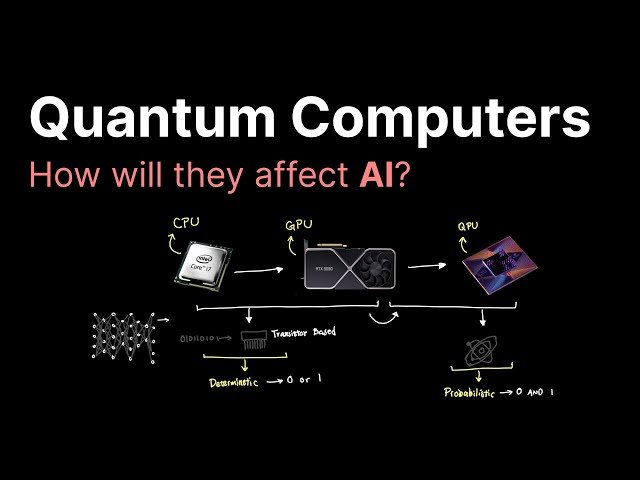
Quantum computing operates on a fundamentally different architecture. While classical computers process information as binary zeros and ones, quantum computers use qubits that can represent zeros, ones, or any quantum superposition of these states. This allows them to handle an enormous number of possibilities simultaneously, theoretically making them superbly suited for tasks involving vast computations like matrix multiplications—a common operation in AI training, involving those floating-point operations (flops).
Llama 3.1 requires staggering amounts of these flops, making efficient matrix multiplication vital. Theoretically, quantum computers could handle these calculations more swiftly, but this leads us to a key implementation challenge. Moving from classical to quantum computing isn’t merely upgrading a component; it’s transforming the foundational computing language—shifting from binary certainty to probabilistic possibilities. This is not just a technological leap but a philosophical shift in how computation itself is conceptualized.
Another knotty issue is adapting current AI training methods, which are predominantly binary-based, to take advantage of quantum computing’s probabilistic nature. Here, we might wonder: if we reformat this binary data into something the quantum ecosystem can handle, are we just forcing a square peg through a round hole?
We’ve seen the immense progress brought about by toggling from CPUs to GPUs for specialized tasks, exploiting the latter’s capability in handling parallel computations effectively. And yet, CPUs haven’t vanished; they thrive in everyday applications from browsing the internet to crunching Excel spreadsheets—tasks for which the brute force of GPUs is unnecessary. This analogy serves as a poignant parallel to our current discourse on quantum computing—the technology’s potential to supersede GPUs for AI training notwithstanding its nascent and theoretical nature.
In considering whether quantum computers should take over the mantle in AI training, we possibly mistake current utility for future potential. AI training functions robustly on parallel computing now, which suggests that leveraging quantum computing in AI might be preemptive. However, quantum computing’s destiny might not hinge on AI applications alone; its future could lie in solving problems we’ve yet to fully comprehend or define—problems that leverage its inherent probabilistic processing capabilities to their fullest extent.
Quantum computing’s route to mainstream utility may resemble the trajectory that GPUs followed—pioneering in niche markets (like gaming for GPUs) to eventually redefine the broader terrain of hardware capabilities. Jensen Huang of Nvidia suggested that the future of quantum might overshadow GPUs, just as GPUs did to CPUs. Yet, for such a transition to occur, quantum computing needs its “gaming moment”—a niche application where its advantages can shine unperturbed by competition from established technologies.
As I reflect on these considerations, I wonder if the question isn’t whether quantum computing can revolutionize AI, but rather if we are prepared to pivot towards entirely new domains where quantum computing could redefine what’s possible, pushing beyond our current computational paradigms.
Whether quantum will be the next GPU or something that challenges our fundamental approach to computing remains a tantalizing question. But one thing is clear: navigating this quantum leap will require curiosity, patience, and a readiness to embrace a fundamentally altered landscape of computational possibilities.