When people talk about the future of quantum computing, the conversation often jumps straight to breakthroughs, billion-dollar investments, and world-changing potential. What gets discussed far less is the reality behind the scenes: the steep learning curve, the endless preparation, and the months of work required just to run a single meaningful experiment.
For Adhisha Gammanpila, founder and CEO of Feynman, that reality became clear early in his career—and it nearly stopped him in his tracks.
Instead, it became the spark that launched his company.
A Foot in Two Worlds
Adhisha’s journey into quantum didn’t follow a single, straight path. He studied both computer science and physics, developing fluency in two disciplines that rarely meet easily. On one side was software engineering: logic, systems, and practical problem-solving. On the other was theoretical physics: abstraction, mathematics, and the strange rules of the quantum world.
Like many students fascinated by quantum mechanics, he initially gravitated toward theory. He envisioned himself pursuing advanced research and contributing to the field academically. But his computer science background kept drawing him toward more applied work. He didn’t just want to understand quantum. He wanted to use it.
That tension—between theory and practice—would later define his entire company.
The 2017 Reality Check
In 2017, IBM began offering cloud access to quantum computers. For the first time, students and researchers outside elite labs could run experiments on real quantum hardware.
For Adhisha, it felt like an open door.
He found a research paper from the early 2000s—dense with mathematical theory—and decided to implement it on IBM’s quantum platform. He assumed the hardest part would be running the experiment.
He was wrong.
The actual execution took only a few hours.
Preparation took six months.
Six months of translating classical models into quantum form. Six months of learning unfamiliar programming frameworks. Six months of mapping data to quantum circuits. Six months of wrestling with documentation, error rates, and hardware constraints.
By the time the experiment finally ran, the result was clear: quantum computing wasn’t inaccessible because of a lack of interest. It was inaccessible because of friction.
The barrier wasn’t curiosity.
It was complex.
A Pattern Emerges
After publishing his work, Adhisha began receiving messages from students and researchers.
“How did you do this?”
“How long did it take?”
“Is it worth the effort?”
He realized his experience wasn’t unusual. Many people wanted to explore quantum computing. Many started. Most gave up.
Engineers were interested in results, not equations. Climate scientists wanted simulations, not gate diagrams. Chemists wanted insights, not months of circuit design.
Quantum promised extraordinary power. But accessing that power required extraordinary patience.
And most people didn’t have six months to spare.
Accessibility as a Mission
That realization changed everything.
Instead of asking, “How do I become better at quantum?” Adhisha began asking, “Why is this so hard in the first place?”
In classical computing, programmers don’t work directly with logic gates. Layers of abstraction hide complexity. Frameworks translate intent into execution. Tools allow people to focus on problems, not plumbing.
Quantum had none of that.
Users were still working at the equivalent of hand-wiring transistors.
Adhisha saw an opportunity.
What if quantum had its own abstraction layer?
What if users could describe what they wanted instead of building it gate by gate?
What if domain experts—chemists, climate scientists, and financial analysts—could use quantum without becoming physicists?
That idea became Feynman.
Building the Copilot
Feynman’s core product is an agentic AI “copilot” for quantum computing.
Rather than forcing users to learn Qiskit, Q#, or OpenQASM, the platform allows them to work in natural language. A user uploads data, describes their goal, and selects infrastructure. The system handles everything else.
Behind the scenes, Feynman’s agents:
- Interpret requirements
- Analyze datasets
- Generate quantum circuits
- Select appropriate algorithms
- Run simulations or hardware jobs
- Return interpretable results
To the user, it feels simple.
To build it, it was anything but.
The team trained specialized models optimized for quantum workflows—far beyond what general-purpose language models could offer. They tested and compared outputs against mainstream AI tools and found consistent performance gaps.
Generic AI could generate code.
Feynman’s AI-generated working code.
That distinction matters in scientific computing.
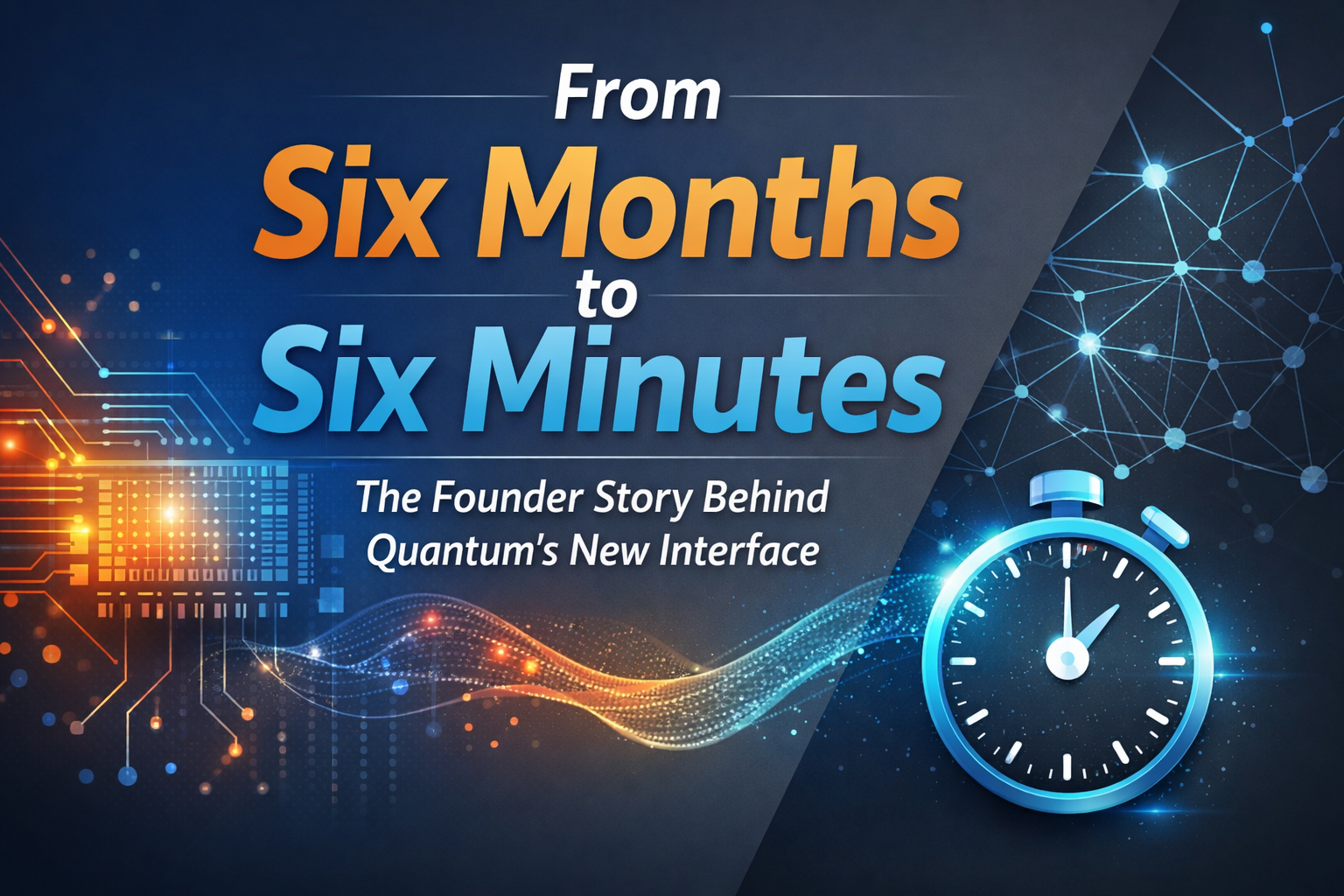
From Months to Minutes
The most striking example of Feynman’s impact came during a protein simulation project.
Protein modeling is one of quantum computing’s most promising applications. It sits at the intersection of chemistry, biology, and medicine—and traditionally requires enormous computational effort.
Using Feynman’s integration with protein databases, Adhisha ran a full quantum protein simulation in under six minutes.
Not six weeks.
Not six months.
Six minutes.
He tested it while traveling, during an airport layover. When it worked, the feature went live almost immediately.
For someone who had once spent half a year preparing a single experiment, the contrast was staggering.
Beyond “Vibe Coding”
Some have compared Feynman to “vibe coding” for quantum—describing goals and letting AI do the work.
Adhisha sees it differently.
Many of Feynman’s users are PhD researchers and postdoctoral scientists. They understand quantum deeply. What they lack is time.
For them, Feynman is a research accelerator.
For industry users, it’s an accessibility bridge.
For students, it’s an entry point.
The platform doesn’t replace expertise. It amplifies it.
Why This Matters
Quantum computing is often framed as a future technology—always five years away, always just out of reach.
Feynman challenges that narrative.
Not by promising miracles.
By removing friction.
When experimentation becomes easier, innovation accelerates. When barriers fall, new voices enter. When tools improve, ideas multiply.
History shows this pattern again and again: from mainframes to personal computers, from command lines to graphical interfaces, and from raw HTML to modern web frameworks.
Each leap wasn’t about more power.
It was about more people.
A Founder’s Philosophy
Adhisha rarely talks about hype cycles. He talks about progress.
His guiding question isn’t, “Is this trending?”
It’s, “Does this move the world forward?”
That mindset shapes Feynman’s roadmap: quantum research agents that work continuously, hybrid workflows combining CPUs, GPUs, and quantum processors, and tools designed for real-world adoption.
Not spectacle.
Substance.
The Six-Minute Future
For startup founders, Feynman offers a blueprint: solve the friction point, not just the technical problem.
For investors, it demonstrates where real value lives—in infrastructure, usability, and scale.
For innovation leaders, it shows how emerging tech becomes usable tech.
For students, it offers something rare in quantum: a doorway.
Adhisha once needed six months to take his first serious step into quantum computing.
Today, his platform helps others do it in six minutes.
That difference isn’t just technical.
It’s transformational.
And it may be exactly what quantum needs to finally move from promise to practice.