The video How AI Will Change Everything Again (the title alone feels like a quiet shrug paired with a raised eyebrow) doesn’t try to shock you—it unsettles you more subtly than that. It leans into a truth we’re only just beginning to absorb: artificial intelligence isn’t arriving in one dramatic wave. It’s coming in layers. Iterations. Quiet updates that reshape the ground beneath us before we’ve had time to name what changed.
What makes this video particularly interesting is its rhythm. It doesn’t sprint toward conclusions. Instead, it circles the idea that AI transformation is not a single event but an ongoing process—one that keeps rewriting its own rules. That framing matters. Because if change is continuous, then adaptation isn’t a one-time effort either. It becomes a way of being.
The video touches on how each generation of AI systems builds on the last, moving from narrow task-based tools to more generalized capabilities. Early systems categorized data. Then they generated text and images. Now they’re beginning to reason, plan, and interact in ways that feel less like tools and more like collaborators. Not perfect collaborators—still flawed, still unpredictable—but undeniably different from what came before.

There’s a quiet tension running through that progression. Each improvement feels incremental, almost harmless on its own. But when you zoom out, the cumulative effect is profound. It’s like watching a shoreline shift—not from one dramatic wave, but from thousands of smaller ones reshaping it over time. The video invites you to notice that pattern, to step back far enough to see the scale of what’s happening.
For neurodivergent thinkers—especially those with ADHD or anxiety—this framing can hit in a very real way. Constant change can feel both energizing and exhausting. There’s a certain cognitive whiplash in trying to keep up with tools that evolve faster than your internal systems can stabilize. The video doesn’t explicitly address this, but it creates space for that experience. It indirectly acknowledges that adaptation has a cost.
And yet, there’s also a possibility woven into that same dynamic. If AI keeps changing, then the way we use it can change too. The video hints at a future where humans aren’t replaced by machines but repositioned alongside them. Tasks shift. Roles blur. Creativity becomes less about producing from scratch and more about directing, refining, and interpreting. That shift can feel unsettling if you’re anchored to traditional definitions of work—but it can also feel liberating if you’re open to redefining value.
One of the more interesting threads in the video is the idea that AI doesn’t just change industries—it changes expectations. Once a tool exists that can do something faster or more efficiently, that capability quickly becomes the new baseline. What was once impressive becomes ordinary. And then the cycle repeats. This is where the psychological impact starts to deepen. It’s not just about what AI can do; it’s about how it reshapes our sense of what is “normal.”
For the Quantum Impact audience, this raises an important question: how do you stay grounded in a world where the baseline keeps moving? The video doesn’t offer a direct answer, but it gestures toward one. It suggests that understanding the trajectory of change—rather than just reacting to each new development—can create a sense of stability. Not control, exactly, but orientation.
There’s also an undercurrent of humility in the way the video approaches AI’s future. It doesn’t pretend to predict exactly where things are going. Instead, it emphasizes patterns: acceleration, iteration, integration. These patterns become a kind of compass. They don’t tell you the destination, but they help you navigate.
From a strategic perspective, this is where the video becomes particularly valuable. It shifts the focus from specific tools to underlying dynamics. Instead of asking, “Which AI platform should I learn?” it nudges you to ask, “How do I stay adaptable in a system that keeps evolving?” That’s a different kind of question—one that requires a different kind of thinking.
And then there’s the emotional layer, which the video handles with surprising subtlety. It doesn’t dramatize fear, but it doesn’t dismiss it either. There’s an acknowledgment—almost a quiet nod—that rapid technological change can create unease. Not because the technology is inherently threatening, but because it disrupts familiar structures. It asks us to let go of certainties before we’ve fully processed them.
This is where the idea of silence—of pause—becomes quietly powerful. In a landscape defined by constant updates, the ability to step back and reflect becomes a kind of strategic advantage. The video, in its pacing and tone, models that approach. It doesn’t rush you. It gives you space to think.
For those navigating ADHD or information overload, this is more than a stylistic choice—it’s a form of accessibility. It recognizes that understanding doesn’t happen in a single burst. It unfolds over time, often in the spaces between inputs rather than within them.
What ultimately makes this video resonate is its refusal to frame AI as either savior or threat. It presents it as a force—complex, evolving, and deeply intertwined with human behavior. That framing invites a more nuanced response. Instead of asking whether AI is “good” or “bad,” it encourages you to consider how it’s being shaped and how you might shape it in return.
For the Quantum Impact audience, this is the kind of conversation that matters. Not because it provides definitive answers, but because it sharpens the questions. It invites a kind of awareness that goes beyond surface-level engagement—a willingness to sit with complexity, to notice patterns, and to respond thoughtfully rather than reactively.
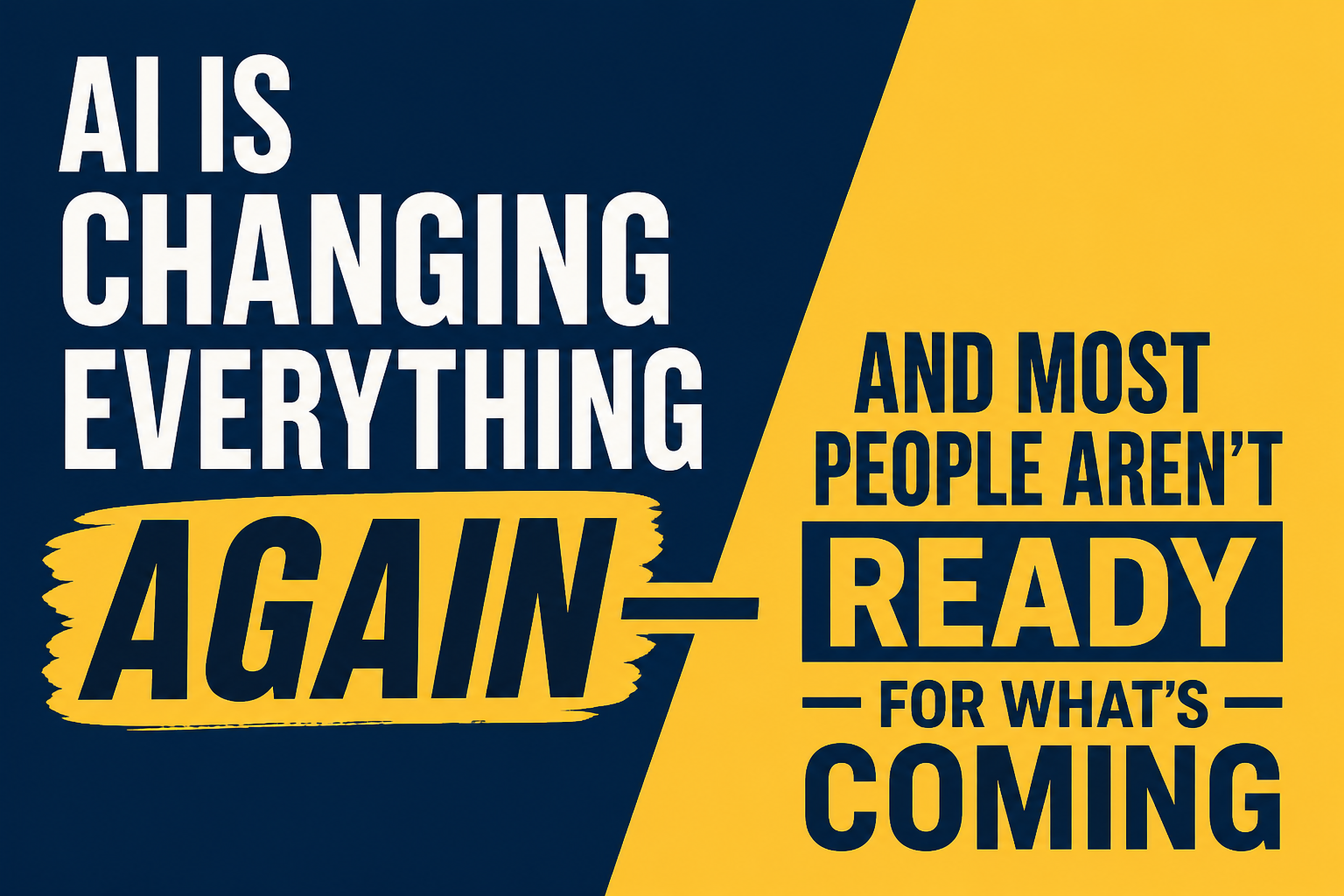
By the end, the takeaway isn’t a prediction. It’s a perspective shift. AI isn’t changing everything once. It’s changing everything again and again. And the real challenge isn’t keeping up with each change—it’s learning how to move with the rhythm of change itself.
That’s not a technical skill. It’s a human one.