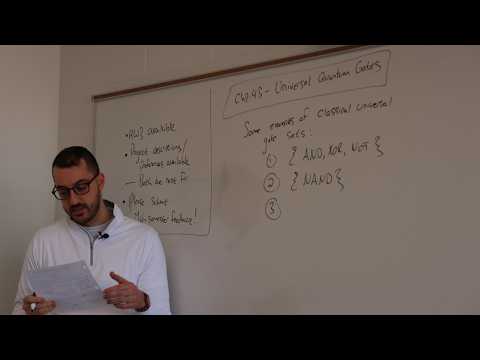
Every once in a while, on Impact Quantum, I meet someone who reminds me why this field feels so alive, not because of the hardware breakthroughs or the headlines, but because of the people quietly doing the work. My conversation with Vyom Patel, a master’s student at the University of Waterloo, was a perfect example. His clarity, honesty, and excitement pulled me right back into the heart of why quantum is more than a discipline. It is a frontier.
I ended this interview with a deeper appreciation for the next generation of quantum thinkers. They are grounded in fundamentals, unafraid of complexity, and always seeking the truth beneath the hype.
Curiosity Meets Discipline
What struck me early in our conversation was that Vyom did not arrive in quantum through a dramatic origin story. He did not grow up dreaming of quantum mechanics or chasing a single big idea. He followed curiosity at the intersection of math and computer science. That intersection, where abstract theory meets computational structure, is where quantum became irresistible to him.
He was not pulled in by marketing language or lofty promises. The intellectual puzzle pulled him in. And that thread kept coming up. The people who thrive in quantum are not always the people with the deepest physics background. They are the people with strong foundational thinking and the patience to wrestle with complex ideas.
A Needed Check on Quantum Hype
One of the most refreshing parts of talking with Vyom was hearing how he evaluates new claims in the industry. In a field that generates attention every single week, it is easy to assume that every announcement signals a significant leap forward. Vyom does not approach it that way at all.
He has a simple personal policy. If there is no technical paper, he does not take the news seriously. If there is a paper, he begins with the abstract, introduction, and conclusion. Only if those sections reflect sound reasoning does he consider reading more deeply. This is not cynicism. This is stewardship. This is how you protect the credibility of a young field.
He reminded me that rigor is the only filter that separates signal from noise in quantum.
The Hard Work of Foundations
Vyom also gave me a powerful reminder of where we really are in the timeline of quantum computing. The field is still building its basics. We are not just pushing toward fault tolerance or big commercial wins. We are still figuring out how to translate classical operations into quantum-safe forms.
Something as simple as multiplying two numbers is not simple on a quantum computer. His research involved identifying structures in matrices and then rethinking how to encode them. To do this, he had to go all the way back to early circuit design principles, the kind taught in second-year computer engineering courses. This is not glamorous work. It is foundational work. And quantum needs people who find joy in doing this slow and careful thinking.
Listening to him talk about the challenge and beauty of these constraints reminded me how early we still are, and how much brilliance will be needed to move forward.
The Surprise Star: QLDPC Codes
The moment I felt myself light up was when Vyom spoke about quantum low-density parity-check codes. QLDPC codes do not make flashy headlines. Most people outside the field will never hear their name. But for him, they represent one of the most promising paths to real, scalable quantum computation.
Classical error correction is everywhere. It makes Wi-Fi work. It makes 5G phones work. It makes financial transactions and hard drives reliable. QLDPC codes bring that same level of efficiency and elegance to the quantum world. They reduce the number of physical qubits needed to maintain a stable logical qubit. In other words, they make quantum more practical.
He shared why IBM and other major players are pushing this direction, and it made me realize that some of the most essential innovations in quantum might be happening in areas the general public has never heard of.
The Future Belongs to Flexible Thinkers
The final lesson that stayed with me came from how he talked about backgrounds, training, and career paths. Vyom did not start with formal quantum education. He learned it recently. He stressed that this field is full of people from math, physics, computer science, engineering, and completely different academic backgrounds.
He made it very clear. This field is not waiting for people who already know everything. It is waiting for people who are willing to learn, rethink, and stay open to new ways of solving problems. Quantum rewards adaptable people.
By the end of our conversation, I felt energized and optimistic. If researchers like Vyom are shaping the next decade of quantum, this field is in excellent hands.