
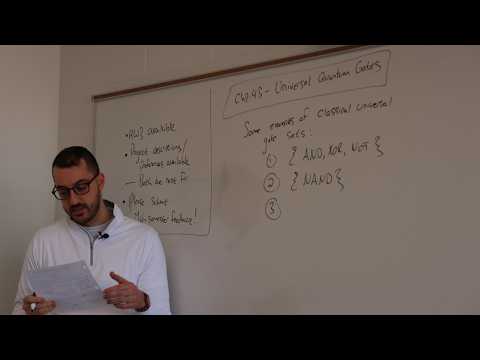
In the quiet, often overlooked dance between classical and quantum computing, there lies an elegant truth: classical computing is simply a subset of the broader, more nuanced symphony of quantum computing. To delve into this interplay, we draw upon chapter 4.5 of the renowned textbook, Quantum Computation and Quantum Information by Nielsen and Chuang. Here, the concept of universal quantum gates unfurls, a notion that challenges and redefines our understanding of computation.
Based on content from Ryan LaRose
Take, for example, the universal gates of classical computing — the logic gates that underpin the binary operations of our digital world. You’re likely familiar with them: AND, OR, and the singularly notable NAND gate. This last one is universal, a concept easily proven by those versed in logic’s foundational courses.
Yet, there’s a subtle magician’s trick hidden within these gate types that reveals their limitations. A gate like the Toffoli, revered for its elegant ability to manipulate bits in the classical realm, does not hold the same power in the quantum domain. Herein lies a fundamental insight: the Toffoli gate’s inability to generate states of superposition, that quasi-magical idea allowing quantum particles to exist in multiple states simultaneously, unveils itself.
A classic Toffoli operation begins and ends with computational basis states. Its matrix, comforting in its reality and predictability, refuses to venture into the surreal world of complex numbers. The Toffoli’s operations are thus bound to classical confines, a reflection of its inability to produce the vibrancy of quantum interference or entanglement.
So what does this all mean? In a world where quantum computing gracefully dances with possibilities beyond the solid lines of classical logic, we witness classical computing being subsumed. Quantum computations can perform all that classical can and more — allowing us to imagine and construct realities steeped in probability and phase, in negative amplitudes and rotations that weave through complex vectors.
This inclusion suggests a universe rich with potential, framed not just by the certainties of zeros and ones but expanded by the intricate tapestries of quantum states. It is a poignant reminder that our tools for understanding and shaping the world are evolving. As we tread further into this domain, we confront and embrace a shift in perspective — one that suggests perhaps our classical restraints are only shadows of the fuller spectrum of quantum potential.
In contemplating these dimensions, we touch upon the edges of what it means to compute, to design, and to understand. A greater question looms: How will we adapt our thinking, our teaching, and our dreams in this broader, richer computational landscape? This quiet reflection urges us to both cherish and challenge our current views, allowing curiosity to guide us into the depths of quantum wonders yet to be fully unveiled.
—








Leave a Reply