It feels like it was just yesterday when quantum computing was a far-off sci-fi fantasy. But for folks like us keeping our eyes on the tech horizon, these fantasies are quickly shaping up to become real business tools, thanks to pioneers like IBM.
IBM has been chipping away at the quantum computing block for nearly a decade, crafting a vision that seemed as distant as the stars. Now, for those of us watching closely, the outlines of that vision are starting to sharpen, and it’s more exciting than ever. By 2026, we’re slated to witness the first demonstrations of quantum advantage—where quantum computers begin solving problems faster than classical computers. By 2029, we’ll be stepping into a groundbreaking era with the first large-scale fault-tolerant quantum computer. Imagine the possibilities when what was once thought impractical becomes everyday tools for our complex problems!
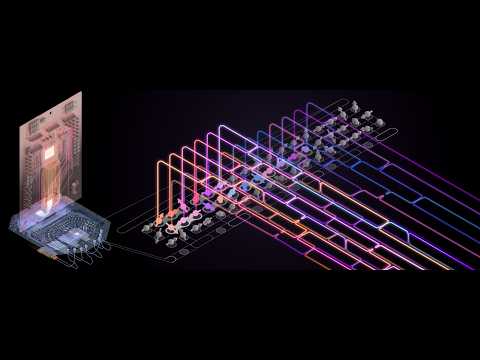
This video is from IBM Research.
Let’s contextualize these milestones in the way you might relate to a workshop with a set of intricate tools. IBM’s roadmap details are akin to ensuring every tool in that workshop is not just present but honed to perfection, promising a seamless workflow in solving complex tasks that were previously daunting.
Diving into the specifics, IBM introduced us to Heron last year, an impressive setup with its tunable couplers and the ability to effectively manage circuits with 5,000 gates. But, what’s coming is even more thrilling. In 2025, the IBM Nighthawk is expected to launch, a powerful new quantum processor featuring a square lattice of 120 qubits targeting complex 5,000-gate circuits. Think of the Nighthawk as your high-performance engine, upgraded to push boundaries further with about 16 times the effective circuit depth achievable today.
This improvement doesn’t just end with hardware. Software too, is getting a robust boost. Since 2017, IBM’s Qiskit SDK has grown to become a go-to framework for quantum software development. In 2025, a new iteration of the Qiskit Runtime engine will enhance scalability and the handling of dynamic circuits, which integrate real-time classical logic to supercharge quantum circuits. This is akin to giving a car’s navigation system an update that not only optimizes the route in real-time but also predicts and adapts to on-road conditions to ensure the fastest, safest path to your destination.
In the journey toward fault tolerance—where quantum computers can self-correct errors and maintain the integrity of data—the leaps are equally significant. From the increase in qubit numbers thanks to advanced chip-to-chip couplers in models like the Flamingo, to the strategic laying out of a roadmap to scaling up with models like Blue Jay in 2033, which aims for 1 billion gates on 2,000 logical qubits. This is akin to planning a city’s industrial growth: it’s not just about building factories; it’s about connecting them with efficient roads, ensuring power supply, and future-proofing against disruptions.
Each year building onto the next, IBM’s dual roadmap of development and innovation seems set to not just advance quantum technology, but integrate it seamlessly with high-performance classical computing to solve not just existing problems but also those we’ve yet to encounter. In less than a decade, we will likely begin tackling some of the world’s most complex computational challenges with unprecedented speed and efficiency.
By zooming back a bit, we can see the bigger picture IBM paints—a futuristic tableau not limited by present computational boundaries. The ongoing evolution from Nighthawk through to Blue Jay sketches a relentless pursuit of quantum excellence, a journey they invite us to join.
In a world where quantum computing matures from experimental curios to practical tools, staying informed and engaged with these developments isn’t just beneficial; it’s crucial. It’s a thrilling time to be at the intersection of curiosity and technology, and as always, the future promises to be a fascinating ride.