There’s a silent evolution happening in the world of computing, one that blends the boundaries between the classical and the quantum, reaching into that ethereal realm where the abstract meets the powerfully real. This evolution, delicately poised on the precipice of what we see and what could be, brings together quantum computing and high-performance computing—two fields that, while distinct, find strength in their convergence.
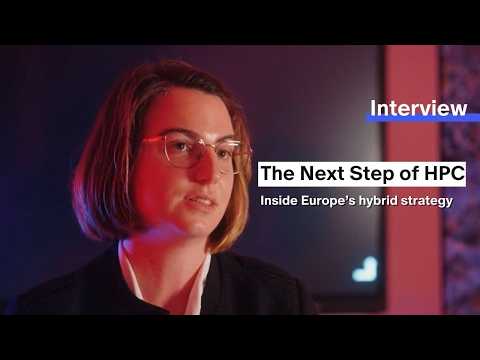
In the recent episode of Quantum Matters, host Murray Thom peels back the layers of this evolving landscape by conversing with Professor Dr. Kristel Michielsen, Director of the Jülich Supercomputing Centre in Germany. The journey begins in a place some might characterize as imposing, yet those who truly engage find it a realm of untapped potential—the world of supercomputers.
Based on content from D-Wave
There’s a silent evolution happening in the world of computing, one that blends the boundaries between the classical and the quantum, reaching into that ethereal realm where the abstract meets the powerfully real. This evolution, delicately poised on the precipice of what we see and what could be, brings together quantum computing and high-performance computing—two fields that, while distinct, find strength in their convergence.
In the recent episode of Quantum Matters, host Murray Thom peels back the layers of this evolving landscape by conversing with Professor Dr. Kristel Michielsen, Director of the Jülich Supercomputing Centre in Germany. The journey begins in a place some might characterize as imposing, yet those who truly engage find it a realm of untapped potential—the world of supercomputers.
Jülich stands as a beacon, housing Europe’s first exascale supercomputer, Jupiter. It’s a dizzying sensation, a testament to human ingenuity that churns through a quintillion calculations each second. Yet, in its vastness, it whispers a story of potential yet realized, a glimpse of what lies beyond the horizon.
Supercomputers, like Jupiter, represent the epitome of classical computing, transforming climate models, optimizing simulations, and offering predictions with a precision that was once unimaginable. But with great power comes greater energy consumption—a city’s worth of electricity to drive this computational colossus. Here lies a paradox, where the pursuit of knowledge comes face to face with our finite resources.
This is where quantum computing enters the narrative. It’s an entity not seeking to replace but to complement, like a thread woven into a tapestry, enhancing rather than overshadowing. Quantum computers, with their unique architecture, find their niche in tasks that evade the classical domain—problems that are laughably expensive in terms of classical time and energy. They operate in a world of probabilities, beyond the binaries, offering an energy efficiency that classical machines can but envy.
The strategy that Jülich employs is foresightful, balancing the might of supercomputers with the finesse of quantum systems. As they integrate D-Wave’s quantum annealing technology into their operations, they tackle complex issues like protein folding, quantum material simulations, and hybrid quantum-classical algorithms. This isn’t a simple symbiotic relationship. It’s a dance where each participant leads when it’s most suited, sharing the spotlight, ensuring that the performance—the problem-solving—is unparalleled.
Dr. Michielsen illustrates this as not merely adding computational prowess but reinventing how we perceive and solve problems. Quantum isn’t here to do what is already done but to make possible what couldn’t be—a sentiment that echoes Richard Feynman’s early musings on these machines: to use the quantum realm itself to better understand, predict, and compute the natural world.
In essence, the dialogue circles back to a central tenet: synergy. A realization that quantum computers are bespoke tailors, crafting solutions for specific issues—those that resist classical computing’s brute force. This hybrid methodology, leveraging the strengths of both domains, mirrors the perennial balance between innovation and application. Herein lies the revelation that the future isn’t about the supremacy of one over the other, but about a harmonious coexistence.
As Dr. Michielsen and the Jülich team forge ahead, their roadmap serves as a guide for others you might soon take this journey—a journey where computing is not about what divides quantum and classical, but what unites them for unprecedented exploration.
With every insightful episode, Quantum Matters beckons us to question what the computing future looks like when the unlikely becomes harmonious. For now, the stage is set for the quietly vivid, observant, quietly introspective narrative where each computing realm offers its echoes, patterns, and whispered insights.
The next chapter in computing isn’t just being written; it’s being composed. And the symphony is one of collaboration, revelation, and an unyielding quest to explore all that is possible when quantum and classical sit side by side, crafting the fabric of our future.
What remains, perhaps, is not solely about the question of capability but the wisdom to use each tool—each innovation—with the deft precision that the future increasingly demands. As we stand on this precipice, the question becomes: How will we choose to weave these threads into the narrative of what’s yet to unfold?
—