
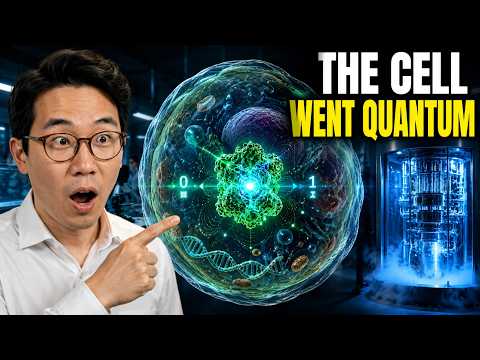
In a twist that even seasoned scientists might not have envisioned, researchers at the University of Chicago have turned the intricate components of life itself into vehicles for quantum computation. Through turning a protein within a living cell into a functioning quantum bit, or qubit, this advancement challenges the longstanding narrative about the constraints of quantum effects in biological settings.
Until recently, the notion that warm, moist, and chemically active cellular environments could harbor quantum states seemed implausible. Quantum mechanics, often associated with the cold, isolated confines of high-tech laboratories, was thought incompatible with the dynamic chaos of living tissues. Yet, this groundbreaking achievement, reported initially in 2025 and further highlighted in 2026, marks a pivotal shift in that perception.
Based on content from Quantum Insight
The researchers, led by David Awschalom and Peter Maurer, pursued a route seldom traveled in quantum research: rather than encasing quantum sensors in biological environments, they leveraged biological materials to craft the quantum system itself. They ingeniously used a fluorescent protein, dubbed enhanced yellow fluorescent protein (EYFP), to serve as a living qubit, functioning as a sensitive quantum sensor within mammalian cells and bacteria.
This discovery opens unprecedented avenues for exploring cellular processes at a nanoscale, with prospective applications in biological research and disease mechanism studies. Imagine nanoscale MRI, where the breadth of imaging contracts from entire bodies to the anatomy of single cells, navigating through the molecular labyrinths of life.
However, it is crucial to correct any overstatements about the scope of this achievement: it is not a fully-equipped quantum computer within a living cell. Instead, these are biological qubits intended primarily for quantum sensing, suggesting nature’s internal mechanisms might complement existing quantum technologies without totally replacing them.
Why does this matter? Traditionally, quantum effects have been hard to harness due to thermal noise—random motions at atomic levels that typically destabilize fragile quantum states. Superconducting qubits, such as those used by Google or IBM, necessitate ultra-cold environments near absolute zero to mitigate such noise. Alternatively, diamond-based quantum sensors function at room temperature but remain external tools, requiring intervention to measure cellular activities.
The innovation from the University of Chicago reshapes this narrative by allowing biology to manufacture quantum sensors internally. This not only taps into the evolutionary prowess of biological systems to replicate at an atomic precision but also broadens the horizons of replicability and scalability—drawing on nature’s own proficiency for mass production to overcome manufacturing inconsistencies that plague artificial qubits.
At the heart of this endeavor is the concept of superposition, where a qubit can exist simultaneously in multiple states—akin to a spinning coin that doesn’t settle until observed. Researchers capitalized on the sensitivity of these protein qubits, essentially turning an ostensible vulnerability into a keen ability to interact with and measure ambient environments.
The practical applications of this technology feel almost speculative yet are grounded in urgent scientific needs. Beyond merely detecting, these qubits hold the promise for transformative impacts in healthcare, particularly concerning diseases like Alzheimer’s, Parkinson’s, and various cancers. By unveiling molecular interactions and misfoldings in real time, years before visible symptoms manifest, early detection and intervention may become routine, fundamentally altering timelines of diagnosis and treatment.
Still, there is work to be done. Compared to diamond-based sensors, these protein qubits are at the nascent stage of sensitivity. Addressing technical challenges such as photobleaching—where proteins lose their luminescence with repeated use—and readout fidelity remain priorities for researchers pushing this field forward.
While a fully operational medical tool is not yet on the nearest horizon, the implications of crafting a pathway through quantum biology are immense. This intersection of disciplines not only extends our understanding of quantum mechanics but also recontextualizes it within the living machinery of cells, each discovery ferrying us closer to untapped insights into both quantum science and life itself.
We stand at a threshold, looking forward to what may become an era where quantum technology harmoniously integrates with the natural fabric of life, suggesting that perhaps the most advanced machines we build may one day take their cues from the oldest systems already in existence.
—









Leave a Reply