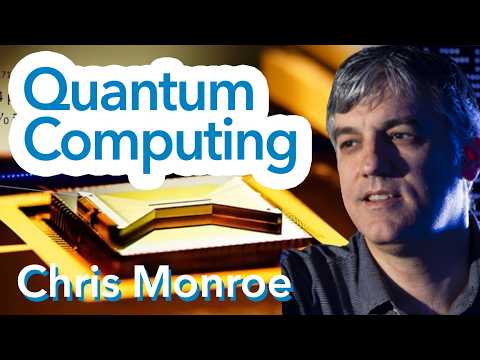
In the realm of technological advancements, quantum computing casts a tantalizing shadow, representing a seismic shift in both academia and industry. The promise of processing information through entangled quantum superpositions has cemented its role as one of the most captivating scientific challenges of our age. In a recent discussion at the Munich Center for Quantum Science & Technology, Christopher Monroe from Duke University illuminated the intricate dance between academic and industrial pursuits in this field.
Based on content from Munich Center for Quantum Science & Technology
The task of building a quantum computer isn’t as simple as translating classical computing paradigms into the quantum world. It requires a new kind of engineering—one that encompasses the control of exotic hardware, from individual atoms to photonic interconnections. Monroe, a pioneering figure in the field, elegantly outlined the current landscape of atomic quantum information systems. His insights spanned highly programmable Hamiltonian quantum simulations to quantum circuit synthesis, all applied across a myriad of scientific disciplines.
Monroe’s perspectives offer a unique blend of optimism and realism. While some may argue that quantum computing is overhyped, others recognize that any field without hype lacks excitement. He acknowledges the burgeoning interest from industry giants like Google and Microsoft, commending their engagement in the field even as he questions their approach to hardware development. “Amazing as it is, these companies struggle with the practicalities of building devices,” Monroe notes. Their focus often centers on the business appeal rather than the nuanced demands of quantum systems.
Yet, there exists a symbiotic tension between the academic world and industrial aspirations. Academics engineer systems that appear esoteric to corporate eyes, often involving the natural quantum systems of atoms and molecules. The engineering challenges are significant, but the potential for physics breakthroughs is immense. In some ways, this traditional academic pursuit mirrors the initial stages of classical computers, seen once as mere academic curiosities before reinventing the modern world.
When considering applications, Monroe positions quantum computing pragmatically. The well-trodden path of Shor’s algorithm provides a glimpse into its powerful potential, even as it beckons for computational resources beyond our current reach. Meanwhile, heuristics like optimization and quantum simulation fall into an ambiguous domain. They lack the rigorous proofs beloved by theoreticians yet hold promise for practical, real-world application.
“The journey requires deploying these machines on real-world problems to carve out value,” Monroe argues. He astutely observes that quantum computers may not always yield the best answer, but they could provide a better answer than existing classical systems, a nuance often lost in the high-octane discourse of technological promises.
As for the big players, Monroe remains critical yet hopeful. With companies investing heavily in superconductors and synthetic qubits, the natural qubits of atomic systems—photonics, ions, and electrons—hold untapped potential. Each qubit’s uniformity offers advantages over the fluctuating characteristics of solid-state systems, highlighting a path that marries natural phenomena with meticulous engineering.
The interdependence between academic research and industry pragmatism is evident, with each domain offering something unique while grappling with distinct challenges. As Monroe articulates, “If quantum computing is going to advance, it will do so on the back of both academic ingenuity and industrial scale.”
The dialogue surrounding quantum computing’s future casts shadows into unknown territories. Yet, this interplay between academia and industry is a dance of discovery. We stand at the dawn of a quantum era, uncertain yet brimming with possibilities, as these worlds continue to redefine what’s possible when seen through the lens of quantum understanding.
How might this dual pursuit not only advance technology but also reflect and reshape our understanding of computation and reality itself in the years to come?
—