Most people picture quantum careers like a hallway with bright lighting and clear signage.
You enter early—maybe with a childhood fascination for science.
You walk forward—degrees, research, and specialization.
And at the end, there’s a door labeled quantum.
Neat. Logical. Reassuring.
But real life rarely feels like a hallway.
It feels more like walking through a city at night, turning corners, doubling back, following something you can’t fully explain yet.
That’s where quantum actually lives.
I keep thinking about a conversation I had recently with Sierra Clouse.
Not because it followed a predictable arc but because it didn’t.
Her story doesn’t open in a lab.
There’s no dramatic “I always knew” moment.
Instead, it starts with a kind of quiet curiosity.
As a kid, she became fascinated with a simple idea: everything comes from something.
Not just objects but systems.
How does something move from here to there?
What invisible structure is holding everything together?
That question didn’t lead her into physics.
It led her into logistics.
Which, on the surface, feels about as far from quantum as you can get.
Warehouses. Supply chains. Operations.
Very grounded. Very real.
But if you slow down and look again, something else is happening.
She’s working with data systems.
Optimization.
Risk.
Early analytics—before we were calling it that.
At the time, it didn’t feel like stepping into the future.
It felt like doing the job well.
But underneath it, she was learning something much deeper:
How systems behave.
How one decision ripples outward.
How complexity hides in plain sight.
Then life, as it does, interrupted the clean narrative.
A recession.
Time away from work.
A re-entry point that didn’t look like a “plan.”
She came back through IT recruiting.
Not glamorous. Not linear. Just… the next available step.
But here’s where the story shifts.
Instead of seeing these moves as resets, she treated them like layers.
Recruiting became exposure.
Project management became structured.
A master’s in Information and Knowledge Strategy added language to what she’d been intuitively doing.
Then came enterprise tech. Microsoft. Xbox.
And somewhere along the way, she moved deeper into cybersecurity, blockchain, cryptography.
At no point was there a sign that said: “You are now on the path to quantum.”
It only makes sense in hindsight.
Like looking at scattered dots and suddenly seeing the pattern.
Security. Decentralization. Cryptography.
Not separate chapters.
A trajectory.
And eventually, inevitably, that trajectory intersected with quantum.
This is the part people miss.
They’re waiting for a clear invitation.
A signal that says you belong here now.
But the people already in the space?
They didn’t wait for permission.
They followed patterns.
They paid attention to what kept showing up.
They let their careers assemble piece by piece until something clicked.
When people ask me how to get into quantum, I notice what they’re really asking.
They want a checklist.
A set of steps they can follow without getting lost.
But the truth is less structured—and more interesting.
What matters most isn’t a specific credential.
It’s a way of seeing.
The ability to notice connections across completely different worlds.
To sit with complexity without needing to simplify it too quickly.
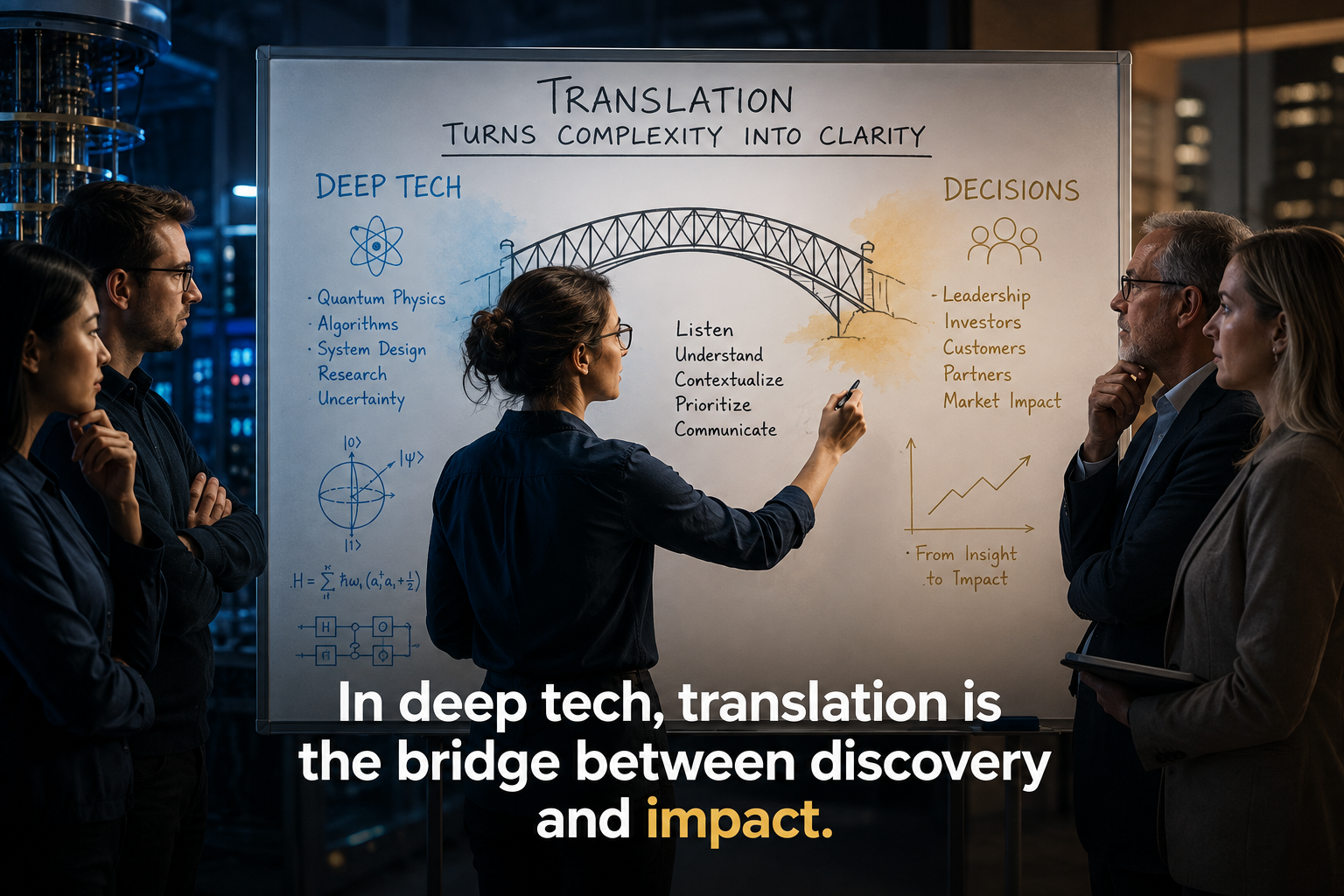
To translate between people who don’t speak the same “language”, technically, business, or operational.
That’s systems thinking.
And once you see it, you start recognizing it everywhere.
Quantum just happens to be a place where it becomes incredibly valuable.
There’s also a quieter shift happening beneath all of this.
For a long time, we were told to specialize.
Pick something. Stay there. Go deep.
And that advice still works—in stable environments.
But quantum isn’t stable.
It’s still forming. Expanding. Rearranging itself.
Which means the people who thrive here aren’t always the ones who stayed in one lane.
They’re the ones who learned how to move between lanes without losing their footing.
Generalists. Translators. Connectors.
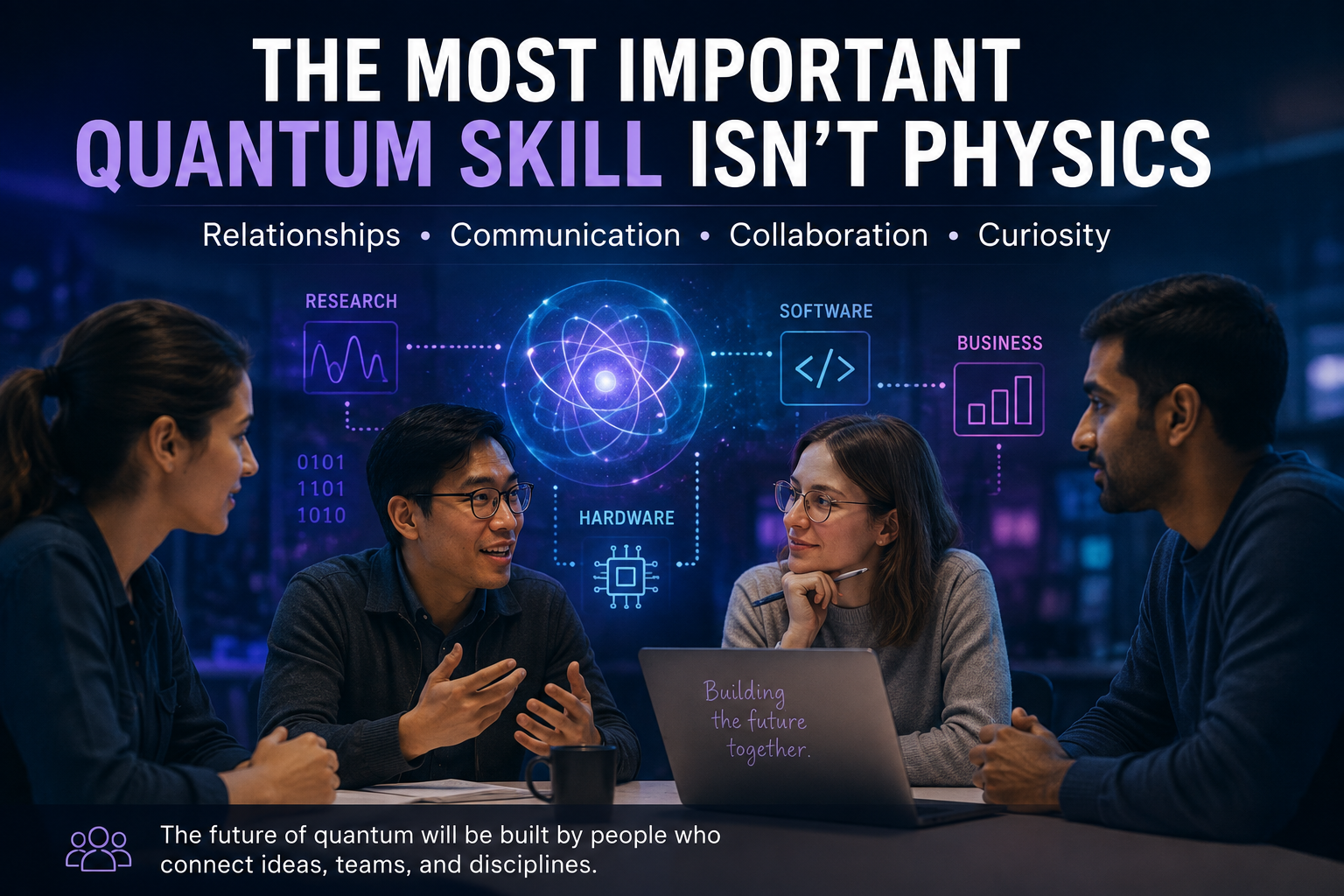
People who can walk into a room of physicists, engineers, and executives—and somehow help them understand each other.
Not because they know everything.
But because they can navigate.
If there’s a thread running through Sierra’s story—and so many others like it—it’s this:
Adaptability isn’t something you add later.
It’s the skill underneath everything.
The willingness to step into something unfamiliar.
To let go of an old identity.
To learn, unlearn, and learn again without needing the path to make immediate sense.
It’s uncomfortable.
But it’s also where all the movement is.
And maybe this is the part that matters most.
Quantum doesn’t just need physicists.
It needs people who can explain it.
Position it.
Build with it.
Question it.
Shape how it enters the world.
It needs people who can take something complex and make it meaningful.
Which means many people are disqualifying themselves too early.
Quietly stepping back because they think their background doesn’t “fit.”
When in reality, their perspective might be exactly what’s missing.
We’re in a strange, in-between moment right now.
Quantum is no longer just theoretical—but it’s not fully embedded in everyday life either.
It’s becoming something.
And the people stepping into it today are helping define what that something will be.
Not just technically.
But culturally. Ethically. Practically.
So if you’ve ever looked at quantum and thought the following:
that’s not for me…
Just pause there for a second.
The path isn’t supposed to be obvious.
It’s supposed to be constructed.
And the pieces you’ve been collecting even the ones that felt random or off-track—
might be quietly forming a pattern you haven’t fully seen yet.