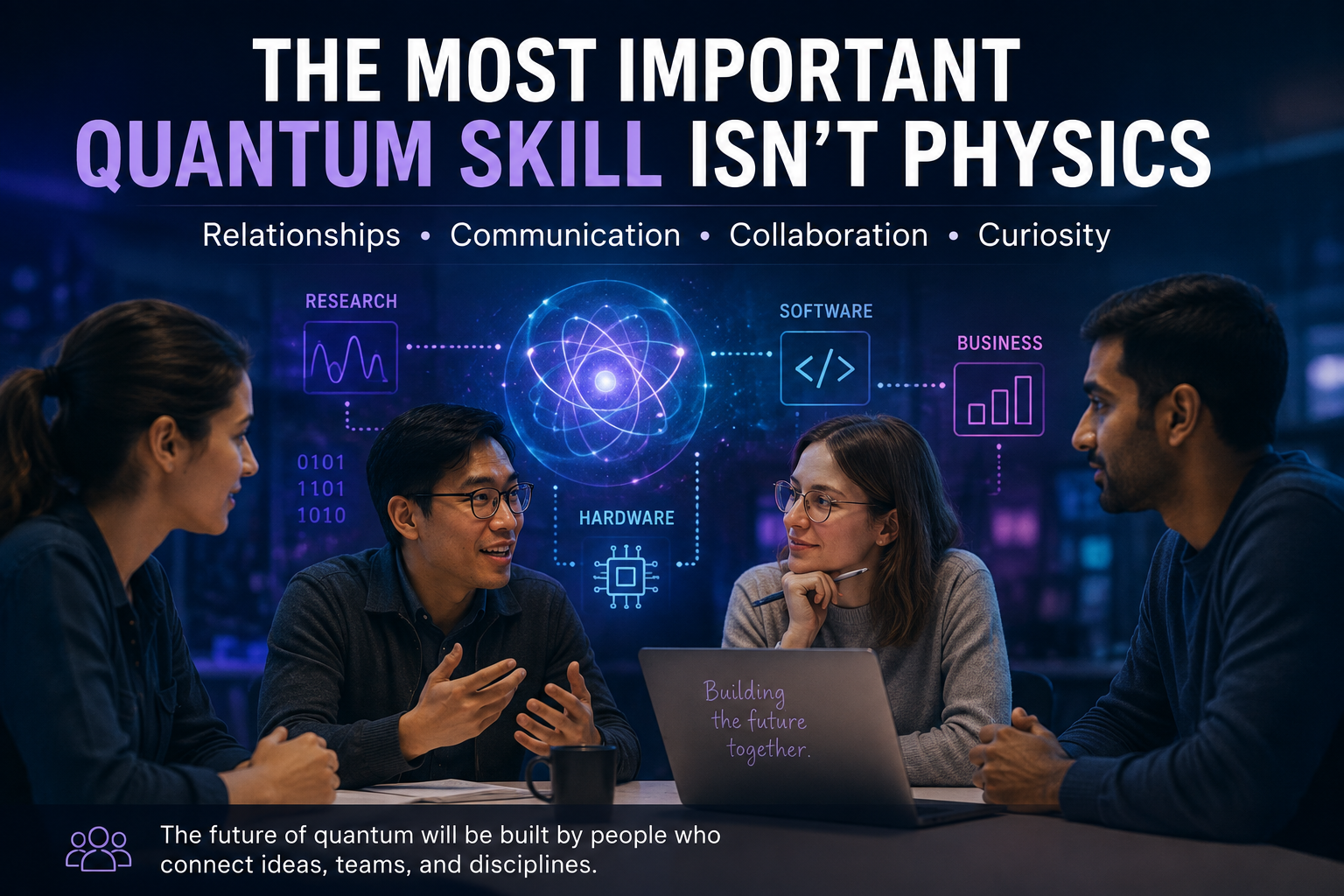
When people imagine a career in quantum computing, they tend to picture a chalkboard covered in equations, a laboratory filled with cryogenic equipment, or a researcher solving problems that few people can even pronounce. It is an understandable assumption. Quantum computing is one of the most technically demanding fields in modern science.
So when I asked Severyn Balaniuk, a Research Software Developer at 1QBit, what skill had proven to be the most valuable throughout his career, I expected to hear mathematics, quantum mechanics, software engineering, or perhaps machine learning.
His answer caught me completely off guard.
Networking.
Not computer networking.
People networking.
Building relationships. Learning how to communicate. Understanding what other teams actually need. Helping people solve problems together.
For a field built on some of the most sophisticated science humanity has ever attempted, it was a surprisingly human answer.
The more we talked, the more it made sense.
Quantum Is a Team Sport
Quantum computing isn’t being built by lone geniuses working in isolation. It is an ecosystem that brings together physicists, software developers, mathematicians, engineers, hardware specialists, chemists, business leaders, investors, and policymakers. Each group speaks its own language.
A physicist may spend years thinking about error correction and quantum states. A software engineer is focused on building tools developers can actually use. Hardware teams are solving entirely different challenges involving lasers, superconducting circuits, trapped ions, or neutral atoms. Business leaders are asking when these technologies will become commercially viable.
Each perspective is essential, but the challenge is getting everyone to understand one another.
Balaniuk explained that one of the most valuable things he learned during his time at the University of Waterloo’s Quantum Intelligence Lab wasn’t simply how to build machine learning models. It was learning how to work with hardware researchers, understand their problems, and identify where his own expertise could make a meaningful contribution.
That kind of collaboration doesn’t appear on many university syllabi.
Communication Is Becoming a Competitive Advantage
Technical expertise will always be the foundation of quantum computing. No one is suggesting that communication replaces physics, mathematics, or engineering. The breakthroughs that move the industry forward still depend on deep scientific knowledge. But technical expertise alone rarely creates meaningful innovation.
Innovation happens when ideas move across disciplines. A researcher developing a new quantum algorithm needs feedback from hardware engineers to understand what is practical today. Software developers need insight into how physicists design and run experiments. Product teams must translate complex research into solutions that businesses can adopt, while investors need to distinguish between genuine breakthroughs and incremental progress. Each group brings a different perspective, but progress depends on their ability to understand one another.
That ability to connect people and ideas is becoming a valuable skill in its own right. During our conversation, Balaniuk explained that companies are looking for people who understand the broader context, communicate effectively, and collaborate across teams to deliver what is actually needed—not simply what is technically possible.
What struck me is that this observation reaches far beyond quantum computing. Every emerging technology eventually reaches a point where technical specialists alone are not enough. Industries also need translators—people who can bridge research and business, software and hardware, science and strategy. They help ideas move from the laboratory into products, partnerships, and ultimately the real world.
In many ways, those translators become the accelerators of innovation. They don’t necessarily invent the technology, but they make it possible for everyone else to understand it, build on it, and bring it to market. As quantum computing continues to mature, that ability to connect worlds may prove just as valuable as writing the next breakthrough algorithm.
Conferences Are More Than Networking Events
When people hear the word networking, they often picture business cards, elevator pitches, or adding another connection on LinkedIn. That wasn’t what Severyn Balaniuk was talking about. For him, networking is less about expanding your contact list and more about expanding your understanding of the industry.
He encouraged students and professionals early in their careers to attend conferences because they offer something far more valuable than introductions. They provide perspective. Sitting in technical talks, listening to researchers from different disciplines, talking with engineers tackling entirely different challenges, and hearing what companies are trying to solve helps you see beyond your own area of expertise. It allows you to understand where your work fits within the broader quantum ecosystem.
That perspective is especially valuable because quantum computing is still in its formative years. The industry is evolving so quickly that many of the roles likely to define the next decade haven’t even been fully established. Career paths are still being written, technologies are still competing for dominance, and new opportunities continue to emerge as the field matures.
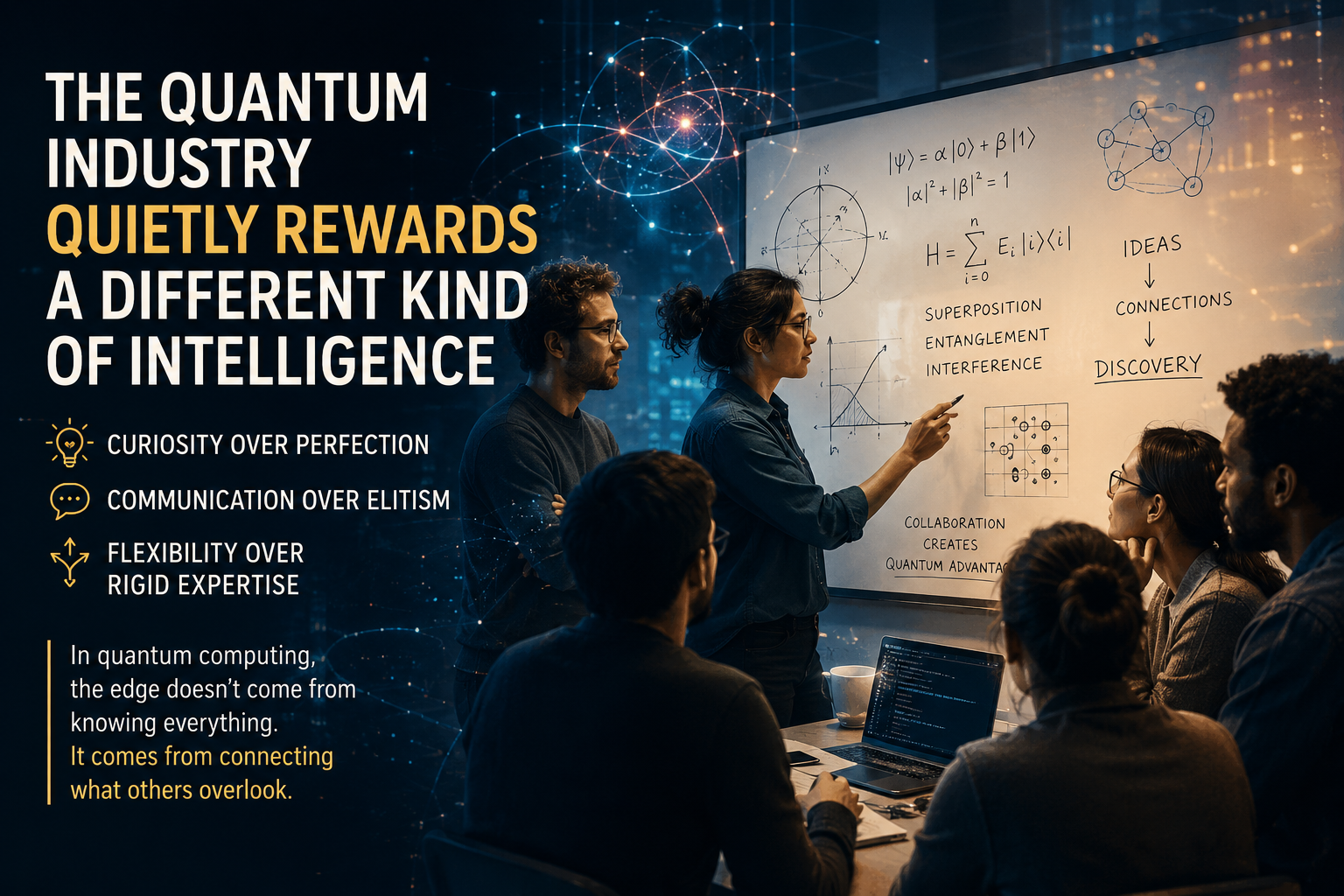
In an environment like this, curiosity becomes a competitive advantage. The people who will thrive may not be those who become experts in a single narrow discipline as quickly as possible, but those who remain open to learning from adjacent fields, collaborating with people who think differently, and recognizing opportunities that exist at the intersection of multiple areas of expertise. As Balaniuk suggests, understanding the bigger picture can be just as valuable as mastering one small part of it.
The Future Needs Translators
As our conversation unfolded, one theme kept resurfacing in unexpected ways. Quantum computing doesn’t just need better hardware, more stable qubits, or new algorithms. It also needs people who can translate between worlds.
The quantum ecosystem brings together researchers, software developers, hardware engineers, entrepreneurs, investors, and enterprise leaders. Each group has its own priorities, vocabulary, and way of thinking. Researchers are driven by scientific discovery, engineers by technical execution, and businesses by solving practical problems and creating value. Progress depends on these communities understanding one another, yet that communication doesn’t always happen naturally.
After interviewing dozens of leaders across the quantum industry, I’ve noticed a consistent pattern. The people creating the greatest impact aren’t always the ones publishing the most papers or building the most advanced hardware. Often, they’re the individuals who help others understand why a breakthrough matters, where it fits within the larger ecosystem, and how it can be applied beyond the laboratory.
These translators bridge the gap between science and strategy, between software and hardware, and between technical innovation and commercial opportunity. They make complex ideas accessible without stripping away their meaning. They bring together communities that might never have collaborated otherwise and create the shared understanding needed to move an entire industry forward.
As quantum computing continues to mature, those communication skills may become just as important as technical expertise. Breakthroughs only transform industries when people understand them, trust them, and know how to build upon them. In many ways, the translators are the ones who help innovation leave the laboratory and enter the real world.
There Is No Single Path Into Quantum
Another part of Balaniuk’s story reinforces this idea. His path into quantum computing didn’t begin in a research lab or with years of studying quantum mechanics. It began with curiosity.
As a high school student, he picked up Seth Lloyd’s Programming the Universe, a book that explores computation through the lens of quantum mechanics. That single book sparked a series of questions that eventually led him to study computer engineering, pursue graduate research, and build a career as a Research Software Developer at OneQubit.
What stands out is that his career wasn’t built around a carefully planned roadmap. Instead, each step naturally led to the next as his curiosity deepened. He wanted to understand how classical computers worked, which led him to wonder how quantum computers might work differently. That curiosity became the thread connecting each stage of his career.
There is an important lesson in that for anyone considering a career in quantum computing. The field is still young, and there is no single path into it. Some professionals arrive through physics, others through mathematics, software engineering, electrical engineering, chemistry, or artificial intelligence. Increasingly, people are entering the industry from disciplines that didn’t traditionally intersect with quantum at all.
For students and professionals looking to make the transition, that should be encouraging. You don’t have to begin as a quantum physicist to contribute meaningfully to the industry. What matters most is a willingness to keep learning, ask thoughtful questions, and remain open to ideas outside your own discipline. In an industry that is still defining itself, curiosity isn’t just the starting point—it may be one of the most valuable skills you can bring.
Building an Industry Together
From the outside, quantum computing often looks like a global race. Governments are investing billions of dollars into national quantum strategies, startups are competing to build scalable hardware, and researchers are publishing new discoveries at a remarkable pace. Most of the headlines focus on who will achieve the next technical milestone first or which architecture will ultimately emerge as the industry standard.
Yet beneath those headlines, something equally important is taking shape. An entirely new professional community is being built. Scientists, software developers, hardware engineers, entrepreneurs, investors, educators, and policymakers are learning how to work together in ways that simply didn’t exist a decade ago. The technology may be advancing rapidly, but so too is the ecosystem surrounding it.
What became clear during my conversation with Severyn Balaniuk is that this community is growing through relationships as much as through research. It is built on conversations between disciplines, collaboration across organizations, and people willing to ask questions they don’t yet know the answers to. Those interactions create the trust and shared understanding that allow ideas to move from academic papers into practical applications.
Technical expertise may open the door to a career in quantum computing, but it is rarely enough on its own. The people who make the greatest impact are often those who can collaborate effectively, learn from others, and contribute to something larger than their own area of specialization. As the quantum ecosystem continues to mature, success will depend not only on individual brilliance but also on our collective ability to build a community capable of turning extraordinary science into real-world innovation.
The Human Side of Quantum
As our conversation came to a close, I realized we had spent nearly an hour discussing quantum computing, yet the lesson that stayed with me wasn’t about qubits, algorithms, or hardware architectures. It was about people.
Quantum computing will undoubtedly require extraordinary advances in engineering. Researchers will continue pushing the boundaries of hardware, developing new algorithms, improving error correction, and solving technical challenges that seem almost unimaginable today. Those breakthroughs will determine what quantum computers are ultimately capable of accomplishing. But the success of the industry itself will depend on something much older than quantum mechanics.
It will depend on trust, communication, and collaboration.
Every major technological revolution has been driven by more than technical innovation alone. The internet grew because researchers, universities, governments, and businesses learned how to work together. Cloud computing became mainstream because engineers, IT leaders, and enterprises found common ground. Artificial intelligence accelerated when researchers shared ideas, open-source communities flourished, and organizations invested in building ecosystems rather than isolated technologies.
Quantum computing appears to be following that same path.
Throughout my conversation with Severyn Balaniuk, one message surfaced repeatedly, even if it wasn’t always stated directly. The future of quantum won’t be built by physicists alone. It will require software developers, engineers, educators, entrepreneurs, policymakers, investors, communicators, and countless others working toward a shared goal. The science may be extraordinarily complex, but building an industry is ultimately a human endeavor.
Perhaps that’s the most encouraging takeaway for anyone looking at quantum from the outside. Not everyone will become a quantum physicist, and not everyone needs to. There is room for people who can communicate complex ideas, connect different communities, ask thoughtful questions, and help translate research into real-world impact.
The next generation of quantum leaders won’t simply be measured by what they discover. They’ll also be remembered for how they brought people together to turn those discoveries into something meaningful. In a field defined by uncertainty and possibility, that ability to build bridges between people may become one of the most valuable contributions of all.