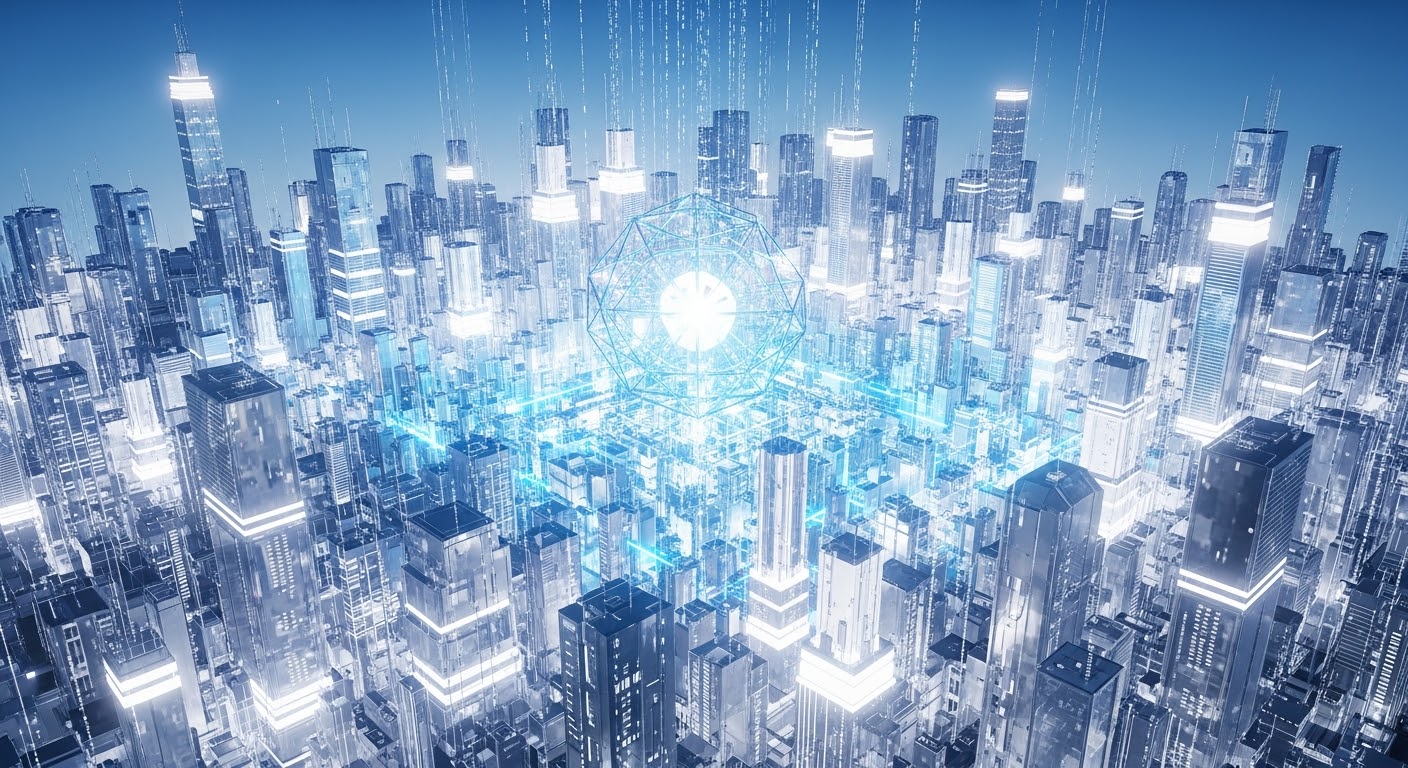
Modern cities are marvels of human ingenuity, living mosaics of light, sound, and motion. But beneath the beauty, they are also fragile ecosystems, straining under their own brilliance. Traffic congestion, flickering power grids, and ever-evolving cyber threats all whisper the same truth: our urban systems were not built for the complexity of today’s world.
Every day, millions of sensors feed rivers of data into city networks. Yet even with the help of big data and artificial intelligence, these digital arteries are clogging. To move beyond reaction into true anticipation, to create cities that sense, think, and respond in real time, we will need a leap not just in computing power but in our understanding of reality itself.
Enter quantum technology.
It is the science of the almost impossible, the art of particles that can exist in two places at once, of probabilities and delicate coherence. And it may hold the key to reimagining how cities breathe, balance, and protect themselves.
Quantum Computing: The Urban Optimizer
Picture this: instead of watching traffic grind to a halt and then scrambling to fix it, a city could predict congestion before it happens. Quantum computers, unlike classical ones that explore one route at a time, can examine countless possibilities simultaneously, like playing every chess game imaginable in parallel.
That means quantum algorithms could take data from millions of sensors, cars, trains, and weather satellites and choreograph a living, adaptive traffic ballet. Buses reroute themselves to avoid jams. Signals shift rhythmically to clear paths through intersections. Even parking availability could be forecast with eerie precision. The result is less idling, fewer emissions, and the quiet return of time to people’s days.
And traffic is only the beginning. Quantum models could help balance energy grids fed by fluctuating renewable sources, predicting demand before it spikes and redirecting power in milliseconds. Water and waste systems could hum with similar intelligence, finding efficiency in the smallest flows and fluctuations.
In essence, inefficiency, the eternal urban gremlin, becomes solvable math.
Quantum Communication: The City’s Digital Shield
A city that thinks is also a city that can be hacked. The more connected our systems become, the more fragile their links can grow. Quantum communication offers a shield woven from the very laws of physics.
Its cornerstone, Quantum Key Distribution (QKD), is like passing a secret so delicate that even a glance from an eavesdropper shatters it. Any attempt to intercept changes the message’s quantum state, alerting both parties immediately. It is not just clever code; it is unbreakable by design.
For citizens, that means digital privacy that endures even against tomorrow’s supercomputers. For city leaders, it means knowing that critical systems such as power grids, hospitals, and emergency networks cannot be silently infiltrated.
In a world where trust in digital systems feels increasingly brittle, this kind of security is less about fear and more about freedom, the freedom to innovate without the constant shadow of risk.
Quantum Sensing: A Nervous System for the City
If quantum computing provides intelligence and quantum communication offers protection, quantum sensing gives cities something closer to awareness —a nervous system attuned to the subtlest tremors of their environment.
Imagine bridges that can feel their own fatigue through quantum vibration sensors, alerting engineers before cracks appear. Picture networks that detect gas leaks or pollution in real time, tracing them back to the precise source before they spread. Quantum magnetometers could even register faint seismic murmurs, giving communities a few extra seconds of warning before an earthquake.
These sensors would make cities not just reactive but intuitively alive. They would know when to breathe deeper, when to brace, and when to adapt.
A Morning in the Quantum City
Step into the near future. Morning sunlight spills over a skyline that hums softly with intelligence. Traffic moves fluidly, your commute recalibrated by a quantum optimization engine you will never see. The bus arrives on time, not by luck but because millions of micro-decisions aligned perfectly overnight.
Streetlights sense when you are near, glowing awake for your safety. Waste trucks glide through neighborhoods on routes rewritten by sensor data. Hospitals coordinate emergency care through quantum-secure channels, while the city grid invisibly balances solar and wind flows across the skyline.
It feels calm, not futuristic, just deeply in tune.
Cities such as London, Singapore, and Toronto are already testing elements of this future, from quantum-encrypted communications to precision-sensing networks. The leap is happening quietly, molecule by molecule.
Building Quantum Cities Responsibly
Building a quantum city requires more than new machines. It asks for new mindsets. Quantum technology is notoriously complex, and the global shortage of quantum-literate professionals is growing. We will need architects who can think in probabilities, urban planners who can read entanglement, and ethicists who can ask not just what we can build, but what we should.
As with any technological revolution, equity must be our compass. Quantum systems could amplify privilege just as easily as they solve inefficiency. The promise must be shared: cleaner air, safer streets, and more sustainable living for everyone, not just those in the shiniest postal codes.
As IBM and MIT researchers often remind us, the greatest challenge of quantum innovation is not physics, it is stewardship. How we choose to wield such power will shape not only our cities but our shared sense of what intelligence means in human spaces.
The Quantum Horizon
By 2050, nearly 70 percent of the world’s population will live in cities. Quantum technologies give us a chance to design those spaces not as cold networks of data, but as responsive ecosystems, alive with possibility and learning as they grow.
The quantum leap will not happen all at once. It will shimmer into being, block by block, as sensors, algorithms, and policies align around something both practical and poetic: cities that think with us, not just for us.
When that day comes, we may look out at the skyline and feel a quiet connection, a recognition that our cities, like us, are complex, curious, and capable of astonishing things.