
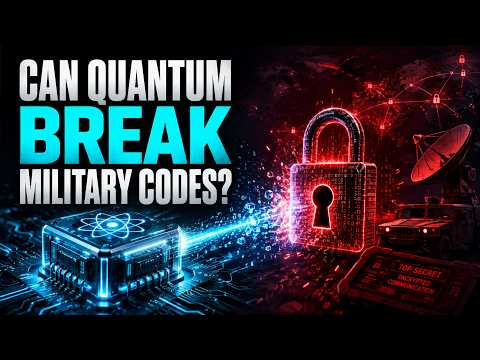
Imagine a world where the unseen codes that fortify military secrets dissolve under the scrutiny of an unassuming cube. This cube—ice-cold and quietly pulsing with computation—could shift the tectonic plates of global security. Welcome to the realm of quantum computing, where the very fabric of digital security faces both unprecedented threats and incredible opportunities.
In the shadowy crossroads of quantum computing and military operations lies a clandestine operation eerily known as “store now, decrypt later” (SNDL). It’s a strategy as insidious as it is ingenious, with adversaries stockpiling encrypted data like gold in a vault, waiting for the day when quantum computers can unspool these tightly knit threads in a heartbeat—an impending moment ominously coined as Q-Day.
Based on content from Quantum SystemHub
At the core of this potential data apocalypse is Shor’s algorithm, a mathematical tool capable of unraveling the complex equations that secure our communications. Public key systems like RSA, designed to withstand assaults from classical computers, crumble before its prowess. Yet herein lies an opportunity masked as a threat: the birth of post-quantum cryptography (PQC). These new cryptographic algorithms stand resilient, fortifying the fortifications against both classical and quantum onslaughts.
Now, if we turn our gaze skyward, the constellation of satellites guarding military and intelligence data feels the tremors of this quantum upheaval. Secure networks face an existential question: how long can they hold their secrets in this rapidly approaching era?
Beneath this looming threat, another facet of quantum technology sparkles with promise—logistics. The intricate dance involved in military supply chains, once choking under the weight of immense computational demands, finds relief in quantum’s embrace. Picture terrain where classical supercomputers stall, yet where quantum computing, through methods like quantum annealing, deftly navigates countless variables simultaneously. Here, intersections of troop movements, resource allocations, and diverse supply chains merge into a choreographed precision guided by quantum calculations.
The unpredictable tapestry of modern warfare, marked by shifting contexts and variables, demands solutions that are both rapid and optimal. Quantum computing doesn’t just streamline; it could transform the very predictability that strategists thrive upon. Real-world demonstrations underscore this potential, with quantum strategies achieving time savings in convoy optimizations—turning hours into lifelines on the battlefield.
Yet, before the ripples transform into waves, the bridge between fantasy and reality demands attention. Our current era is dominated by NISQ devices—noisy intermediate-scale quantum computers—whose qubits remain fragile, whispering their computations in the silence of near-zero temperatures. The promise of fault-tolerant quantum computing becomes the beacon guiding us forward, but the path is littered with technological and logistical hurdles.
Strategically, the race is undeniable. Militaries and organizations must sprint towards encryption strategies robust enough to stand in the face of quantum threats. The migration to post-quantum cryptography is not optional, but vital. The numbers speak volumes: a shift that demands a decade of preparation must confront a threat only a few years hence. What emerges is a question that transcends technology: amidst these knotty challenges, what do we prioritize?
This crossroads leads us to a final contemplation. As this quantum dawn unfolds, the dual nature of these advances provokes us to weigh the scales of potential threats against tangible benefits. Will it be the whispered threat against secrecy or the thunder of logistical supremacy that redefines our future military strategies? The answer may not only dictate the gears of war but the very foundation of our strategic thinking in an era leaning ever closer towards entropy and opportunity.
So, as we brace for this quantum turn, we must remain vigilant—constantly asking the pressing questions and peering into technological horizons with both caution and anticipation. In doing so, we stay not just witnesses to history but shapers of its flow.
—











Leave a Reply