In the global race for quantum supremacy, the conversation often centers on which hardware has the most qubits or the coldest dilution refrigerator. But as Prime Minister Mark Carney has frequently noted in recent economic summits, a computer without a workforce is just an expensive piece of modern art.
While other nations are struggling with protectionist barriers and talent shortages, Canada is executing a masterclass in Human Capital Sovereignty. By leveraging a unique mix of immigration policy, decentralized research hubs, and a first-of-its-kind “Quantum Materials Supply Chain,” Canada is no longer just a research lab; it has become the world’s most attractive headquarters for the quantum elite.
The Reverse Brain Drain: Why the Best Are Heading North
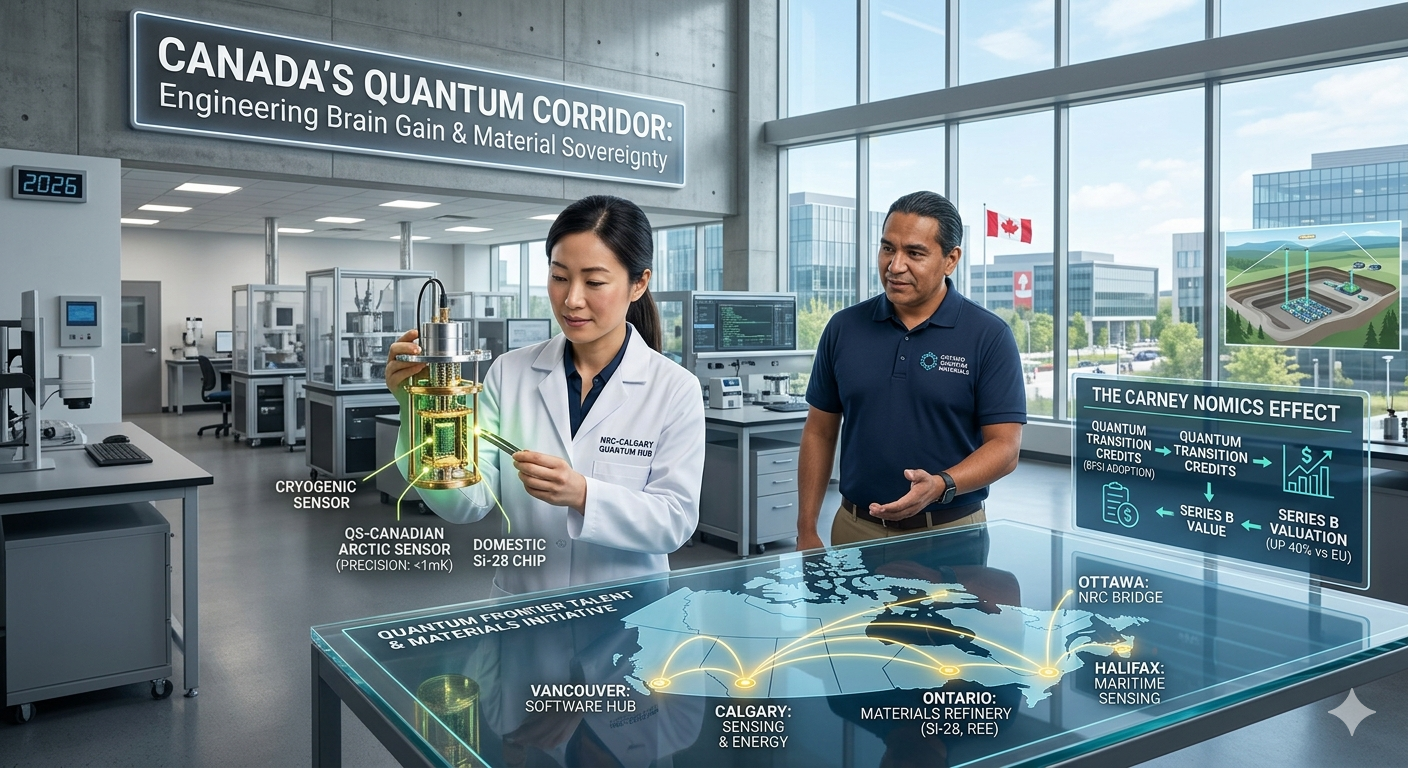
For decades, the “Brain Drain” to Silicon Valley was the Achilles’ heel of the Canadian tech sector. In 2026, the tide has officially turned. Under the Carney administration’s “Quantum Frontier Visa,” Canada has streamlined residency for specialized PhDs and engineers in quantum physics and cryogenics.
But it’s not just about easier paperwork. Canada is winning the talent war because it offers something the private-equity-driven markets of the U.S. often lack: Long-horizon stability.
- The NRC-Industrial Bridge: The National Research Council (NRC) has launched a series of “Applied Quantum Labs” where researchers can spend 50% of their time on pure academic discovery and 50% on commercial scale-ups without losing their tenure or intellectual property rights.
- The Cost of Living Offset: By decentralizing quantum hubs away from just Toronto and Vancouver—expanding heavily into Calgary’s “Energy-Quantum Hub” and Halifax’s “Maritime Sensing Cluster”—Canada is offering a high-quality lifestyle that is increasingly out of reach in Palo Alto or London.
Beyond the Qubit: The Rise of Quantum Sensing
While the general public is obsessed with quantum computers, the Carney government has quietly placed a massive bet on Quantum Sensing. This is the “hidden” quantum economy that is already yielding dividends in 2026.
In the Canadian North, quantum sensors are being deployed for “Sub-Surface Sovereignty.” These sensors can detect mineral deposits and navigate in GPS-denied environments (such as deep underwater or under Arctic ice) with precision that classical systems cannot match.
“We aren’t just building a faster calculator,” says a lead researcher at the Montreal Quantum Institute. “We are building the ‘nervous system’ for the next century of resource extraction and environmental monitoring.”
By focusing on sensing, Canada has found a way to monetize quantum technology today rather than waiting for fault-tolerant computers in 2030. This creates a self-funding loop: the revenue from quantum sensing in the mining and oil sectors is being funneled back into the long-term goal of universal quantum computation.
The “Critical Materials” Pincer Move
One of the most significant shifts in 2026 is Canada’s refusal to be a mere exporter of raw materials. Under the updated National Quantum Strategy, the government has incentivized the domestic processing of isotopes such as Silicon-28 and the refining of high-purity rare-earth elements required for superconducting qubits.
By creating a “vertical stack,” Canada is insulating its quantum industry from global supply shocks.
- Domestic Foundries: The launch of the First Nations-partnered quantum-material refinery in Northern Ontario ensures that the “dirt” used to build these machines stays Canadian until it becomes a high-value component.
- The Export Lever: By controlling the materials, Canada gains a seat at the table with tech giants like IBM and Google. If you want the ultra-pure materials, you have to help build the Canadian ecosystem.
The “Carney-Nomics” of Quantum: De-Risking the Future
Mark Carney’s primary contribution to the sector has been the introduction of Quantum Transition Credits. Much like carbon credits, these financial instruments allow traditional industries—such as the Big Five banks and major telecommunications players (Rogers, Bell)—to receive tax offsets for “Quantum-Proofing” their infrastructure early.
This has solved the “Valuation Gap” that plagued quantum startups in the early 2020s. By creating a guaranteed domestic market of buyers (the banks and telcos), the government has de-risked the sector for venture capitalists. The result? Canadian quantum startups are seeing Series B valuations 40% higher than those of their European counterparts because their “first customer” is already built into national policy.
The 1,100-Word Outlook: The Sovereign Choice
As we look toward the 2027 fiscal year, the narrative of Canada as a “middle power” is being rewritten. In the quantum realm, there are no middle powers—only those who own the stack and those who rent it.
Canada’s strategy is a calculated blend of:
- Talent Aggression: Moving the world’s best minds to the “Quantum Corridor.”
- Sensing Pragmatism: Making money now while the hardware matures.
- Material Sovereignty: Controlling the physical ingredients of the future.
For the tech writer and the investor alike, the message is clear: The maple leaf is no longer just a symbol of peace; it is becoming the trademark of the most secure, stable, and vertically integrated quantum economy on the planet.
Key Takeaways:
- The “Brain Gain” is real: Canada’s visa and research policies are creating a talent vacuum, drawing experts away from traditional tech hubs.
- Sensing is the “Now”: While computing is the “future,” quantum sensing is already transforming the Canadian mining and defense sectors.
- Financial Innovation: Mark Carney is using financial tools (Transition Credits) to force the adoption of quantum tech, creating a built-in market for startups.