In the digital age, privacy has become almost synonymous with one phrase: end-to-end encryption.
It’s the invisible technology that ensures the messages you send can only be read by the person on the other end of the conversation. Not your internet provider. Not the messaging platform. Not hackers.
For years, end-to-end encryption has been the gold standard of digital privacy.
But a new challenge is quietly approaching—one that could eventually make today’s encryption obsolete.
It’s known as the “harvest now, decrypt later” problem.
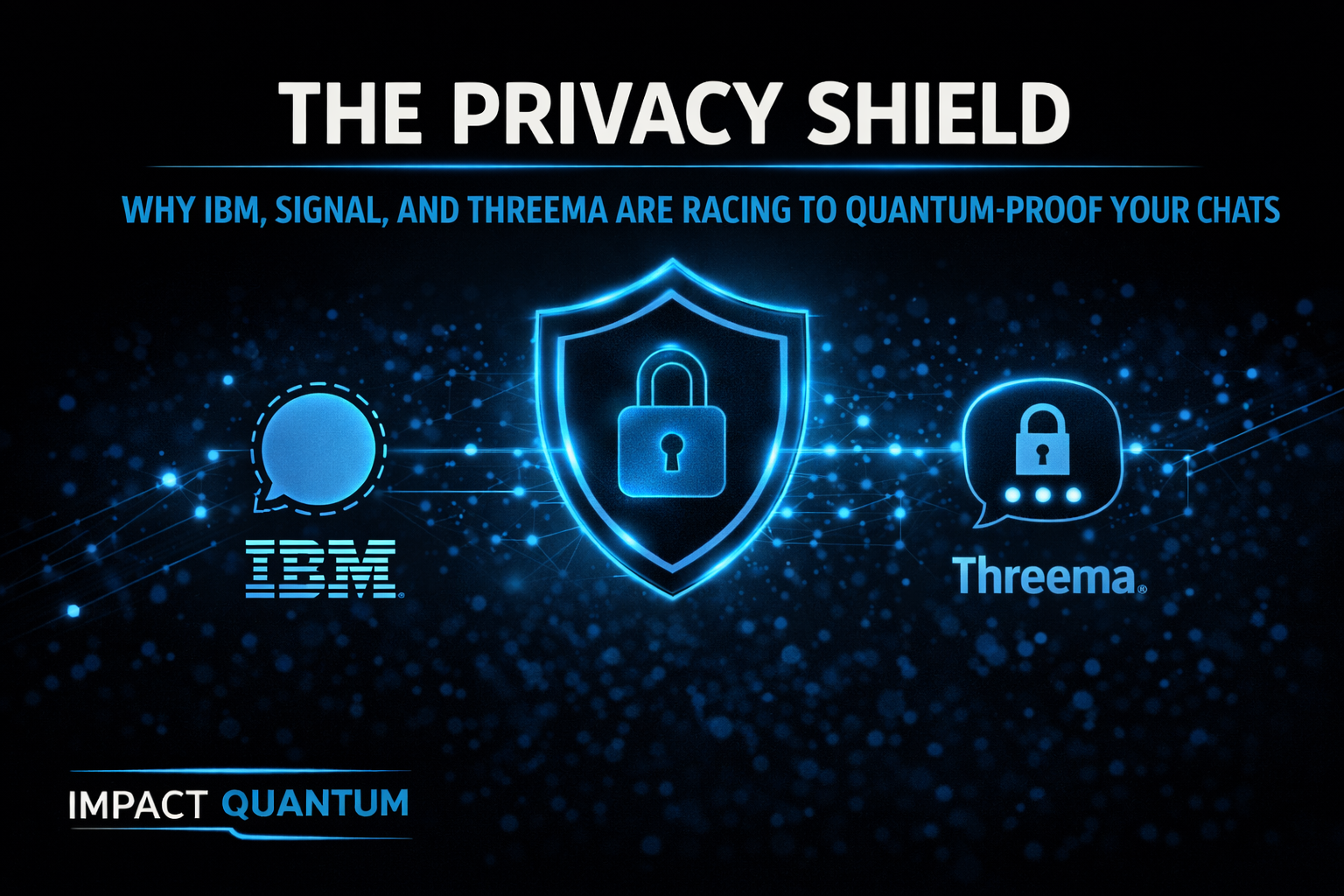
And it’s the reason IBM has announced a research collaboration with two of the most privacy-focused messaging platforms in the world: Signal and Threema.
Together, they are working on the next generation of messaging security—quantum-safe encryption.
For anyone who relies on secure communication, this collaboration signals something important:
The race to protect our digital conversations has already begun.
The “Harvest Now, Decrypt Later” Threat
At first glance, the urgency around quantum-safe encryption can seem confusing.
After all, large-scale quantum computers capable of breaking today’s encryption don’t yet exist.
So why prepare now?
Because encrypted data has a lifespan.
Governments, intelligence agencies, and sophisticated cybercriminals already collect encrypted communications and store them for future analysis.
The idea is simple:
Capture the data today.
Decrypt it later.
If quantum computers eventually become powerful enough to break current encryption standards, those stored communications could suddenly become readable.
That means conversations happening today—about legal strategy, medical information, financial transactions, or intellectual property—could be exposed years from now.
In other words, privacy isn’t just about the present moment.
It’s about protecting information across time.
Why Signal and Threema Matter
The companies involved in this collaboration weren’t chosen randomly.
Both Signal and Threema have built reputations as some of the most secure messaging platforms available.
Signal, a nonprofit platform, is widely trusted by journalists, activists, and cybersecurity professionals who require extremely strong privacy protections.
Threema, based in Switzerland, is known for its strict data sovereignty policies and strong adoption among European organizations that prioritize secure communication.
These platforms have already pushed the boundaries of secure messaging.
By partnering with IBM, they are now exploring how to extend that protection into the post-quantum era.
IBM brings deep expertise in post-quantum cryptography (PQC)—a field dedicated to designing encryption systems that remain secure even in the presence of quantum computers.
Just as importantly, IBM’s research helps ensure that these stronger algorithms can run efficiently on everyday devices without draining battery life or slowing down performance.
In other words, the goal is security that remains invisible to the user.
Rethinking the Weakest Link
In many modern encryption systems, the most vulnerable moment occurs during what’s known as the key exchange.
Before two devices can send encrypted messages, they need to agree on a shared secret key.
This process is often described as a digital “handshake.”
The problem is that many traditional key exchange methods rely on mathematical problems that quantum computers are expected to solve much faster than classical computers.
That’s where the IBM research comes in.
The collaboration focuses on Key Encapsulation Mechanisms (KEMs)—new cryptographic structures designed to resist quantum attacks.
KEMs create a protective mathematical wrapper around encryption keys, making it extremely difficult—even for a quantum computer—to extract them.
By integrating these techniques into messaging protocols, the researchers aim to build encryption systems that remain secure long after quantum computing matures.
Why This Matters for the Impact Quantum Community
At Impact Quantum, we often talk about how breakthroughs in physics eventually ripple outward into everyday life.
This collaboration is a perfect example of that process.
Quantum computing is still emerging, but the work happening today is already shaping the infrastructure that protects our digital world.
There are several reasons this research matters.
First, it strengthens trust in digital communication. If people begin to doubt that their conversations are truly private, it can have a chilling effect on journalism, activism, and business innovation.
Second, it contributes to global standards. The research emerging from collaborations like this often becomes the blueprint for broader industry adoption.
The encryption techniques tested in Signal and Threema today may eventually influence how messaging systems across the world operate—from WhatsApp to iMessage.
And finally, it reinforces the idea that cybersecurity must evolve alongside computing technology.
As our devices become more powerful, so too must the systems designed to protect them.
The Quiet Work Behind the Scenes
The good news is that most users won’t need to change anything.
There won’t be a “quantum edition” of your favorite messaging app.
The entire goal of this research is to ensure that the transition to quantum-safe security happens quietly, in the background, without disrupting the experience people rely on every day.
In many ways, that’s the hallmark of good infrastructure.
When it works well, you barely notice it.
The quantum revolution will bring enormous changes to computing.
But thanks to collaborations like the one between IBM, Signal, and Threema, our privacy may already be getting a head start on the future.