When people talk about the future of quantum computing, the conversation usually gravitates toward the same familiar places.
The United States. Canada. Germany. The United Kingdom.
We hear about research breakthroughs emerging from leading institutions, billion-dollar investments from major technology companies, and government initiatives designed to secure leadership in what many view as the next great technological revolution.
These regions have undoubtedly earned their reputations. They are home to world-class researchers, thriving startup ecosystems, and some of the most advanced quantum infrastructure.
But focusing exclusively on these established centers may cause us to overlook one of the most important developments unfolding in the quantum industry today.
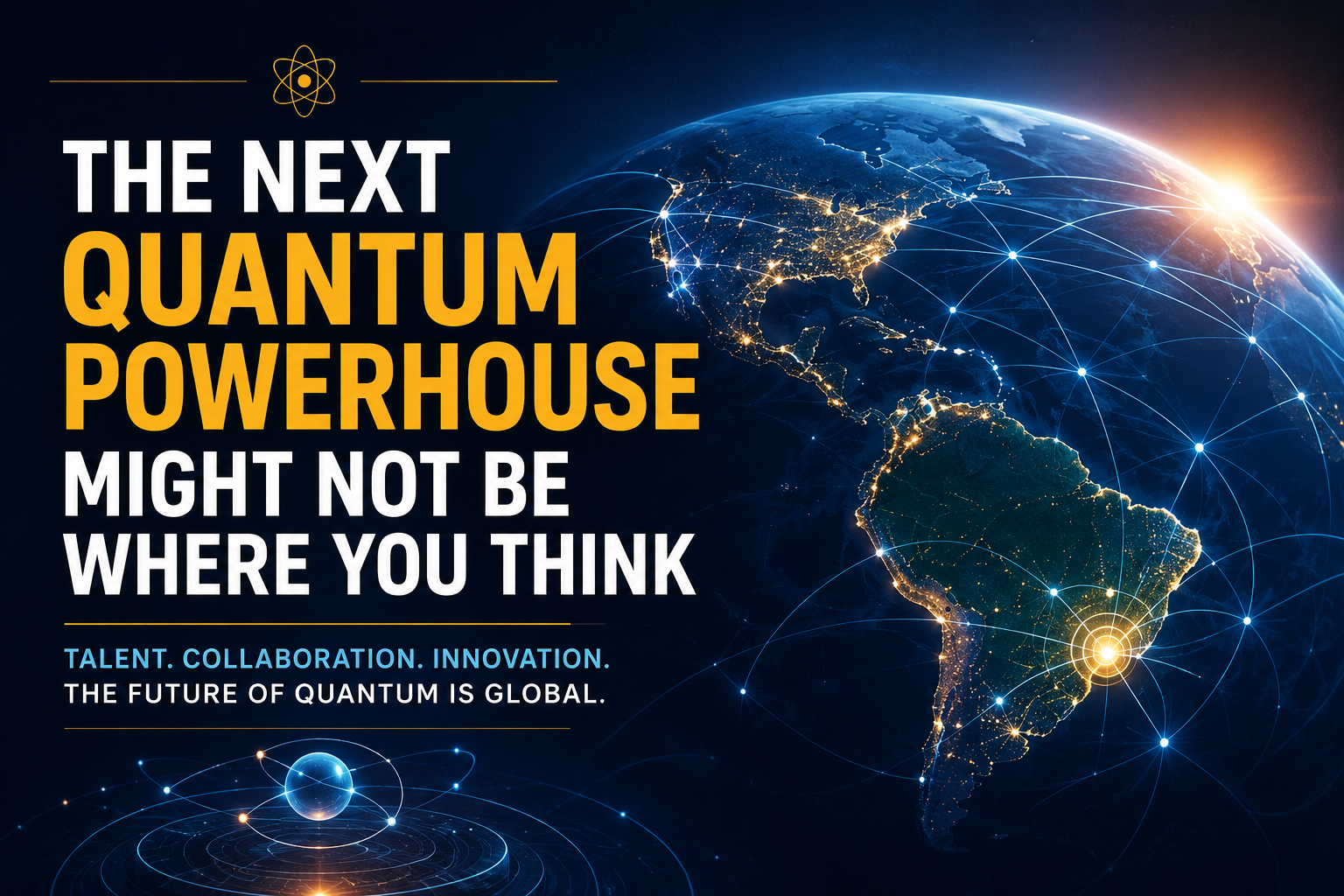
The future of quantum computing is becoming increasingly global.
Quietly, and often far from the spotlight, new quantum ecosystems are emerging across Latin America, Asia, Africa, and the Middle East. While they may not yet command the headlines of Silicon Valley or Waterloo, they are building talent, attracting investment, establishing research programs, and creating the foundations for long-term innovation.
One conversation recently reminded me just how much the global quantum landscape is changing.
During a pre-interview discussion for the Impact Quantum Podcast, I spoke with Miguel Lisboa, a young quantum researcher based in northeastern Brazil. Like many people who enter the field, he began his journey with curiosity. Fascinated by physics and advanced scientific concepts from an early age, he explored quantum computing after encountering it in popular media and then delved deeper through his own research.
What makes his story interesting is not simply his personal path into quantum computing.
It is where that path is leading.
Rather than relocating to one of the world’s traditional technology capitals, Miguel is helping build what aims to become one of the largest quantum computing centers in Latin America. Supported by significant investment and ambitious national planning, the initiative represents a broader trend that deserves far more attention than it currently receives.
For years, discussions about quantum computing have often carried an unspoken assumption: that meaningful innovation would emerge primarily from a handful of elite institutions concentrated in North America and Europe.
History suggests otherwise.
Major technological revolutions rarely remain confined to their original centers of development. The internet began in research laboratories and government programs before spreading globally. Artificial intelligence, once concentrated within a small number of institutions, is now being advanced by researchers and companies on nearly every continent.
Quantum computing appears to be following a similar trajectory.
Countries around the world increasingly recognize that quantum technologies are not simply scientific curiosities. They represent strategic capabilities with implications for national security, economic competitiveness, advanced manufacturing, healthcare, telecommunications, and energy systems.
As a result, governments and institutions are investing accordingly.
Brazil has emerged as one of the most interesting examples of this trend.
While many people outside the region may not immediately associate Brazil with quantum research, the country has been steadily building expertise in physics, mathematics, computer science, and advanced engineering for decades. Today, those foundations are beginning to support a more coordinated effort to establish a meaningful presence within the global quantum ecosystem.
This is important because technological leadership is ultimately built on people.
And talent remains the most valuable resource in any emerging industry.
One of the themes that recurred in my conversation with Miguel was the importance of access.
He described how much of his growth came not from having all the answers, but from actively seeking out people who could help him learn. Conferences, research groups, professional communities, and international networks became critical components of his development as a researcher.
That observation carries an important lesson for the broader industry.
Talent exists everywhere.
Opportunity does not.
For decades, geography often determined who could participate in cutting-edge scientific fields. Researchers needed to be physically located near major universities, laboratories, or technology companies to access the resources necessary to contribute.
That model is changing.
Remote collaboration, open-source software, cloud-based quantum platforms, virtual conferences, and international research partnerships are lowering barriers that once seemed insurmountable. A student in Brazil, Kenya, India, or Vietnam can now access educational resources and research communities that would have been unimaginable a generation ago.
As these barriers continue to fall, the global talent pool available to the quantum industry expands dramatically. A student in Brazil can collaborate with researchers in Germany. An engineer in India can access the same cloud-based quantum platforms used by teams in North America. A researcher in Africa can participate in international conferences and contribute to open-source projects without ever boarding a plane. The democratization of access is gradually reshaping who gets to participate in the quantum economy.
This shift also highlights the growing importance of international collaboration. The challenges facing quantum computing are simply too large for any single institution, company, or country to solve alone. Building fault-tolerant quantum computers, developing new quantum algorithms, advancing quantum networking technologies, and discovering practical commercial applications will require expertise from multiple disciplines and contributions from researchers around the world.
As a result, the future quantum ecosystem is unlikely to be defined solely by competition. It will also be shaped by collaboration. Researchers in Brazil may work alongside colleagues in Germany. Startups in Canada may partner with institutions in Singapore. Government-funded initiatives in Europe may support projects involving collaborators across Latin America and Asia. Increasingly, innovation will emerge from networks of connected organizations rather than isolated centers of excellence.
For companies building quantum talent pipelines, this evolution presents both an opportunity and a challenge. Organizations that continue recruiting exclusively from traditional hubs may find themselves competing for an increasingly limited pool of talent. Meanwhile, those willing to engage globally may discover highly skilled researchers, engineers, and innovators in places they had never previously considered.
The next generation of quantum leaders may not come from the institutions everyone expects. They may emerge from growing ecosystems that are still largely invisible to the broader industry today. That possibility should excite all of us because one of the most fascinating aspects of technological progress is its unpredictability.
Breakthroughs often arrive from unexpected directions. The researcher who solves a difficult problem may not be sitting in a famous laboratory. The startup that develops a transformative application may not be located in a well-known technology hub. The next major quantum innovation could emerge from a region that many industry observers are not even watching yet.
That is why conversations about quantum computing should extend beyond qubits, hardware roadmaps, and funding announcements. They should also include discussions about people, communities, educational pathways, and the emerging ecosystems taking shape around the world. These are the foundations upon which the future quantum industry will ultimately be built.
The quantum revolution will not belong to a single country, company, or continent. It will be created by a global community of researchers, entrepreneurs, educators, policymakers, and innovators working together across borders. And some of its most important chapters may be written in places that rarely make today’s headlines, but may define tomorrow’s breakthroughs.