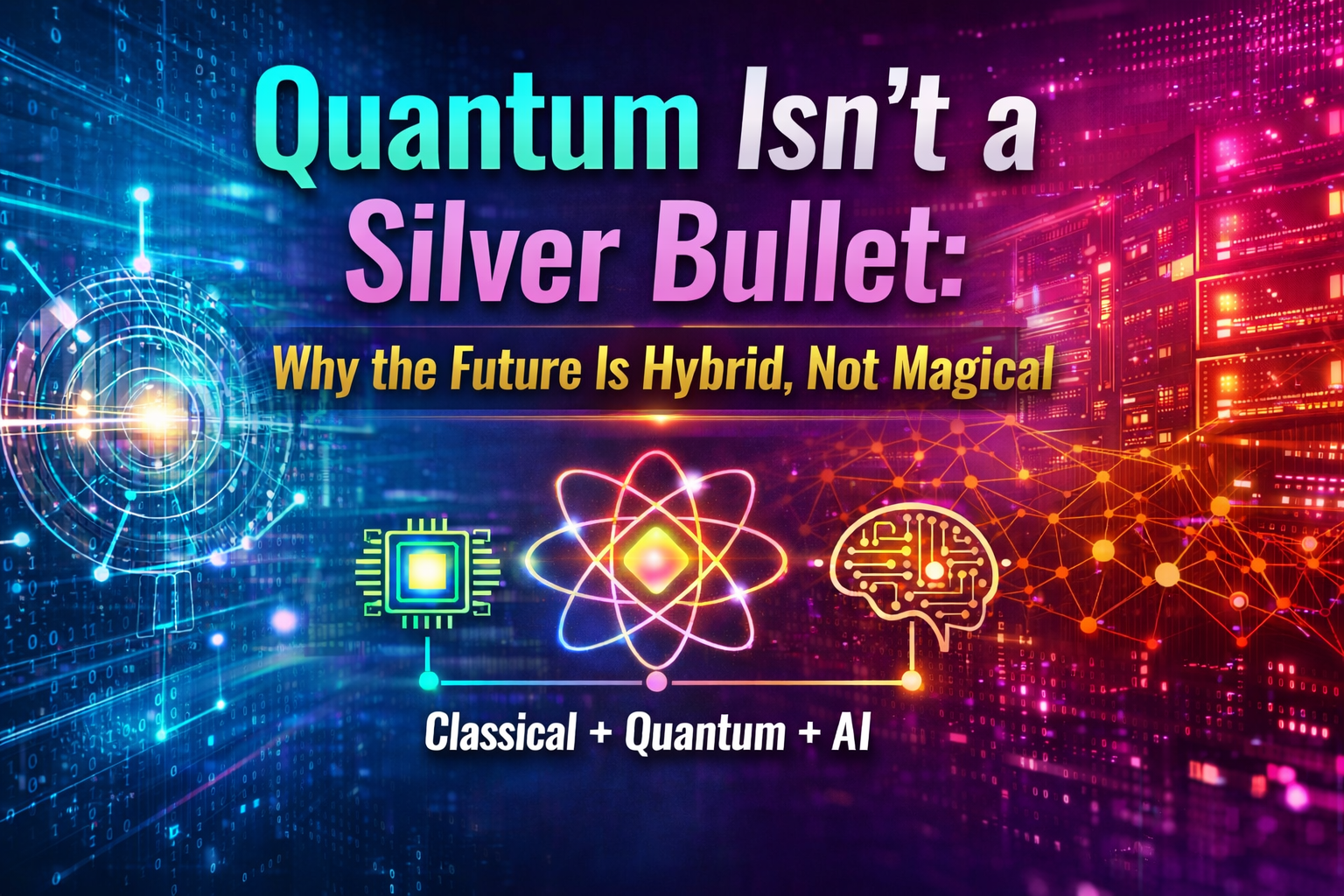
Every emerging technology goes through a familiar phase. First comes curiosity. Then excitement. Then hype. Quantum computing is firmly in that third phase right now.
Quantum is either the inevitable successor to classical computing or a mysterious black box that will one day “solve everything.” Neither framing is accurate, and both do a disservice to leaders trying to make real decisions about investment, strategy, and timing.
The truth is far less magical and far more helpful.
Quantum computing is not here to replace classical systems. It exists to remove specific bottlenecks where classical methods struggle, stall, or become prohibitively expensive. The future of computation is not quantum, instead of classical, it is hybrid, deliberate, and problem-specific.
Quantum Is Not One Solution to All Problems
One of the most persistent misconceptions about quantum computing is that it represents a universal acceleration of computation. Faster everything. Better answers. Instant advantage.
That is not how it works.
As one quantum founder put it plainly:
“Quantum is not one solution to all problems.”
That statement alone cuts through a great deal of noise.
Quantum computing is a different way of representing and manipulating information. It excels at particular classes of problems—often those involving enormous state spaces, complex optimization landscapes, or probabilistic systems that grow exponentially. For many workloads, classical high-performance computing (HPC) remains not only sufficient, but superior.
Overpromising does not accelerate adoption. It delays it. Executives who lived through the early AI hype cycle recognize this pattern well. The lesson from AI was not that the technology failed, but that expectations had to mature before value could emerge.
Quantum is walking the same path.
Bottlenecks, Not Entire Pipelines
The most productive way to think about quantum is not as a replacement architecture, but as a precision tool. It fits into existing systems at the exact point where classical methods start to break down.
Portfolio optimization is a clear example.
As the number of assets increases, the number of possible configurations explodes. Classical algorithms rely on approximations to manage this complexity, but those approximations inevitably discard information once the problem crosses a certain threshold.
Quantum methods approach this differently. By representing the system in a way that reflects its underlying structure, they can explore these massive solution spaces more effectively—not magically faster, but more scalable in specific regimes.
As explained in the discussion:
“Quantum is not going to rebuild the whole thing. It’s just another way of looking at a problem—but it can unclog a bottleneck that’s reducing overall performance.”
That distinction matters. Quantum does not replace the financial pipeline, the logistics stack, or the AI workflow. It targets the most challenging part of the problem and returns results to classical systems for validation, interpretation, and execution.
The Real Future: Hybrid Pipelines
This is where quantum becomes practical.
Modern systems are already hybrid. AI models rely on classical computing, specialized accelerators, and enormous data infrastructure. Quantum fits into this ecosystem as another specialized tool—not a silver bullet, but an enhancer.
In practice, this means hybrid pipelines where
- Classical systems manage data ingestion, preprocessing, and orchestration
- Quantum methods are applied selectively to optimization or sampling tasks
- AI models interpret outputs, generate signals, and support decisions
As the transcript makes clear, expecting Quantum to operate in isolation misses the point:
“Quantum is not that kind of computing. It’s not here to solve everything—it’s here to solve very specific problems that sit at the core of a pipeline.”
This framing also makes quantum actionable now. Teams can develop quantum-ready or quantum-inspired algorithms using classical simulations today while preparing for future hardware improvements. When quantum processors mature, those systems transition; they are not rebuilt from scratch.
Why This Matters for Leaders and Policymakers
For C-suite leaders, product strategists, and policymakers, the real question is not when quantum arrives, but where it creates measurable value.
Moving beyond hype allows organizations to:
- Avoid premature or misaligned investments
- Identify real use cases with near- to mid-term ROI
- Build internal literacy without unrealistic expectations
- Communicate honestly with boards, regulators, and stakeholders
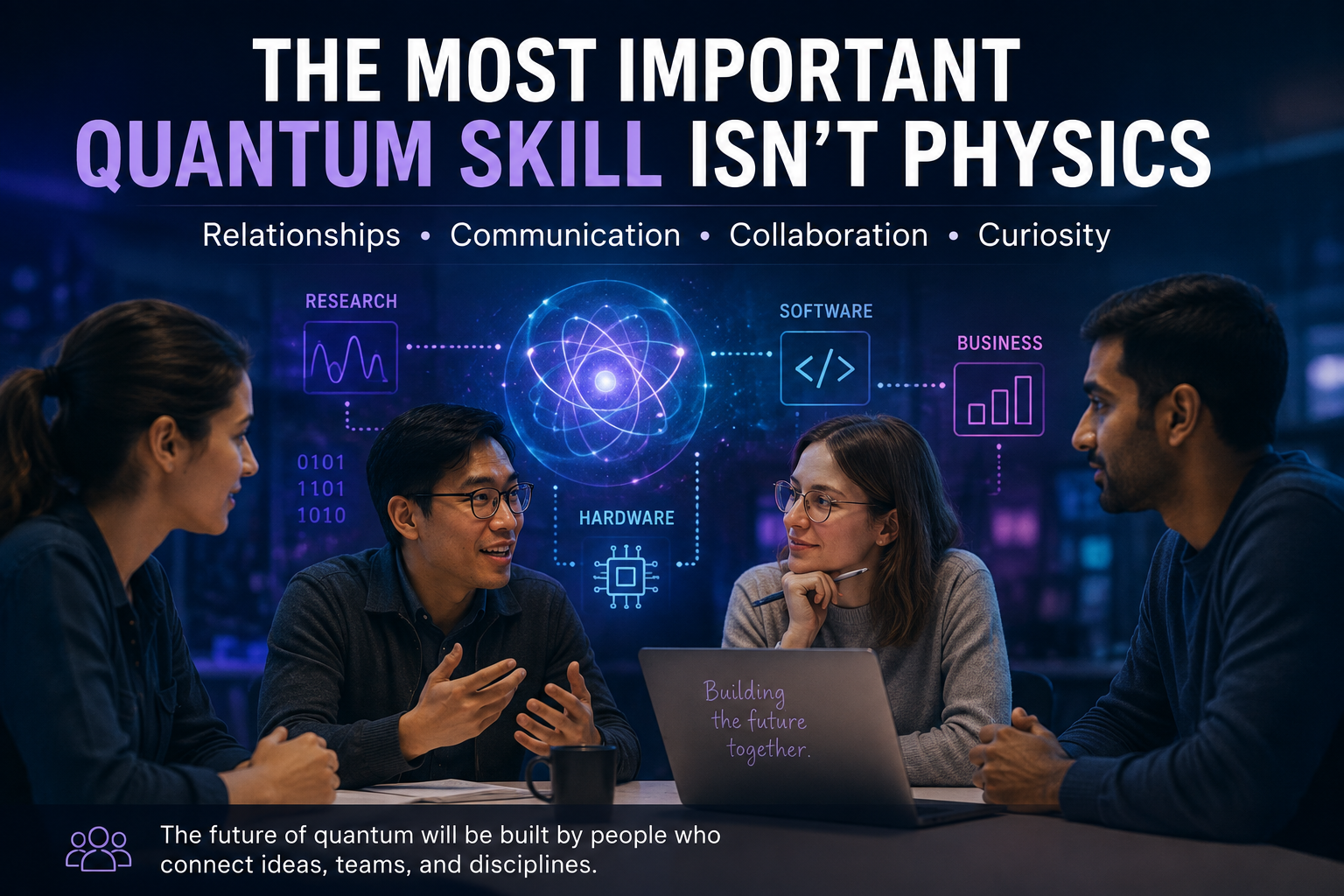
It also reshapes workforce strategy. Quantum progress does not depend solely on physicists. It depends on problem-solvers, system designers, engineers, and communicators who can bridge disciplines and integrate tools intelligently.
From Myth to Utility
Every transformative technology eventually sheds its mythology. AI did not replace human intelligence; it augmented it. Cloud computing did not eliminate on-prem systems—it reshaped access and scale.
Quantum will follow the same trajectory.
Qubit counts or headlines will not measure its success; instead, it will be measured by whether it removes friction, reduces costs, and solves problems that were previously impractical.
That future is not magical.
It is hybrid, grounded, and already taking shape.