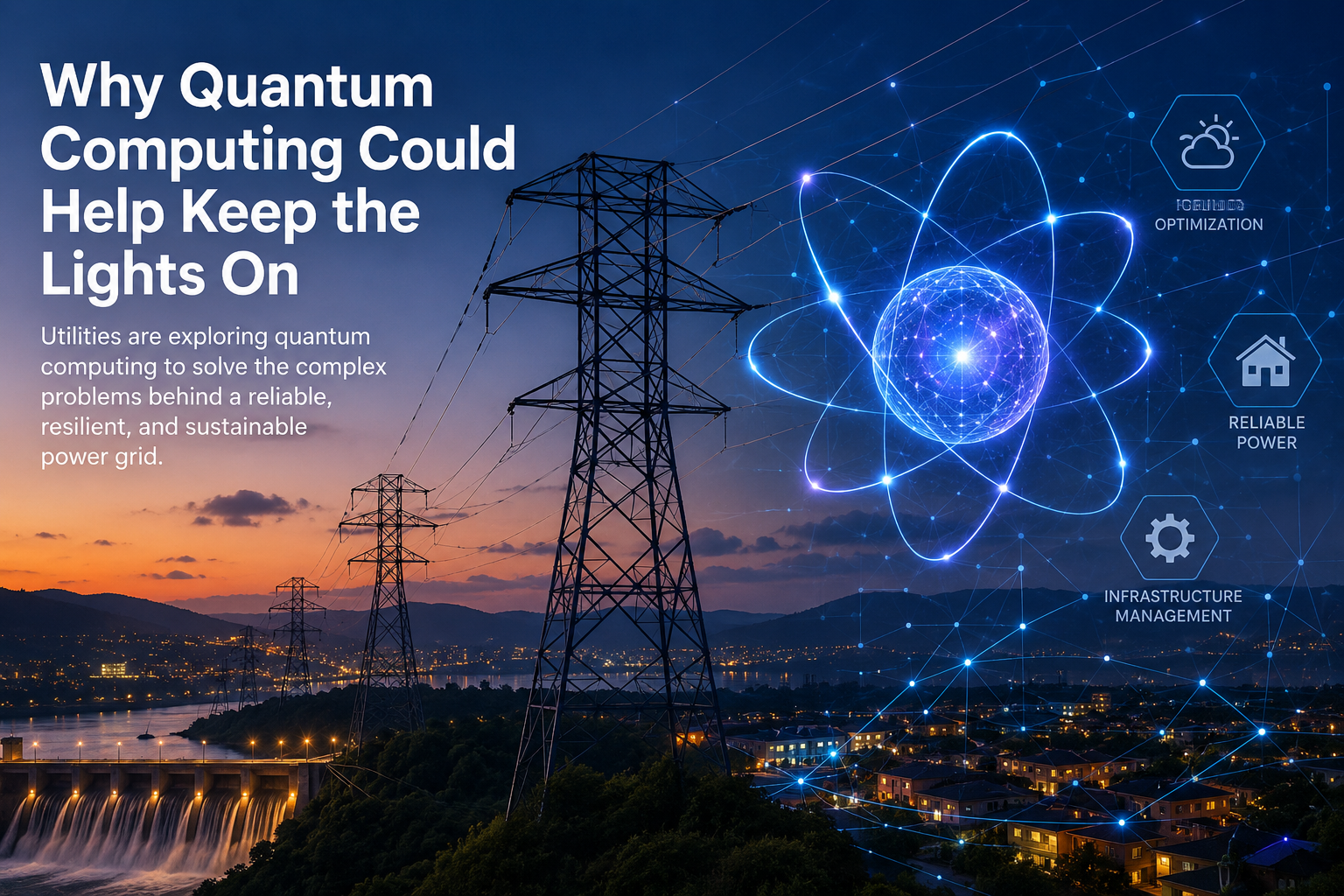
Most people associate quantum computing with breaking encryption, accelerating drug discovery, or solving abstract scientific problems that seem far removed from everyday life.
Electricity grids rarely enter the conversation. Yet one of the most compelling applications for quantum computing may be hiding in plain sight: helping utilities manage the increasingly complex challenge of delivering reliable power to millions of people. That idea came into sharp focus during a recent episode of the Impact Quantum Podcast featuring Sébastien Lussier, Quantum and HPC R&D Manager at Hydro-Québec’s Research Center.
While quantum computing often feels futuristic, the problems utilities face today are very real. Extreme weather events are becoming more common. Energy demand continues to rise. Renewable energy sources introduce new variables into grid management. Infrastructure is aging. And every decision made inside a modern electrical network affects countless others.
The challenge is no longer generating electricity; it’s about optimizing it.
A Grid Too Complex to Fully Simulate
One of the most surprising moments in the conversation came when Lussier described the scale of Hydro-Québec’s optimization challenge.
“We have some use cases where it would take right now several thousand years to simulate the whole grid from the power plant to the customer. And those kind of results, we want them within less than 10 minutes.”
That statement immediately reframes the discussion around quantum computing.
This is not about theoretical physics. It’s about decision-making.
Hydro-Québec operates one of the largest integrated energy systems in North America. Its network spans generation, transmission, distribution, and customer delivery. Every reservoir level, weather forecast, transmission constraint, maintenance schedule, and demand forecast introduces another variable into the system.
Multiply those variables across thousands of assets and millions of customers, and the optimization challenge becomes enormous. Classical computers already perform remarkable calculations. But certain optimization problems grow exponentially more difficult as complexity increases. That is where quantum computing begins to attract attention.
The Future May Be Hybrid
One misconception about quantum computing is that it will replace traditional computing. Most experts do not see it that way. Instead, the future is increasingly viewed as a hybrid environment where CPUs, GPUs, AI systems, and quantum processors work together.
Lussier described quantum not as a replacement but as another tool within a broader computational ecosystem. For organizations like Hydro-Québec, the objective is simple: find the fastest and most efficient way to solve difficult problems.
Whether the answer comes from classical high-performance computing, artificial intelligence, quantum systems, or a combination of all three is ultimately less important than achieving reliable results. That practical mindset is becoming increasingly common across industries evaluating quantum technology.
Climate Change Is Making Optimization More Important
Managing an electrical grid has never been simple. Today, climate variability adds another layer of complexity.
Utilities must prepare for droughts, floods, ice storms, heat waves, and increasingly unpredictable weather patterns. Reservoir levels fluctuate. Storms damage infrastructure. Demand spikes can emerge unexpectedly.
In Quebec, hydropower remains highly reliable, but even hydroelectric systems face difficult planning decisions. Water stored in reservoirs represents future energy. Use too much too early, and reserves may become constrained later. Hold too much and opportunities for generation may be lost.
“We’re trying to give our people the best tools they can have to see as far as they can go reliably in the future and how to manage those extreme cases.”
This is where advanced simulation becomes incredibly valuable. The more accurately utilities can model future scenarios, the better they can allocate resources, reduce waste, and maintain service reliability.
Quantum computing could eventually help process these enormous optimization problems faster than current approaches allow.
Keeping Infrastructure Healthy
Grid management extends far beyond power generation. Utilities must also maintain thousands of miles of infrastructure. Transmission lines age. Transformers deteriorate. Vegetation grows dangerously close to power lines.
Equipment failures can trigger outages affecting entire communities.
Today, Hydro-Québec is already using artificial intelligence, imaging technologies, LiDAR scanning, and predictive analytics to improve infrastructure monitoring. The goal is not simply to react when something breaks. It’s to predict failures before they happen. Future quantum sensing technologies may push these capabilities even further.
More sensitive detection systems could help utilities identify structural weaknesses, equipment degradation, or environmental risks earlier than current technologies permit. While these applications remain in development, they illustrate that quantum’s potential extends beyond computation alone.
Reliability Always Comes First
One reality often overlooked in discussions about emerging technology is that utilities cannot afford experimentation on live systems. A social media platform can tolerate occasional glitches, and a power grid cannot.
Every innovation must ultimately meet extremely high standards for reliability, safety, and resilience. That creates an interesting tension. Research teams need to move quickly. Operational teams need stability. Balancing those priorities is one of the biggest challenges facing utility innovation programs.
As Lussier explained, moving from successful research to real-world deployment often takes years because the final stages of reliability testing require enormous effort. The technology may work. The harder question is whether it can be trusted every single time.
Can Quantum Prevent Blackouts?
The honest answer is that quantum computing is not going to eliminate blackouts anytime soon. The technology is still maturing, and most utility-focused quantum applications remain in the research and testing phase. Yet focusing solely on whether quantum can prevent outages misses the bigger story. The real opportunity lies in helping utilities make smarter decisions faster in an environment that is becoming more complex every year.
Modern power grids must balance countless variables simultaneously, including weather forecasts, energy demand, transmission constraints, infrastructure maintenance, renewable energy generation, and emergency response planning. Quantum computing has the potential to process and optimize these interconnected systems at a scale that classical computers alone cannot achieve. If successful, it could help utilities improve forecasting, optimize power flows, strengthen climate resilience, and make better long-term infrastructure decisions.
The most compelling quantum applications are often not the ones that generate dramatic headlines. They are the practical solutions that improve everyday life. Keeping electricity reliable for millions of homes and businesses may not sound as exciting as breaking encryption or discovering new drugs, but it represents one of the most meaningful challenges in modern society. If quantum computing can help utilities operate more efficiently, anticipate problems sooner, and adapt to a changing climate, its impact could be felt every time someone flips a light switch and the power simply works.