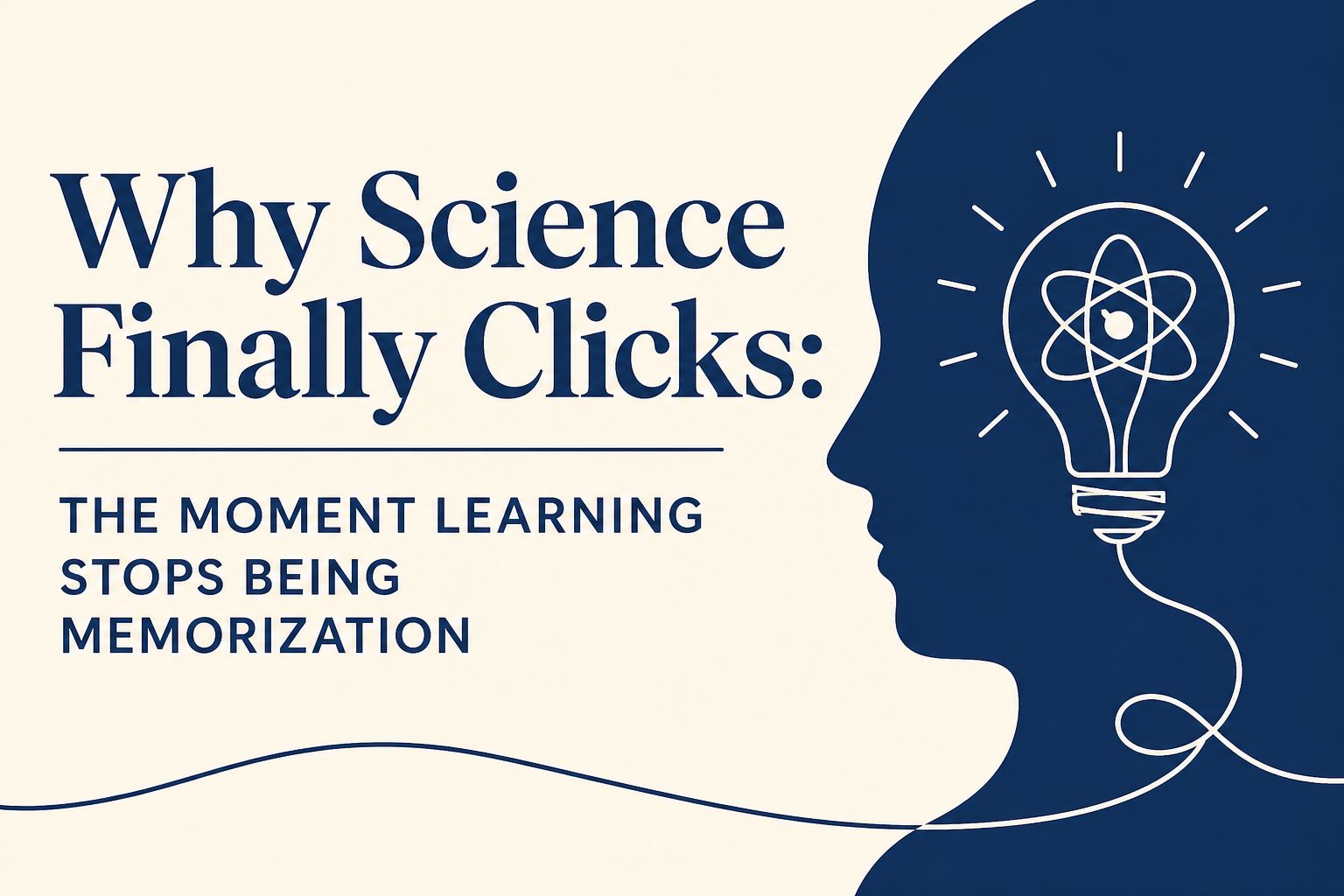
There’s a moment in learning that’s easy to miss if you’re not looking for it. Nothing dramatic happens. No breakthrough headline. No sudden declaration that this is it. It’s quieter than that. Almost internal. A shift in how something feels.
Before that moment, science can feel like a collection of instructions. A sequence of steps to follow. Formulas that sit on the page, unmoving, waiting to be applied in the “right” way. You memorize them. You repeat them. You hope they hold. And for a while, that’s enough to get by. But it isn’t enough to stay.
In a recent conversation on the Women in Quantum podcast, Bruna Shinohara described this early experience with a kind of clarity that feels familiar the second you hear it: “During high school, everything was like, ‘Wow, this is the formula, and you do something with this, but I never understood where it came from.”
There’s a distance in that kind of learning. You can follow the steps, but you’re not inside the idea. You’re orbiting it. It works just enough to move forward, but not enough to feel connected.
And then, sometimes unexpectedly, something shifts.
For Bruna, it happened when she reached university, when physics was no longer presented as something to accept but something to trace back to its origin. “The first time that someone was like, oh, this is why energy is conserved in the system… that’s when it clicks.”
That word—clicks—does more work than it seems. Because what she’s describing isn’t just understanding. It’s alignment. The moment when the structure of the concept and the structure of your thinking finally meet in the same place. When that happens, the subject stops feeling static. It starts to move.
This is the part we don’t talk about enough in quantum. We talk about complexity. About how hard it is. About how counterintuitive the concepts are. And all of that is true. But complexity isn’t what pushes people away first. Distance does. The feeling that what you’re learning is disconnected from meaning.
If quantum is introduced as a set of abstract rules without context, without narrative, without intuition, it becomes something to survive rather than something to explore. And for many people, especially those already unsure if they belong in the room, that’s where the path quietly ends. Not because they couldn’t understand it. But because no one showed them how to enter it.
There’s another line Bruna shares that lingers: “I feel like my mind is expanding.”
That’s the real signal. Not perfect comprehension. Not immediate mastery. But expansion. The sense that something is opening rather than closing in on you. It’s subtle, but it changes everything. Because once learning feels like expansion, curiosity has somewhere to go.
And curiosity, more than anything else, is what sustains people in fields like quantum.
This is where education quietly reveals its fault lines. When teaching focuses only on the what, it rewards memorization. It creates short-term success. You can pass the test. You can solve the problem set. But it doesn’t create attachment. It doesn’t give you a reason to stay when things get harder, which they always do.
Understanding the why builds something slower but more durable. It allows you to reconstruct ideas, not just recall them. It gives you a way back in when you get stuck. And maybe more importantly, it gives you a sense that the subject is not fixed. That it can be questioned. Explored. Reimagined. That it’s alive.
Quantum, in particular, asks for this kind of relationship. It isn’t as intuitive as classical systems. It doesn’t map neatly onto everyday experience. And because of that, it can feel inaccessible almost immediately. But that’s also where its appeal lives.
As Bruna describes it, what drew her in wasn’t clarity in the traditional sense; it was the opposite. The counterintuitive nature of it. The way things behave is different than expected. The way the rules shift just enough to make you pause. That pause matters. Because it invites curiosity instead of shutting it down.
There’s also something else happening here, just beneath the surface. A question that doesn’t get asked directly but sits quietly in the background: who gets to experience that moment of clarity?
If the entry point to science is built around memorization, around getting it “right” without understanding it, then only a certain type of learner will stay long enough to reach that deeper layer. The rest drift away early, often assuming the problem is them.
But what if it isn’t?
What if the issue isn’t the complexity of the subject, but the way it’s introduced? What if more people would find that moment, the one where everything shifts, if we designed learning to lead them there?
There’s a kind of generosity in teaching that goes beyond simplifying content. It’s not about making things easier. It’s about making them accessible without losing their depth. It’s about allowing someone to gradually step into an idea, to feel their way through it, to build intuition alongside knowledge.
When that happens, something changes in the learner. They stop asking, can I do this? And start asking, what else is possible here?
That shift doesn’t always look dramatic from the outside. It might be a longer pause before answering a question. A different kind of curiosity. A willingness to stay with confusion instead of immediately trying to resolve it. But internally, it’s a reorientation.
From performance to understanding. From memorization to meaning. From distance to connection.
And maybe that’s the part that stays with you. Not the formulas themselves, but the moment they stopped feeling like something you had to remember and started feeling like something you could understand.
It’s easy to overlook when it happens. But once it does, it’s hard to go back. Because you’ve seen what’s underneath.
And once you’ve seen that, you don’t just learn science differently. You relate to it differently.
There’s a moment when science stops feeling like memorization… and starts feeling like clarity. And for a lot of people, that moment is the difference between leaving and staying.
Listen to the full episode here: https://player.captivate.fm/episode/546eeb31-773c-40ab-90e4-0b750953e36e