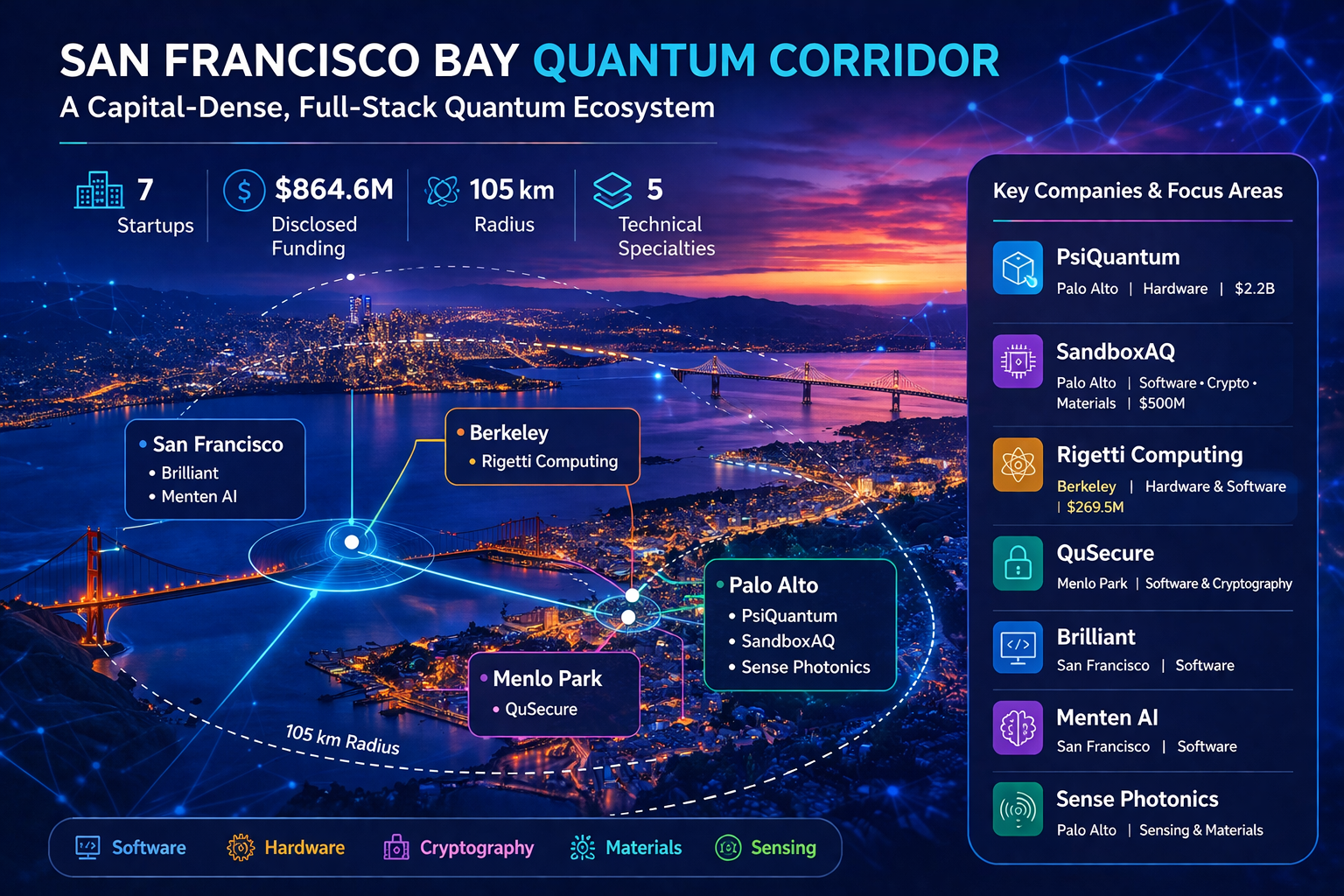
There’s a moment when you look at a map like this, and it can feel underwhelming. San Francisco highlights three companies. Three doesn’t seem like dominance or even a signal at first, just another node, another place where something’s happening, but not necessarily everything. Then the map expands slightly, not dramatically, just enough to include Palo Alto, Menlo Park, and Berkeley. And suddenly, everything shifts. It ceases to feel like just a city and begins to resemble a system.
Seven companies. That number feels different. Not because it’s big, but because of what lies beneath it. $864.6 million in disclosed funding across all seven, fully transparent. Then, almost unnoticed, two figures that skew the scale of everything else. PsiQuantum at $2.2 billion. SandboxAQ at $500 million. You don’t need to analyze them to sense what they do to the corridor. They shift the center of gravity. They make the whole region seem heavier. More committed. Like something here has already crossed a threshold, while most places are still approaching.
Visit the interactive report here.
And yet, it doesn’t collapse into a single story. That’s what’s unexpected. The Bay doesn’t focus on one direction. It contains multiple layers simultaneously. Software flows through most of the companies, quietly shaping how the ecosystem turns complexity into something usable. Hardware is still present, anchoring the system in physical reality. Cryptography and materials appear alongside it, less visible but just as vital. There’s even sensing, tucked into the edges of the map. It’s not neat. It’s not simple. But it’s complete in a way that feels intentional.
You can most clearly detect that tension in Rigetti Computing. It exists in a different stage than most of the corridor. Revenue-stage. Not just heading toward something, but already part of it. That detail changes the tone. It pulls the Bay from pure potential into active participation. It indicates that this isn’t just a place where ideas are funded. It’s a place where at least some of them are already being realized.
The corridor remains in motion around it. Five of the seven companies are still in the pilot stage. That creates a strange kind of balance—neither fully mature nor early. It’s a system learning in real time, close enough to the market to feel pressure but still flexible enough to change direction. In a place like this, where capital, enterprise access, and talent sit so close together that learning accelerates, quietly but constantly.
Companies like QuSecure and SandboxAQ expand the scope from just computation to trust. Security becomes an integral part of the story, not an afterthought. It indicates that what’s being built isn’t merely powerful; it’s designed to be used safely and reliably in systems that truly matter.
And then, at the edge, there’s Sense Photonics. Earlier stage. More uncertain. It keeps the corridor open. Prevents it from becoming too defined, too fixed. Because without that edge, systems like this can start to harden. They can lose the ability to imagine something different.
That’s what remains. Not the scale. Not even the capital. But how everything is positioned is close enough to influence everything else. Cities that blend into one another. Companies that operate across multiple layers. A system that depends not on a single strength but on how those strengths intersect.
It doesn’t feel like dominance. It feels like proximity.
And that, more than anything, is what makes it hard to ignore.