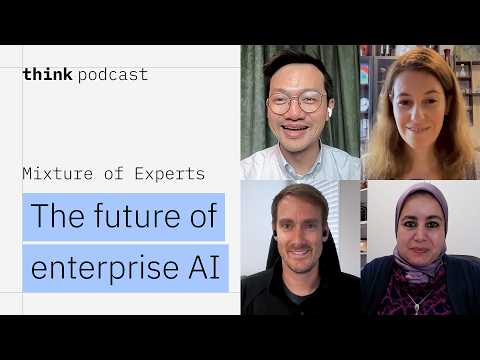
The conversation around AI’s evolution in enterprise settings is never static. Every so often, there’s an unveiling, a shift, or a breakthrough that catches attention, but beyond the spectacle often lies a nuanced narrative that deserves pause. In this week’s episode of Mixture of Experts, host Tim Hwang, alongside an insightful panel featuring Marina Danilevsky, Gabe Goodhart, Kaoutar El Maghraoui, and special guest Jamie Garcia, explores IBM Granite 4.1, IBM’s latest AI offerings, and their broader implications.
Based on content from IBM Technology
The conversation around AI’s evolution in enterprise settings is never static. Every so often, there’s an unveiling, a shift, or a breakthrough that catches attention, but beyond the spectacle often lies a nuanced narrative that deserves pause. In this week’s episode of Mixture of Experts, host Tim Hwang, alongside an insightful panel featuring Marina Danilevsky, Gabe Goodhart, Kaoutar El Maghraoui, and special guest Jamie Garcia, explores IBM Granite 4.1, IBM’s latest AI offerings, and their broader implications.
Understanding IBM Granite 4.1
IBM’s introduction of Granite 4.1 is not simply about showcasing the capacity of multimodal models, but rather about refining these models to excel in specific tasks. There is a poignant elegance to this approach, like crafting a tool forged with precision for bespoke assignments. Unlike the more generalized AI models that loom in the landscape, Granite 4.1 caters to niche requirements — enhancements in understanding tables, transcribing speech with finesse, and reading charts with superior accuracy. It represents a paradigm shift from monolithic structures to more adaptable, modular frameworks.
Marina highlights the pivot from creating models with broad applicability to those that embed deeply into organizational workflows, essentially augmenting existing agent frameworks. This stratagem speaks volumes about enterprises’ tangible needs where value often resides in detail-oriented specificity — can a model delve into the subtleties of table comprehension effectively without the frills?
The Agentic Approach with IBM Bob
IBM’s Project Bob emerges as a formidable agentic coding assistant, underscored by an innovative spirit akin to that of a masterful conductor in a bustling symphony. Bob orchestrates tasks across domains with an acuity, balancing the complex interplay of routine functions and unique challenges within enterprise ecosystems. As Tim and Kaoutar discuss, the impetus for creating such compositional systems lies in dismantling the misconception that a singular, sprawling model is the panacea for AI endeavors. Instead, they champion a more modular, interchangeable architecture that serves businesses’ practical needs.
Agents, as Gabe explains, are more than automatons; they are anchors in the operational seas of enterprise AI, caught in the push and pull between unpredictability and standardized necessity. Yet, therein lies a question of sustainability — can businesses afford the sprawling omniscience of an agent when routine tasks require precision and economy?
Optimizing AI Infrastructure
The panel further delves into Google DeepMind’s DiLoCo technology, pondering its potential to reshape how AI workloads are distributed, optimized, and consumed. The discussion hints at a future where infrastructure itself could pivot, influenced by energy consumption, scalability, and economic efficiency. The key insight here is the subtle yet critical dance between maximizing AI potential and minimizing unnecessary computational expenditures — a conversation as technical as it is philosophically resonant.
Quantum Paths with Jamie Garcia
Our journey doesnt end purely in the digital or theoretical. Jamie Garcia’s contributions steer the focus toward the burgeoning horizon of quantum computing, a domain where IBM has marked its presence boldly. As enterprises grapple with the complexities of classical computing, quantum aspirations beckon, promising exponential leaps in processing power and problem-solving capacities. Yet, it’s not without its hurdles. Jamie underscores the strategic partnerships with universities as vital conduits for innovation and education — collective bridges to a quantum advantage.
Reflections and Forward Steps
As we wrap up this week’s exploration, there’s a lingering understanding that AI’s trajectory, especially in a business context, is about careful curation and orchestration. It’s about discerning not just what can be done, but what should be prioritized, how resources should be managed, and which technological threads should be woven into the fabric of an organization’s evolving strategy.
The essential takeaway might just be a call for reflection — for enterprises to assess not only their technological ambitions but also the practical wisdom in modularity and specialization. And as they do, one might ponder: How will the compositional ecosystems we create today dictate the efficiencies of tomorrow?
For those curious about diving deeper into AI’s multifaceted world or understanding these waves of change rippling through the tech landscape, visit the full episode of Mixture of Experts. It could be a first step into a larger and more intriguing dialogue.
—