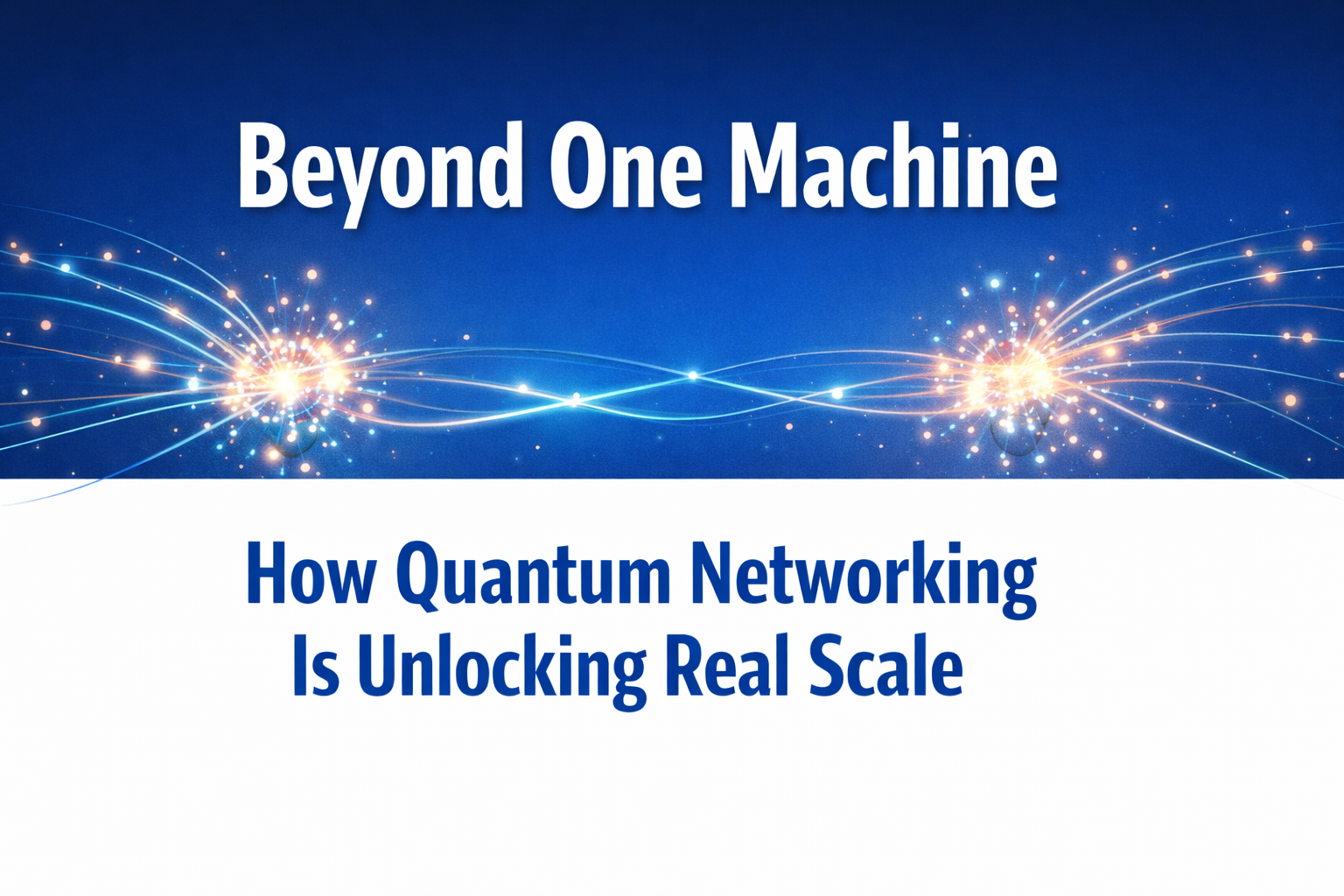
Recently, IonQ demonstrated that two separate quantum systems could be linked using photonic interconnects. Light, essentially. Photons carry fragile quantum information from one system to another.
At first glance, it sounds technical. Abstract. Another lab result in a field that often feels just out of reach.
But this one lands differently.
Because it answers a question the industry has been quietly circling for years:
What happens when quantum computers stop being alone?
To understand why this matters, it helps to think about how we’ve been approaching quantum computing up until now.
For a long time, the focus has been singular. Build one machine. Make it bigger. Add more qubits. Stabilize them. Reduce errors. Repeat.
It’s a bit like trying to build the world’s most powerful brain… in isolation.
And there’s a kind of pressure in that model. Everything has to happen inside one system. Every improvement, every breakthrough, every step forward is constrained by the physical limits of that one machine.
The wiring gets more complex. The cooling systems become more demanding. The noise starts to creep in faster than progress can keep up.
You can almost feel the tension in it.
How big can we make this thing before it becomes too fragile to hold together?
Quantum networking gently steps around that question.
Instead of forcing one machine to do everything, it asks something quieter, but far more expansive:
What if we didn’t have to?
What if, instead of one massive quantum computer, we had many smaller ones… connected?
Working together. Sharing information. Passing quantum states between them.
Not unlike how classical computing evolved.
We didn’t solve computing by building one giant computer. We built networks. Then clouds. Then entire distributed systems that span continents.
Quantum, until recently, hadn’t crossed that threshold.
It was still standing alone.
The breakthrough with photonic interconnects is what begins to change that.
Photons are uniquely suited for this role. They can travel long distances without losing their quantum properties as easily as other systems. They can carry entangled states—those delicate, almost paradoxical connections between particles—from one place to another.
So when IonQ links two systems using photons, they’re not just sending data.
They’re sending quantum information in its native form.
That distinction matters.
Because quantum information isn’t like classical bits. You can’t simply copy it, amplify it, or resend it without consequences. It has to be transferred carefully, almost like handing off something fragile between two people who both understand its weight.
And for the first time, that handoff is starting to work outside of tightly controlled, single-system environments.
There’s a shift here that feels almost philosophical.
The industry has been asking:
How do we build the most powerful quantum computer?
But networking introduces a different kind of intelligence. A distributed one.
Now the question becomes:
What happens when many quantum systems cooperate?
And that question opens doors that a single machine never could.
Imagine this in more familiar terms.
Right now, most quantum computers are like isolated labs. Powerful, yes—but contained. You bring problems to them. They process what they can. Then you take the results and leave.
But a network changes the relationship.
Now, quantum systems can specialize.
One system might be better at a certain type of calculation. Another might have higher fidelity. Another might be physically closer to a dataset or a classical system that needs to interact with it.
Instead of forcing one machine to do everything, you distribute the work.
You create a system of systems.
And suddenly, scale doesn’t just mean “more qubits in one place.” It means reach. Flexibility. Coordination.
There’s also something quietly reassuring about this direction.
Because one of the biggest challenges in quantum computing has always been fragility.
Qubits lose coherence. Errors accumulate. Systems need to be kept at temperatures colder than space itself. The margin for stability is… thin.
Trying to scale all of that inside a single machine has always felt like stacking something delicate higher and higher, hoping it doesn’t collapse under its own complexity.
Networking offers another path.
Instead of building upward, you build outward.
Smaller, more manageable systems. Connected. Redundant. Able to share the load.
It doesn’t eliminate the fragility—but it distributes it in a way that feels more… survivable.
And then there’s the idea that sits just beyond the immediate horizon: the quantum internet.
It’s easy to say the phrase and move on, but if you slow down, it carries weight.
A quantum internet wouldn’t just be a faster version of what we have now. It would operate under entirely different rules.
Information could be transmitted with built-in security based on the laws of physics. Intercepting it would disturb it. Copying it would be impossible in the traditional sense.
Entirely new forms of communication could emerge—ones that we don’t fully have language for yet.
But none of that happens without the first step.
Systems talking to each other.
What makes this moment feel real isn’t that everything is solved.
It isn’t.
The connections are still limited. The distances are still being tested. The reliability isn’t yet where it needs to be for large-scale deployment.
But the direction has changed.
And direction, in a field like this, matters almost more than speed.
Because once you know something is possible—not theoretically, but physically, experimentally possible—you start designing toward it.
Engineers begin optimizing for connection, not just isolation.
Architectures evolve.
Roadmaps shift.
There’s a subtle feeling that comes with watching a field reach this kind of moment.
It’s not excitement, exactly. Not the loud kind.
It’s more like recognition.
Like watching a puzzle piece finally settle into place—not the whole picture, but enough to see where things might go next.
Quantum computing, for years, has been about proving that individual systems can work.
Now, it’s beginning to explore what happens when they work together.
And that’s a different kind of future.
One that feels less like a single breakthrough waiting to happen…
and more like a network slowly, carefully, learning how to exist.
If you listen closely, you can almost hear it.
Not a machine powering on.
But a conversation, just beginning.