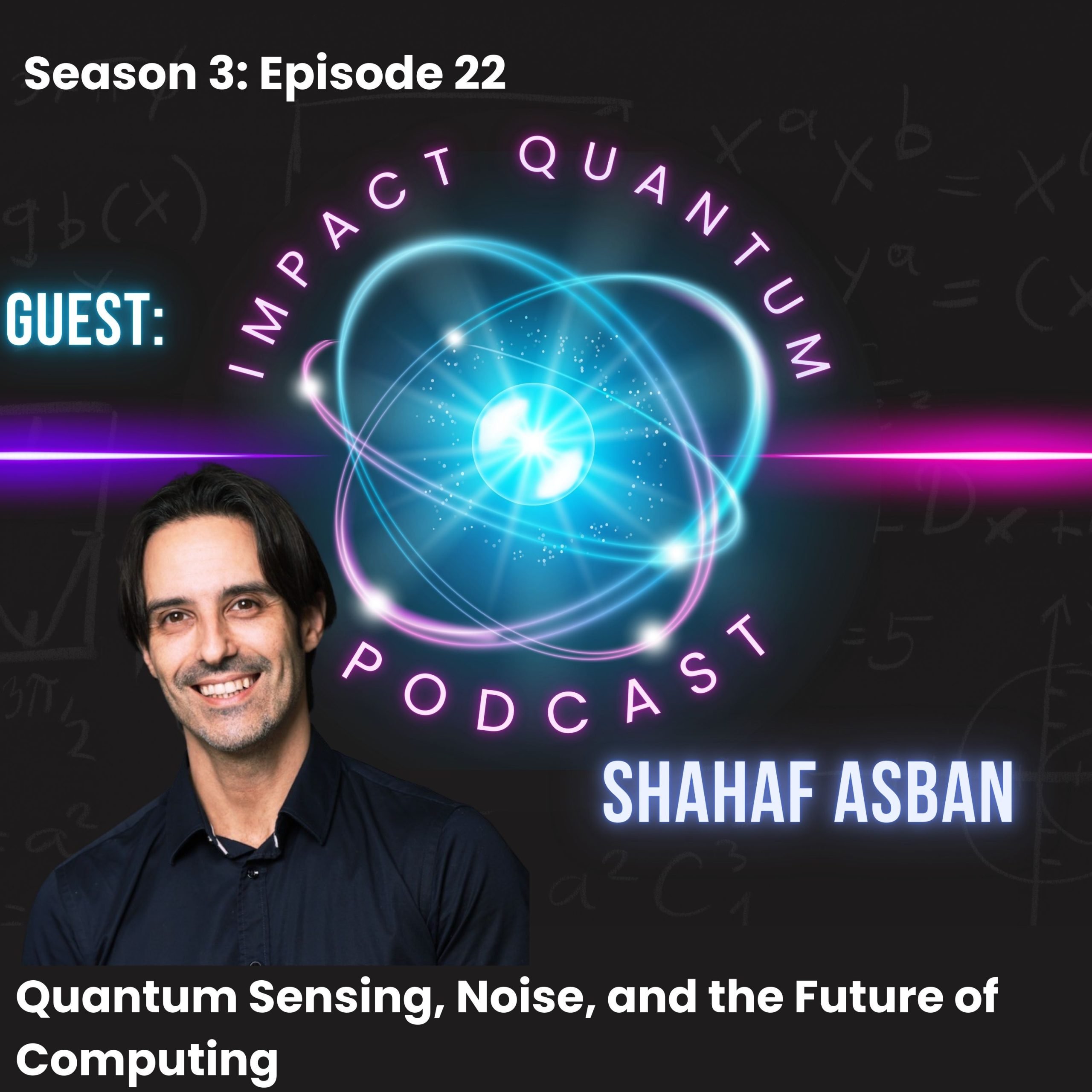
Every once in a while on Impact Quantum, a guest arrives with the kind of mind that pulls you into a new layer of understanding you didn’t even know you were missing. That was my experience speaking with Shahaf Asban, the Head of Research and Principal Scientist at Classiq. What started as a casual “let’s talk about sensing” quickly expanded into a sweeping journey through music, mathematics, open quantum systems, entanglement, noise, hardware architecture, AI, future careers, and the very real transformation quantum technology is already setting in motion.
Shahaf’s story begins far from the world of quantum mechanics. He started in music, literally recording, drumming, composing, and working inside a studio surrounded by sound. But the deeper he delved into acoustics and audio algorithms, the more he found himself drawn to electrical engineering. From there, the path curved into mathematical physics, stochastic processes, and ultimately a PhD that centered on open quantum systems and the information we extract from particles that refuse to sit quietly in equilibrium.
That winding path isn’t just interesting trivia; it’s a living example of how quantum careers are born: not from a single straight line, but from curiosity that refuses to stay in one lane.
What Quantum Sensing Actually Is, and Why It Matters
One of the first things I asked Shahaf was simple: What is quantum sensing? His explanation was the clearest I’ve ever heard.
All sensing, classical or quantum, comes down to this:
You use one system you understand very well to learn something about another system you know less.
A thermometer, for example, is a tiny device whose temperature shifts when placed in your warmer body. Your body changes the thermometer. You read the change.
Quantum sensing keeps the same logic but adds the peculiar behaviors of quantum systems, such as superposition, entanglement, and highly sensitive state changes.
Quantum sensors can be smaller, more precise, and capable of gathering information classical sensors can’t access at all. But they’re also harder to tame, more reactive, and more intertwined with the world around them than anything in classical engineering.
As Shahaf put it, quantum sensors allow us to extract more information because the “probe” itself carries quantum features that classical particles don’t.
A Physicist Who Thinks Like a Human
One of my favorite parts of the conversation was when I asked how he explains his job to non-technical people. Shahaf laughed, because the honest answer is it depends on who he’s speaking to.
But at its core, he explained that Classiq builds the “layer” that lets non-physicists write software for quantum computers. They are building the compilers and orchestration tools that sit between human programmers and the experiment-grade machines we currently call quantum processors. His job is to look two or three years into the future, anticipate what developers will need, and help build it now.
It’s both deeply scientific and convenient, a rare combination.
Connecting Quantum and AI
Shahaf also navigated the question everyone asks: What’s the connection between AI and quantum?
He broke it down beautifully:
Classical machine learning evolved from statistical algorithms developed decades ago.
These algorithms approximate functions by learning from examples and minimizing error.
Quantum algorithms are probabilistic too, but the probabilistic nature comes from physics, not from parameter refinement.
There are overlaps, especially in variational quantum algorithms, which behave a bit like ML models. But the deeper promise of quantum is not in mimicking AI approaches; it’s in enabling new types of transformations and sampling processes that classical systems will never reach.
The Big Messy Topic: Noise
If there’s one word that frustrates the industry and fascinates physicists, it’s noise.
Shahaf explained noise in quantum systems in a way that finally clicked for me:
In classical computing, you lock a transistor into a 0 or 1, and your whole job is to prevent it from flipping. Quantum systems are not only more complex to control but also inherently sensitive to factors such as temperature, crosstalk between qubits, measurement processes, and even the act of trying to entangle particles to enable meaningful computation.
You need interaction to perform quantum operations.
But interaction also introduces noise.
You cannot avoid the thing that creates the problem.
The entire field of error correction depends on reducing noise below a certain threshold. Right now, hitting that threshold is one of the industry’s most significant engineering challenges.
Where Quantum Might Touch Everyday Life
When I asked him where the impact of quantum would first be seen, he didn’t hesitate: materials science and chemistry.
Drug discovery.
Protein interactions.
New materials for energy, transportation, aerospace, and medicine.
Today, we cannot simulate most molecules directly; there are too many electrons to model without approximations. Quantum computing changes that, which in turn changes entire industries.
Busting Quantum Myths
Shahaf pointed to one misconception he wishes he could erase: the idea that all quantum tech requires giant gold chandeliers hanging in cryogenic chambers.
Yes, some systems must be cooled.
But much of quantum technology, including everyday devices, already uses quantum principles without needing extreme equipment.
He encouraged people to think of quantum computing today the way we thought of AI 30 to 40 years ago: present, promising, and rapidly improving.
The Message That Stuck With Me
Shahaf’s most important takeaway was simple and grounded: we must stay curious but realistic. Overhype can set the field back. Under-communication can leave the public confused or afraid. Transparency is essential.
Quantum is not magic.
Quantum is not tomorrow.
Quantum is progressing steadily, rigorously, and faster than many realize.
And conversations like this one make the path ahead feel clearer, more human, and a whole lot more exciting.