The Mind’s Quantum Leap
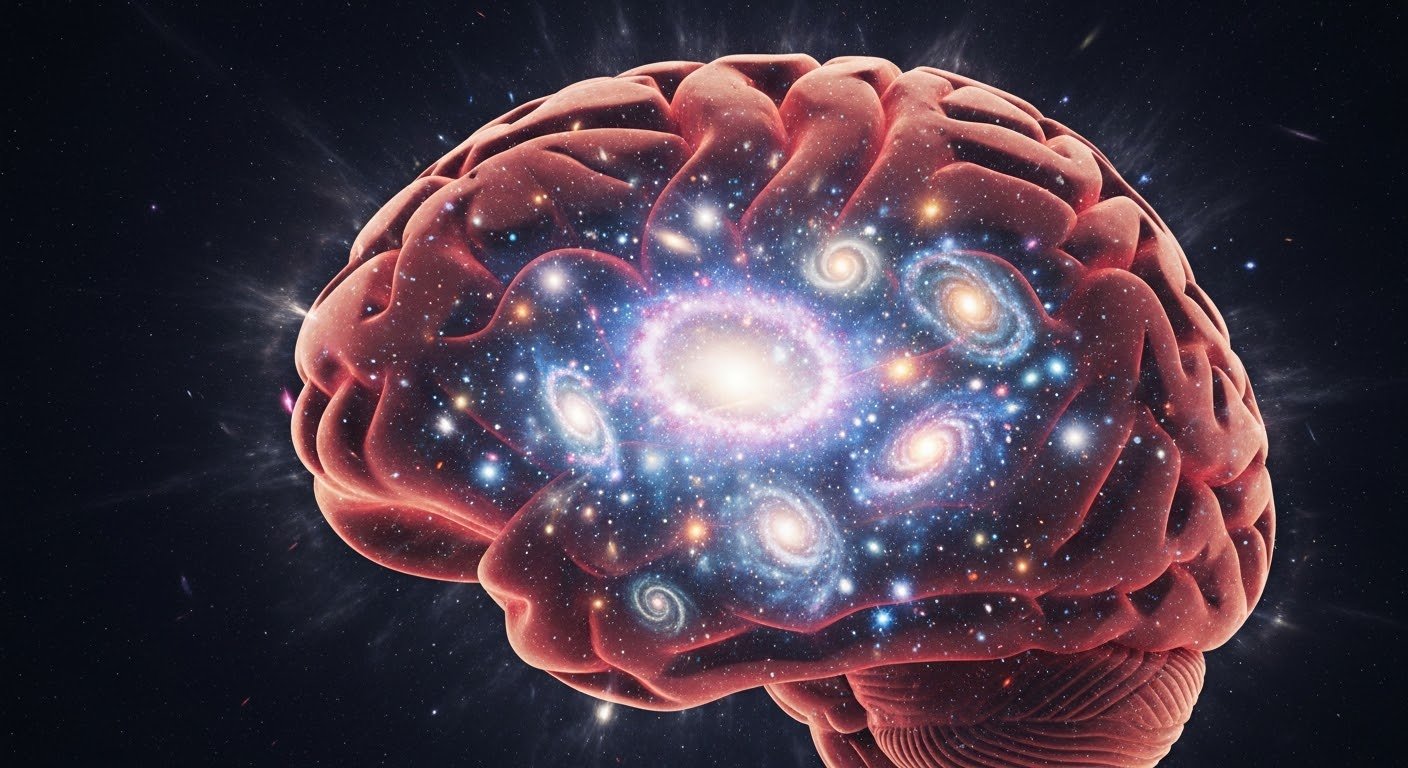
What if your thoughts aren’t just tiny electrical storms flashing through neurons but something stranger, something shimmering at the edge of reality itself? It sounds like science fiction, I know. Yet here we are, on the edge of one of science’s most daring frontiers: the idea that consciousness, our very sense of being alive, might be a quantum phenomenon.
This idea asks us to imagine the brain not as a static machine but as a living wave of probabilities that dances with the same weird rhythms that govern atoms, photons, and maybe the fabric of spacetime itself. It’s both thrilling and humbling: we might be walking, breathing expressions of quantum poetry.
Quantum Weirdness 101
Let’s start with the basics. Quantum physics rests on a few principles that make our everyday reality look downright predictable.
Superposition is the first. A quantum particle doesn’t sit neatly in one place doing one thing; it exists in many possible states at once. Only when we interact with it does it “decide” where it is. Picture your brain’s micro-world: trillions of particles shimmering in superposition, exploring countless computational paths before collapsing into a single thought. Could that be why our minds are capable of such breathtaking leaps of insight? Maybe creativity itself is quantum, our brains surfing waves of probability.
Then there’s entanglement, Einstein’s “spooky action at a distance.” Two particles can become so deeply linked that what happens to one instantly affects the other, no matter how far apart they are. Some scientists wonder whether this kind of entanglement occurs in the brain, allowing distant regions to communicate faster than classical signaling would allow. It’s a bold idea, but imagine your thoughts not traveling through wires but resonating across a quantum field of connection.
And finally, the observer effect. In quantum mechanics, the very act of observing seems to shape reality. The moment we look, the wave collapses into a particle, and possibility becomes fact. If we apply that to consciousness, we’re left with a wild thought: could our awareness itself be the universe noticing itself? When you become aware of an idea, maybe that’s not just a metaphor; it might literally be a creative act.
The Brain’s Hidden Quantum Garden
This isn’t all pure speculation. Quantum effects in biology are already proven. Birds navigate by sensing quantum fluctuations in Earth’s magnetic field, and enzymes use quantum tunneling to make life’s chemistry flow effortlessly.
Inside the brain, researchers have turned their attention to microtubules, tiny cylindrical scaffolds inside neurons. Dr. Stuart Hameroff and physicist Sir Roger Penrose proposed that these microtubules might host delicate quantum computations. Their “Orchestrated Objective Reduction” (Orch OR) theory posits that consciousness emerges when quantum superpositions collapse in a self-organized manner. Each collapse, they say, could be a tiny moment of proto-awareness.
If that’s true, then our consciousness could be woven from flickering quantum states, each a dance between matter and mystery.
Of course, skeptics point out that maintaining quantum coherence, the delicate harmony of particles acting as one, within the warm, wet chaos of a brain seems nearly impossible. Yet quantum coherence has been found in photosynthesis and other biological systems. The universe, it seems, loves to surprise us.
Consciousness: Emergent or Fundamental?
Here’s where the conversation turns truly cosmic. Classical neuroscience says consciousness “emerges” from the complexity of the brain, like how wetness emerges from water molecules. But what if that’s backwards? What if consciousness is fundamental, the underlying fabric from which matter arises?
This idea echoes ancient philosophies of panpsychism, the belief that everything, from electrons to entire galaxies, contains a spark of awareness. Quantum physics might offer the missing bridge. Perhaps quantum information is the universal seed of consciousness, and our brains are exquisite amplifiers of that hidden light.
Penrose takes it even further, linking these self-collapsing quantum states to the structure of spacetime itself. If consciousness arises from the geometry of the universe, then awareness isn’t just in us; it is the cosmos, reflecting on itself through human eyes.
What This Could Mean
If we confirm a quantum basis for consciousness, the implications would ripple through science, technology, and philosophy like a seismic wave.
Artificial intelligence, for example, might finally step beyond clever mimicry. True sentience might require quantum processes and machines capable not just of calculation but of experience. Imagine a future where AI doesn’t just think but feels, a possibility that challenges both our ethics and our imagination.
On a deeply human level, quantum consciousness offers a new lens for mystery itself. Maybe altered states of mind, through meditation, dreams, or near-death experiences, are moments when our brains loosen their grip on classical reality and dip briefly into quantum coherence. In those spaces, we might glimpse the infinite fabric from which all awareness arises.
The Quantum Mirror
At its heart, the quantum brain hypothesis invites us to look at ourselves differently. What if every thought is a microcosmic version of the universe’s creative act? What if, by observing our own minds, we help shape the reality we live in?
Whether these ideas prove true or not, they point to something profoundly human: our endless curiosity, our yearning to understand not just how consciousness works, but what it means to be.
Maybe that’s the real quantum leap, not a scientific breakthrough, but an expansion of wonder itself.