Have you ever found yourself tangled in the seemingly obscure world of quantum physics, grappling with its enigmatic principles that defy our everyday experiences? Well, you’re not alone. The realm of quantum physics is littered with myths and misunderstandings that can puzzle even the sharpest minds. It’s like trying to understand the inner workings of a futuristic engine while only being familiar with classic car repair.
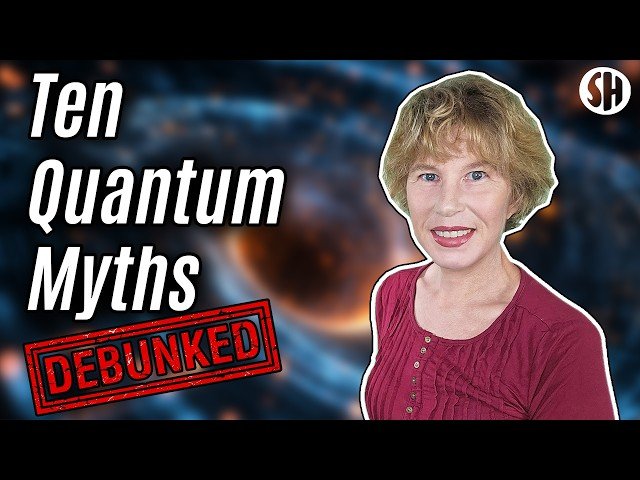
This video is from Sabine Hossenfelder.
Today, I’ll unpack ten of these myths and shed some light on the mysterious yet fascinating world of quantum physics. Let’s dive deep into these quantum quandaries and explore the real from the surreal.
1. Quantum Physics Means Discreetness: It’s easy to think that quantum mechanics locks everything into neat, discrete packages. Electrons orbit nuclei in discrete energy levels, and light is absorbed and emitted in quanta. This might mislead some to believe all quantum properties are discreet. However, when electrons aren’t bound to a nucleus, such as those freely moving through a wire, their positions can be continuous. Light, composed of photons, also supports this continuous interplay as photons can assume any energy.
2. Quantum Physics Proves Parallel Universes Exist: This is a particularly sticky myth popularized by interpretations like those by David Deutsch, suggesting that quantum computers wield their computational power through operations in multiple universes. Although the many-worlds interpretation of quantum mechanics suggests every quantum event is a branching of the universe, this remains a mathematical interpretation, not an empirically proven fact.
3. Quantum Physics Implies Randomness defines Nature: Indeed, quantum physics introduces inherent randomness in processes such as particle decay, demonstrating unpredictable outcomes. However, claiming nature itself is fundamentally unpredictable strays into philosophical terrain, as it remains an unanswered and possibly unanswerable question.
4. Einstein Rejected Quantum Physics: The famous phrase “spooky action at a distance” wasn’t a dismissal but an expression of Einstein’s discomfort with quantum states affecting each other instantly over distance, which he found counterintuitive. Einstein’s critiques were more about quantum mechanics’ completeness rather than its core principles.
5. Quantum Entanglement Is Faster Than Light: Here’s where language plays tricks on us. Entanglement—a phenomenon where particles become interconnected so that the state of one (no matter the distance) instantly correlates with the state of another—doesn’t transmit information faster than light, thus not violating relativity.
6. We Can’t Quantize Gravity: The traditional theories of quantum mechanics break down when dealing with extreme conditions such as those inside black holes. While scientists have been working on quantum theories of gravity since the 1960s, none has yet been universally accepted. This shows the theories aren’t complete rather than entirely unworkable.
7. Superpositions Are Strange: This may sound exotic, saying objects can be in multiple states simultaneously, like Schrödinger’s proverbial cat, which is alive and dead at the same time. However, this is a fundamental feature of quantum systems—although hard to align with everyday experiences, in quantum mechanics, it’s a basic operation.
8. Superpositions and Entanglement Are The Same: Although related, these aren’t interchangeable. Superposition refers to states being a sum of possibilities, whereas entanglement involves a correlation between these states across particles.
9. Quantum Physics Is Only for the Microscopic: This is a scale issue. While the quirkiest quantum effects are most noticeable at tiny scales, quantum phenomena occur in everything everywhere. The difficulty lies in detecting such effects in larger, warmer systems.
10. Consciousness Influences Quantum Outcomes: Early quantum theorists pondered if the observer’s mind influenced quantum experiments—a concept appealing in its mystique but unsupported by evidence. Today, while consciousness is still not well understood, it’s agreed that it doesn’t affect quantum mechanics.
Quantum physics, with all its complexities and counterintuitive nature, invites not only fascination but also a lot of myths. Understanding these helps demystify the vast landscape of physics and brings us closer to grasping the underlying principles of our universe. Whether you’re a curious learner or an aspiring physicist, diving deeper into this knowledge, much like using a platform like Brilliant.org, equips you to further unravel the mysteries sewn into the framework of reality.