For years, fault-tolerant quantum computing has lived in an uncomfortable space between theoretical brilliance and brutal engineering reality. Researchers have demonstrated increasingly sophisticated algorithms capable of transforming chemistry, materials science, logistics, cryptography, and machine learning. Yet one stubborn problem continues to haunt the industry:
The hardware cost of actually running them.
Quantum systems are extraordinarily resource-hungry. Even seemingly modest computations can require millions — sometimes billions — of fault-tolerant operations once error correction enters the picture. And buried deep inside many of those computations sits a particularly notorious bottleneck:
The Toffoli gate.
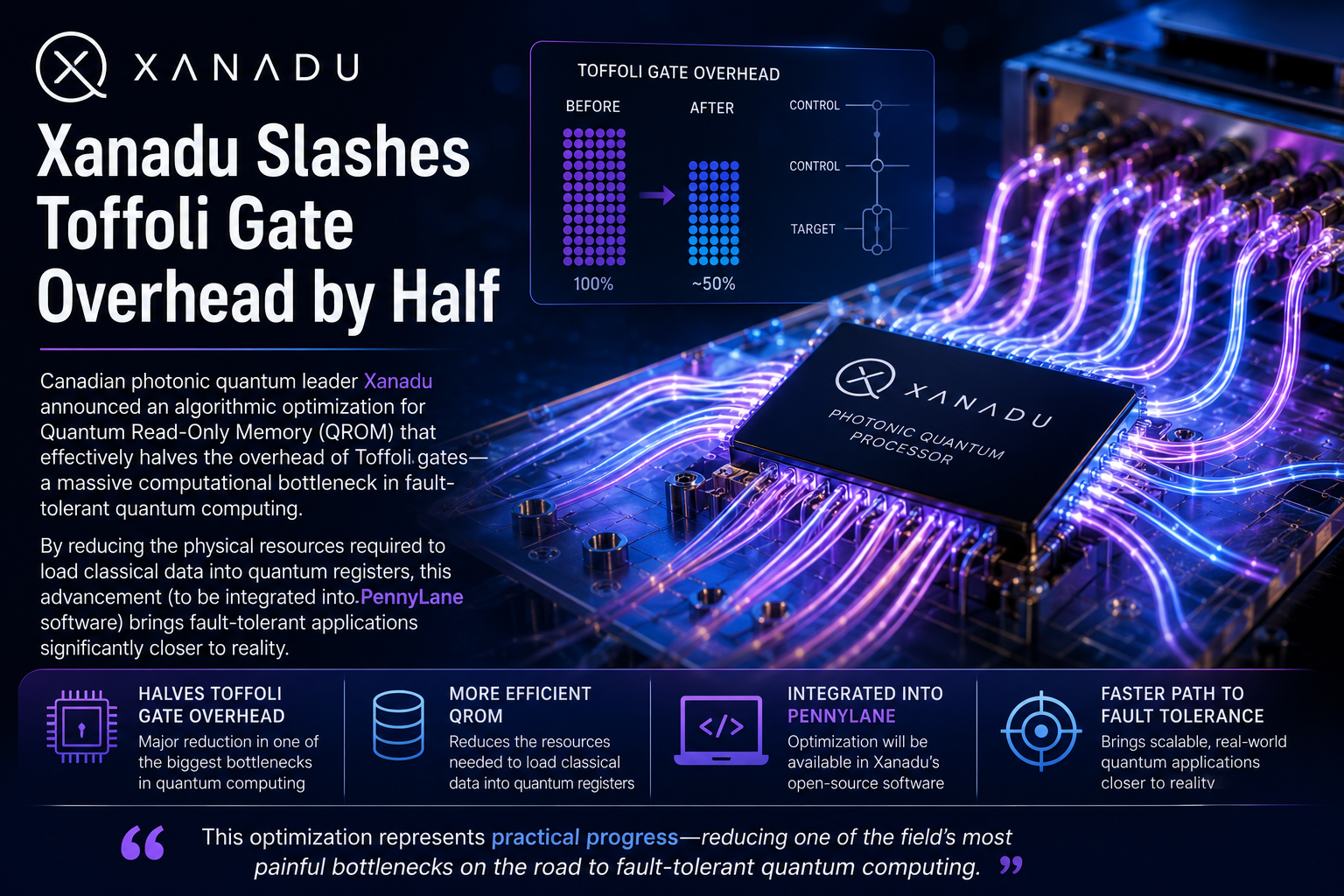
This week, Canadian photonic quantum computing company Xanadu announced a major algorithmic optimization targeting that exact problem. The company revealed a new approach for Quantum Read-Only Memory (QROM) that effectively cuts Toffoli gate overhead roughly in half — a breakthrough that could significantly reduce the physical resources needed for large-scale fault-tolerant quantum applications.
And while the announcement may sound deeply technical on the surface, its implications are surprisingly practical.
Because in quantum computing, reducing overhead is not a minor optimization.
It is survival.
The Hidden Cost of Quantum Computation
One of the biggest misconceptions surrounding quantum computing is that the primary challenge is simply building more qubits.
In reality, raw qubit counts are only part of the story.
The much harder challenge is maintaining stable, error-corrected computations long enough to perform meaningful work. Quantum systems are incredibly fragile. Environmental noise, thermal fluctuations, and microscopic imperfections can all introduce errors into calculations almost instantly.
That is why fault tolerance matters so much.
Fault-tolerant quantum computing uses layers of error correction to protect information during computation. But this protection comes at an enormous cost. A single “logical qubit” — the stable computational unit researchers actually want to use — may require thousands or even millions of physical qubits underneath it.
And then there is the gate overhead.
Certain quantum operations are vastly more expensive than others, especially when translated into fault-tolerant architectures. Among the most resource-intensive are Toffoli gates, a three-qubit logical operation commonly used in arithmetic, optimization, chemistry simulations, and data-loading routines.
The problem is that modern quantum algorithms often require staggering numbers of them.
In some cases, Toffoli gates dominate the total computational cost of an entire application.
Which means reducing them even modestly can have enormous downstream effects.
Cut them in half, and suddenly hardware requirements, runtime estimates, and energy demands all begin shifting in meaningful ways.
That is exactly why Xanadu’s announcement matters.
Why QROM Became a Problem
At the center of this breakthrough is Quantum Read-Only Memory, or QROM.
QROM is essentially the mechanism quantum computers use to load classical data into quantum registers during computation. And despite sounding relatively straightforward, this process becomes incredibly expensive at scale.
Large quantum algorithms — especially those involving chemistry simulation, machine learning, and optimization — rely heavily on repeatedly accessing structured datasets during calculations.
Every one of those data-loading operations carries computational overhead.
And much of that overhead comes from Toffoli gates.
Historically, QROM implementations have been surprisingly inefficient, consuming enormous numbers of fault-tolerant operations simply to move classical information into usable quantum states.
It is one of those deeply unglamorous engineering realities that rarely makes headlines but quietly determines whether large-scale applications become feasible.
Xanadu’s optimization attacks this problem directly.
The company developed an algorithmic approach that reduces the number of required Toffoli gates by approximately 50 percent during QROM operations. That reduction dramatically improves resource efficiency across a wide range of fault-tolerant algorithms.
And importantly, this is not just theoretical math sitting in a research paper.
The optimization is expected to be integrated into Xanadu’s open-source quantum software framework, PennyLane, making the advancement accessible to researchers and developers building quantum applications.
That accessibility may ultimately matter as much as the optimization itself.
The Industry Is Entering the Efficiency Era
Quantum computing spent much of the last decade focused on scale.
More qubits.
Larger processors.
Bigger demonstrations.
But the industry is now entering a different phase — one increasingly defined by efficiency.
Researchers are realizing that fault-tolerant quantum computing cannot rely solely on brute-force hardware expansion. The resource requirements are simply too extreme.
Every optimization matters.
Every reduction in overhead compounds across entire systems.
And increasingly, the companies making meaningful progress are not just improving hardware. They are improving the computational architecture surrounding it.
This is where Xanadu has carved out a particularly interesting position within the industry.
Unlike many quantum firms pursuing superconducting architectures, Xanadu focuses on photonic quantum computing — systems that use particles of light rather than electrical circuits to perform computations.
Photonic systems offer several potential advantages, including room-temperature operation, networking flexibility, and compatibility with existing fiber-optic infrastructure. But like every quantum architecture, they also face scaling challenges.
Which is why software-level optimizations become so important.
In many ways, this announcement reflects a broader shift happening across quantum computing:
The realization that algorithmic engineering may become just as important as hardware engineering.
Because ultimately, fault-tolerant quantum computing is not a single breakthrough.
It is the accumulation of thousands of smaller efficiencies stacked together over time.
Infrastructure, Not Just Innovation
There is also something strategically important about where this work is happening.
Canada has quietly become one of the world’s most influential quantum ecosystems, supported by strong university research, government investment, and a growing cluster of quantum startups. Companies like Xanadu are helping position the country as a meaningful player in the global race toward fault-tolerant systems.
And that race is becoming increasingly geopolitical.
Quantum computing is no longer viewed as a purely academic pursuit. Governments now see it as strategic infrastructure tied to economic competitiveness, cybersecurity, pharmaceutical discovery, advanced manufacturing, and national security.
Which means breakthroughs that reduce computational cost carry implications far beyond research labs.
Lower overhead means lower barriers to experimentation.
Lower barriers accelerate adoption.
And adoption is what ultimately transforms emerging technologies into industries.
That may be the most important part of this announcement.
Not that Xanadu solved fault tolerance overnight.
They did not.
The industry still faces enormous challenges involving qubit stability, error correction, manufacturing scale, cryogenics, networking, and computational reliability.
But this optimization represents something increasingly valuable in quantum computing:
Practical progress.
Not hype.
Not inflated timelines.
Not vague promises about revolutionary disruption.
Just a meaningful reduction in one of the field’s most painful bottlenecks.
And historically, industries are rarely transformed by one singular breakthrough.
They advance through infrastructure improvements that quietly make the impossible slightly more achievable.
That is what this feels like.
Not the arrival of fault-tolerant quantum computing itself.
But another important piece of the road leading toward it.