For years, quantum computing existed in public conversation like a creature from folklore.
Every headline sounded cinematic.
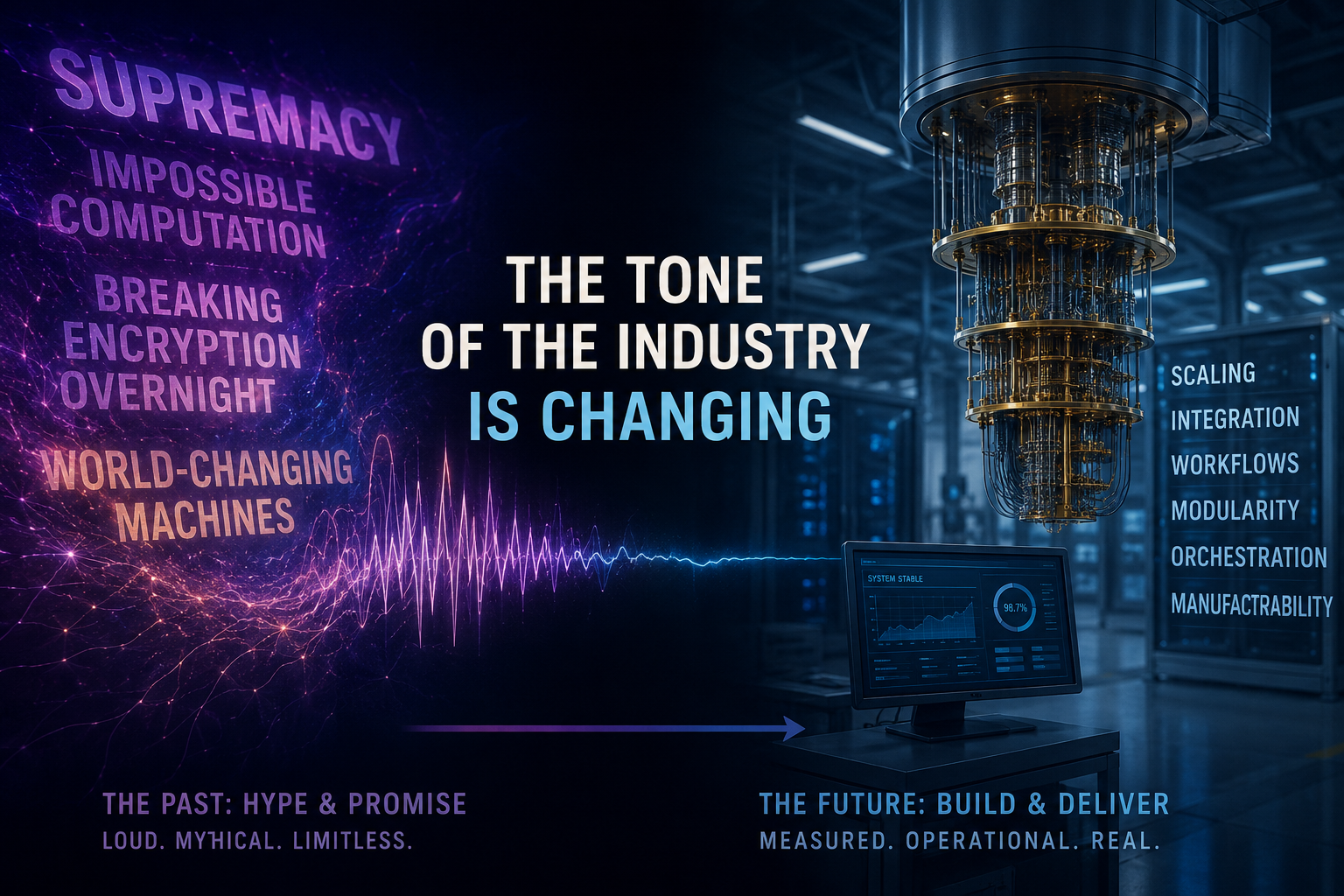
Quantum supremacy.
Impossible computation.
Machines that could crack encryption overnight.
A technological leap so dramatic it would redraw the boundaries of civilization in a single stroke.
The language was enormous because the expectations were enormous.
And for a while, that made sense.
Early quantum breakthroughs were genuinely strange. Researchers were demonstrating behaviors that felt detached from ordinary engineering logic. Qubits could exist in superposition. Entanglement created correlations that sounded closer to philosophy than hardware design. Even experienced scientists sometimes struggled to explain the systems without reaching for metaphors involving parallel universes or probability ghosts.
The industry learned quickly that mystery attracts attention.
So quantum companies, investors, media outlets, and governments all leaned into the mythology. The narrative became less about engineering timelines and more about destiny. Quantum was framed as an inevitable technological event, something immense, disruptive, and almost supernatural.
But something has shifted recently.
Not just in the technology.
In the tone.
And that change may matter more than people realize.
Over the past year, the vocabulary surrounding quantum computing has begun to sound noticeably different. The dramatic language has not disappeared completely, but it no longer dominates the conversation the way it once did.
Instead, another set of words keeps surfacing:
Scaling.
Integration.
Workflows.
Modularity.
Manufacturability.
Error mitigation.
Orchestration.
Infrastructure.
Those are not the words of mythology.
Those are the words of operations teams.
And that is usually what happens when a technology starts inching toward reality.
The loud phase fades first.
Then comes the difficult part: building systems people can actually use.
You can feel this transition almost everywhere in the industry now. Quantum announcements increasingly sound like discussions you might hear inside mature enterprise software companies or semiconductor firms. Teams are talking about supply chains, cryogenic engineering, fabrication consistency, interoperability, and deployment environments.
That may sound less exciting to outsiders.
But it is often the clearest sign that a field is growing up.
Real technologies eventually leave the theater phase.
At first, every emerging industry survives on spectacle. Spectacle attracts funding. It attracts talent. It attracts political momentum and media attention. Big promises act like ignition fuel.
Artificial intelligence experienced the same pattern. So did commercial spaceflight. So did the internet itself.
The early years are driven by imagination.
The later years are driven by systems.
And systems are quieter.
There is something psychologically important happening here that extends beyond vocabulary. The industry seems increasingly aware that credibility matters more now than hype.
That awareness changes how people speak.
A few years ago, quantum conversations often carried an undertone of inevitability, as though practical quantum advantage was simply waiting for enough processing power to arrive. Today, the messaging feels more disciplined. Companies are more willing to discuss limitations openly. Researchers speak more carefully about timelines. Investors ask harder questions about pathways to commercialization rather than accepting broad declarations of transformational potential.
This is not pessimism.
It is maturation.
The difference matters.
Immature industries tend to optimize for attention. Mature industries optimize for reliability.
And reliability is not glamorous.
Nobody writes breathless headlines about calibration stability or error correction layers. No one rushes to social media because a hardware platform has improved manufacturability by 12%. But those are exactly the kinds of developments that determine whether a technology survives contact with the real world.
Reality has very little interest in mythology.
Reality asks different questions.
Can the system run consistently?
Can it integrate with existing infrastructure?
Can developers actually build around it?
Can enterprises maintain it?
Can it scale economically?
Can it operate outside carefully controlled demonstrations?
Those questions are less cinematic than “Will quantum computers change humanity?”
But they are far more useful.
The emotional atmosphere surrounding quantum is changing because the industry is slowly transitioning from theoretical possibility into operational responsibility.
That transition is uncomfortable.
The mythology era allows ambiguity to remain intact. During that phase, almost every challenge can be deferred into the future. Limitations feel temporary. Timelines remain flexible. Expectations expand faster than accountability.
Operational phases are different.
Suddenly, engineering constraints become visible. Bottlenecks emerge. Integration problems multiply. Talent shortages matter. Hardware roadmaps become painfully specific. Companies must explain not just what quantum systems might someday accomplish, but how customers will interact with them in practice.
This is where many technologies stumble.
Not because the science fails.
Because operational complexity arrives all at once.
In quantum computing, that complexity is enormous. The field is attempting to coordinate advances across hardware physics, cryogenics, materials science, software tooling, networking, manufacturing, algorithms, and cloud infrastructure simultaneously.
That is not a single breakthrough problem.
It is a systems engineering problem.
And systems engineering changes the emotional texture of an industry.
The atmosphere becomes more practical. Less theatrical. More interdisciplinary. Teams spend less time describing abstract future outcomes and more time solving coordination challenges between imperfect components.
Ironically, this quieter phase may be the most important period quantum computing has experienced so far.
Because this is the phase where industries either become durable or drift into permanent experimentation.
You can already see signs of durability beginning to appear.
Partnerships increasingly focus on integration rather than symbolism. Governments are discussing workforce development and infrastructure readiness. Enterprises are testing hybrid workflows instead of waiting for magical standalone quantum machines. Hardware companies are designing modular architectures because they understand scalability cannot depend on fragile laboratory customization forever.
Even the language around “quantum advantage” has become more nuanced. There is growing recognition that useful quantum systems may emerge gradually through highly specialized applications rather than through one dramatic overnight transformation.
That perspective feels less cinematic.
But probably more honest.
Technological progress is rarely a clean moment of arrival.
Usually, it looks messy.
It arrives in fragments. In workflow improvements. In narrow industrial use cases. In backend systems most people never notice. Entire industries often change quietly before the public realizes change has already happened.
The internet did not suddenly appear fully formed in a single cultural moment. Neither did cloud computing. Neither did machine learning.
Quantum may follow a similar path.
Not a thunderclap.
A slow integration into the fabric of existing systems.
And perhaps that is why the industry’s tone matters so much right now.
Language reveals psychological positioning. It reveals whether an industry sees itself as speculative theater or operational infrastructure.
At the moment, quantum increasingly sounds like infrastructure.
That does not mean the ambition has disappeared. If anything, the long-term implications remain staggering. But the center of gravity is shifting away from abstract futurism and toward implementation.
Toward deployment.
Toward manufacturable systems.
Toward software stacks, orchestration layers, and engineering discipline.
In other words: toward reality.
And reality tends to have a different voice.
Less mythological.
More methodical.
Less obsessed with spectacle.
More concerned with whether the machine can survive outside the lab.
For people watching the industry closely, that tonal shift may be one of the strongest signals yet that quantum computing is entering a new phase — not the end of the story, but the beginning of a far more demanding chapter.
The chapter where the hard part starts.
Building something the world can actually use.