If you’ve ever been curious about quantum computing but held back for one reason…
“I’m too late.”
You’re not alone.
Many people discover quantum after studying something else. After building careers in software, finance, policy, education, or business. After choosing “practical” paths. After thinking deep tech was only for physicists.
By the time they start paying attention, the headlines are everywhere. Governments are investing billions. Startups are scaling. Universities are launching programs. Tech giants are hiring.
It feels like the train has already left the station.
In her conversation on Women in Quantum, quantum security professional Devika Mehra offers a powerful counterpoint: being “late” to quantum is largely a myth.
What matters isn’t when you arrive.
It’s how you learn once you do.
The False Pressure to Know Everything
Quantum has a reputation problem.
It’s often presented as impossibly complex. Full of equations, jargon, and abstract theory. Surrounded by gatekeeping language that makes newcomers feel unqualified before they even begin.
So when people arrive late, they assume everyone else knows more.
They don’t.
Even people with advanced degrees continue to learn. The field is evolving so rapidly that no one has mastered it. New hardware, algorithms, standards, and applications appear constantly.
Devika is candid about this reality: even after completing her master’s degree, there are many things she doesn’t know.
That’s not failure.
That’s the nature of frontier science.
The T-Shaped Learning Model
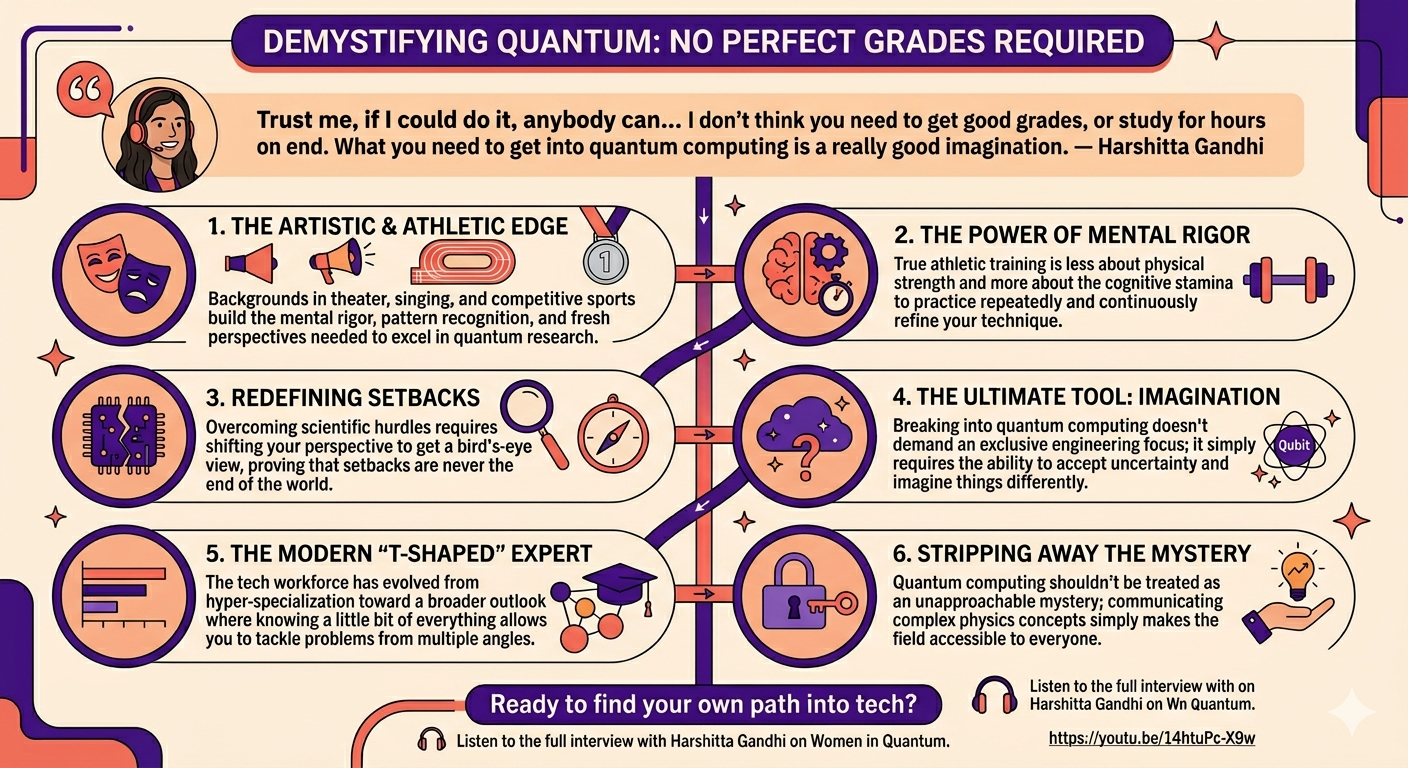
One of the most practical ideas Devika shares is the “T-shaped” learning model.
Imagine the letter T.
The horizontal bar represents breadth.
The vertical line represents depth.
In quantum, the top of the T is your broad exposure. You learn a little about hardware, software, algorithms, cryptography, chemistry, policy, and applications. You don’t master everything. You familiarize yourself.
You explore.
You listen.
You read.
You observe.
This stage isn’t about expertise. It’s about orientation.
It helps you answer one critical question:
Where do I belong in this ecosystem?
Breadth Before Depth
Too many beginners try to go deep too fast.
They sign up for advanced physics lectures. They download dense research papers. They enroll in highly technical courses without foundations.
Then they feel overwhelmed.
Discouraged.
Lost.
Devika advises the opposite.
Start with the basics.
Build comfort with foundational math. Learn high-level concepts. Listen to accessible talks. Read simplified explanations. Follow people who translate complexity.
Mix beginner content with aspirational content.
Some things will make sense immediately.
Some won’t.
That’s okay.
Every exposure plants a seed.
Over time, those seeds connect.
Understanding accumulates quietly.
Choosing Your Lane
Once you’ve explored broadly, patterns emerge.
Maybe you’re fascinated by security.
Maybe chemistry applications excite you.
Maybe you care about policy and ethics.
Maybe hardware draws you in.
Maybe software and algorithms feel natural.
This is where the vertical line of the T forms.
You choose a lane.
Not because it’s trendy.
Because it resonates.
Quantum isn’t one career path. It’s an ecosystem.
You don’t need to become a physicist to contribute. You can be a developer, educator, marketer, strategist, analyst, policy advisor, or entrepreneur.
There is room.
The key is depth with intention.
Go deep where you’re motivated to persist.
Why “Late” Starters Often Thrive
Ironically, people who enter quantum later often have advantages.
They bring transferable skills.
Software engineers understand systems.
Finance professionals understand risk.
Educators understand communication.
Marketers understand storytelling.
Policy experts understand governance.
Quantum needs all of them.
Latecomers also tend to be more intentional. They aren’t drifting into the field. They’re choosing it.
That choice fuels discipline.
It sustains motivation.
It carries people through difficult learning curves.
Devika’s own journey reflects this. She didn’t enter quantum at the beginning of her education. She built professional experience first. Then pivoted. Then specialized.
Her prior experience didn’t slow her down.
It strengthened her.
Letting Go of the Race Mentality
One of the most harmful myths in tech is that careers are races.
Who started earliest?
Who published first?
Who raised the most funding?
Who got hired the youngest?
Quantum doesn’t work that way.
It’s a long game.
Infrastructure, standards, education, and applications are still forming. This field will evolve for decades.
You are not competing with a clock.
You are building a path.
Devika emphasizes that you don’t need to “conquer” quantum. You don’t need to know everything. You don’t need to master every subfield.
You need to know enough to do meaningful work.
That’s it.
Progress Over Perfection
Another quiet truth: many people delay starting because they want to feel “ready.”
Ready enough.
Smart enough.
Prepared enough.
Readiness is a moving target.
You become ready by starting.
By learning imperfectly.
By asking “basic” questions.
By revisiting fundamentals.
By making mistakes.
Momentum creates competence.
Not the other way around.
A Message to Beginners
If you’re reading this and wondering whether quantum is “too late” for you, here’s the truth:
If you’re curious, you’re early enough.
If you’re willing to learn, you’re ready enough.
If you’re persistent, you’re capable enough.
Start wide.
Explore freely.
Choose deliberately.
Go deep patiently.
That’s how careers in emerging fields are built.
Not overnight.
Not perfectly.
But intentionally.
The Real Myth
The real myth isn’t that people are late to quantum.
It’s that anyone ever arrives fully prepared.
They don’t.
They arrive curious.
And then they build.