There’s a moment, somewhere between the data and the interpretation, where the noise settles.
Not silence exactly. Just… a shift. The kind where patterns stop feeling abstract and start feeling like something you can almost touch.
I kept coming back to that as I moved through the dataset. A hundred companies, each one carrying its own version of the future. Different architectures, different claims, different geographies. At first, it reads like a map. Then it starts to feel more like a weather system—pressure building in some places, thinning in others, currents you can’t see directly but can feel if you stay with it long enough.
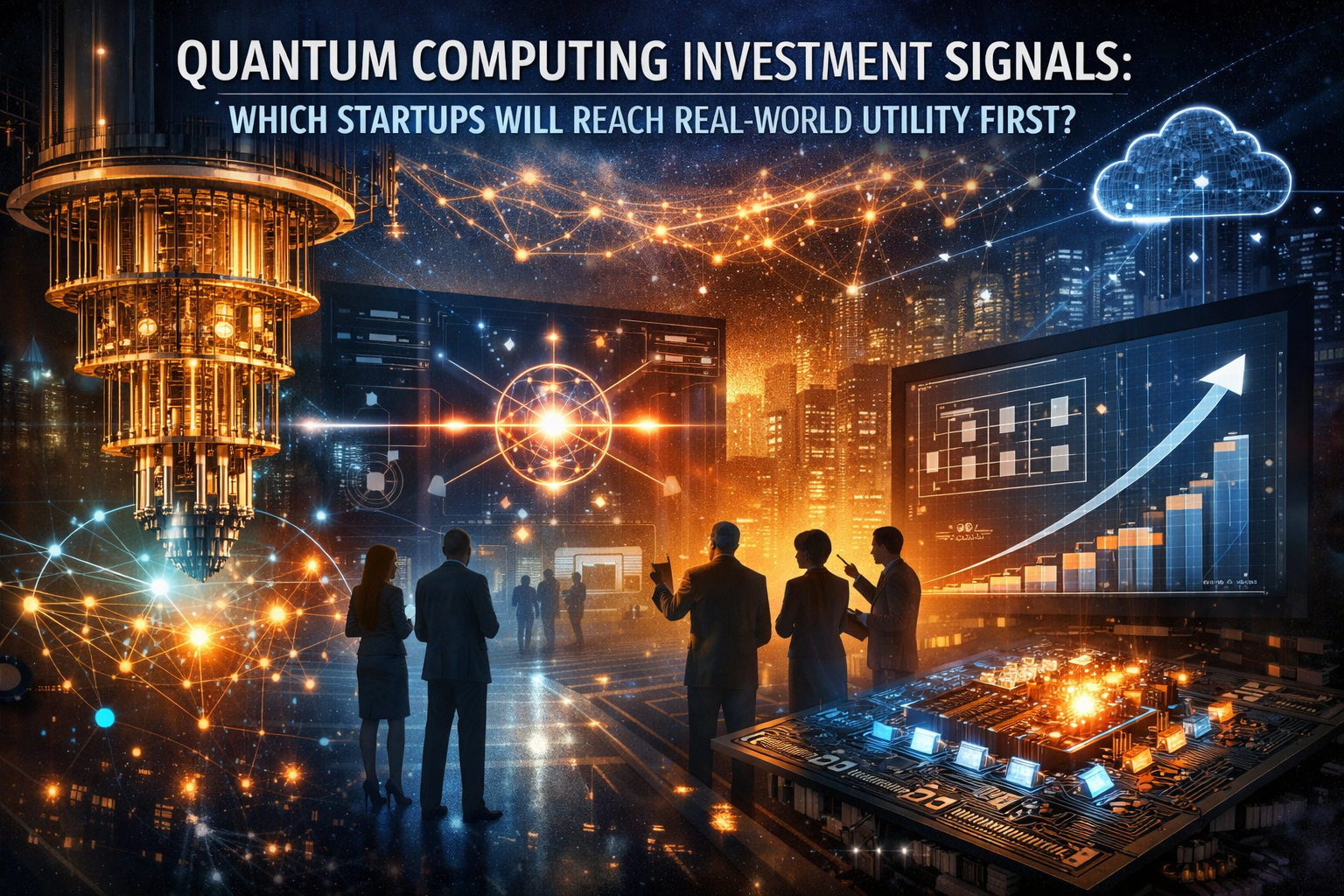
The question everyone asks sits there at the surface: Which modality wins?
Photonic. Superconducting. Trapped ion. Neutral atom.
It’s a clean question. Almost too clean.
Because underneath it, something less comfortable is happening. Something harder to categorize.
The question is shifting.
Not which technology is best, but which one can actually arrive somewhere real without breaking under its own weight.
That’s where things start to separate.
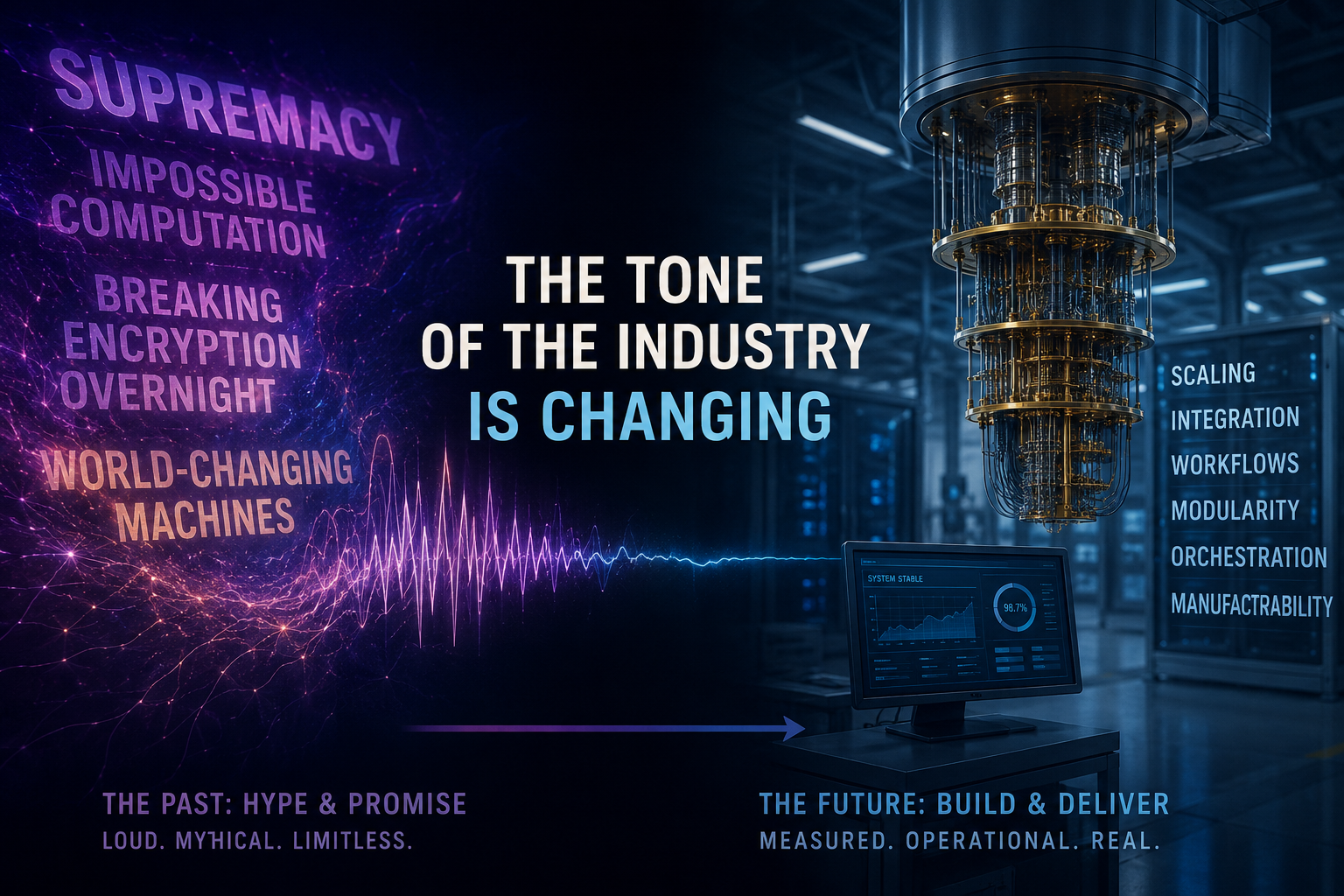
When you look at the dataset this way, it doesn’t behave like a race anymore. It behaves like a filtration process. Signals pass through. Others don’t.
You begin to notice how uneven the field is. Not in ambition—there’s no shortage of that—but in proximity to something usable. Forty-two (42) companies are hovering in the NISQ or hybrid space, close enough to hint at potential applications. Forty-one (41) is still suspended in that research-to-pilot phase, where everything feels promising but nothing quite lands. And then just a handful, five (5), that speak in the language of fault tolerance, like they’re already thinking beyond the horizon everyone else is still trying to see.
It’s not a failure. It’s just… distance.
And distance matters more now than it used to.
Because the audience has changed.
This isn’t just a conversation between physicists anymore. Or even specialist investors who are comfortable funding uncertainty for a decade at a time. There’s a different kind of attention entering the room. Enterprise buyers. Infrastructure teams. People who are used to asking quieter, sharper questions.
Can this plug into something I already use?
What does this reduce for me?
Where does the risk actually sit?
They’re not looking for elegance. They’re looking for friction.
And you can feel, as you read through the dataset, how few companies are speaking directly to that.
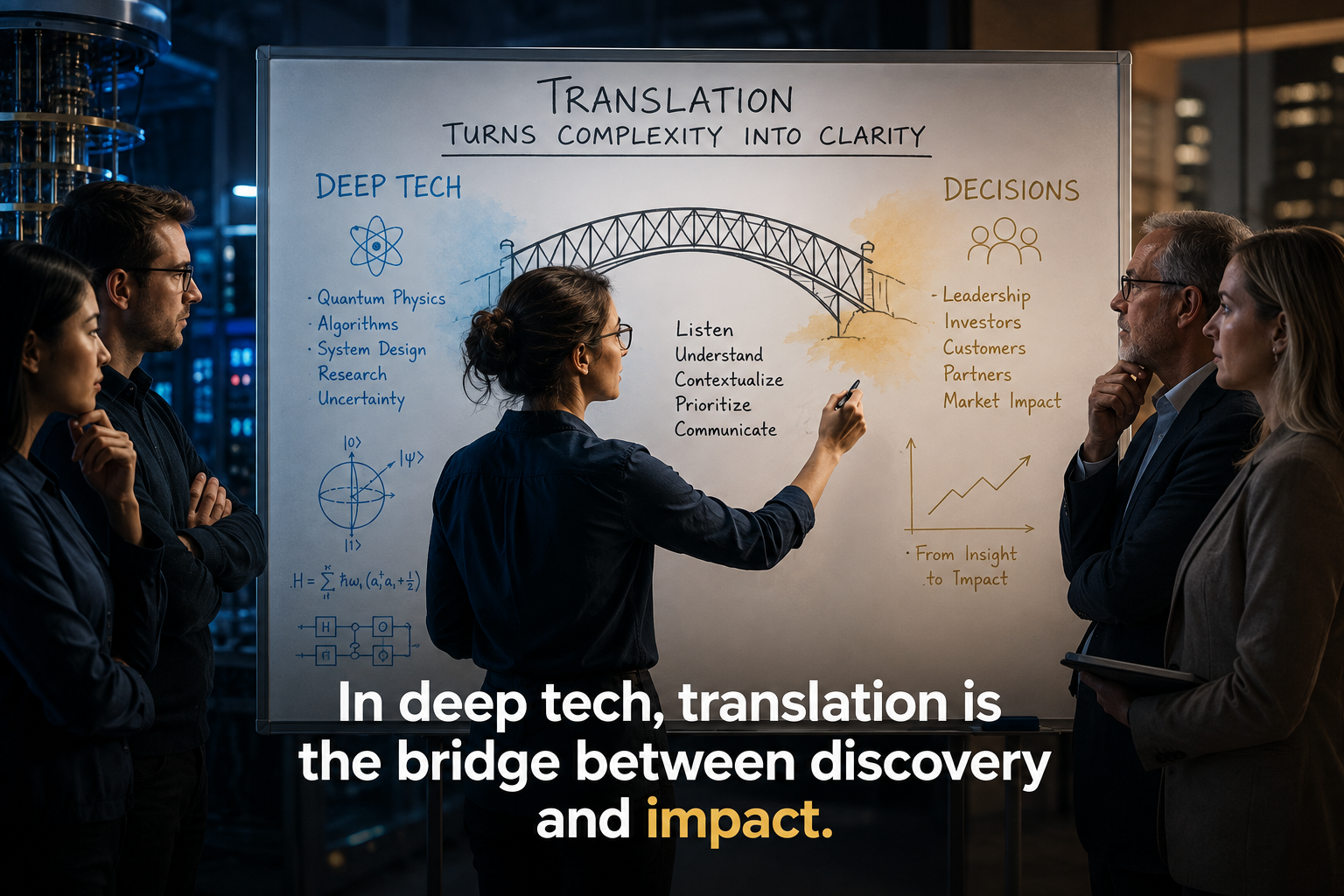
Not because they don’t have depth, but because they don’t translate it.
There’s a kind of opacity that lingers. Eighty-four out of a hundred have no clear articulation of error correction, mitigation, control layers, or any of the invisible scaffolding that actually determines whether something works outside of a lab.
It creates this strange tension.
You sense the sophistication. But you can’t quite see it.
And in a market like this, what isn’t visible becomes its own kind of risk.
That’s why certain companies feel different when you encounter them. Not louder, just clearer.
Riverlane, where error correction isn’t implied but stated, almost like a boundary line drawn around uncertainty.
Qedma, narrowing the chaos of noise into something that feels manageable.
Q-CTRL, Quantum Machines are working in that layer most people overlook: the control systems, the orchestration, the part that quietly determines whether anything else matters.
Then others, ParityQC, Classiq, where the intelligence sits above the hardware, translating complexity into structure.
It starts to reframe what “defensibility” even means here.
Not the machine itself. Not anymore.
The system around it. The way everything connects, adapts, and stabilizes.
The parts that don’t photograph well.
And then there’s the question that lingers just beneath all of this, almost unspoken but impossible to ignore once you notice it.
Where does this live?
Not technically. Geographically.
Because suddenly, that matters in a way it didn’t before.
You see it in the dataset if you look long enough. Certain regions feel… easier. Less friction. The U.S., Canada, parts of Europe, Japan, and Australia. Places where the pathways to procurement, to cloud infrastructure, and to partnership feel established, even if the technology isn’t.
And then other regions where the technical story might be just as strong, but something else introduces hesitation. Policy. Export constraints. Trust.
It’s subtle. But it changes the shape of what’s investable.
Because utility isn’t just about whether something works.
It’s whether it can move.
Through systems. Through borders. Through procurement processes that don’t care how elegant your architecture is if it can’t be integrated, secured, and supported.
That’s where the top layer of the dataset starts to feel… different.
Not because the claims are bigger. But because the path is clearer.
Quantinuum—there’s a sense of completeness there. Full stack, yes, but also proximity to real environments. Azure sits quietly in the background like an anchor.
QunaSys—focused, almost deliberately narrow, but in a way that connects directly to chemistry, to materials, to something already in motion.
Pasqal—bridging into enterprise pilots, into networks that already exist.
Q-CTRL again—because control, it turns out, is one of the deepest moats available.
Xanadu—positioned in a way that feels… accessible. Less friction at the edges.
And then others just outside that circle. Close, but not quite as legible. D-Wave with its hybrid utility. Quandela with that subtle sovereignty angle. ORCA is still early. SandboxAQ is orbiting space from a slightly different axis.
It’s not about ranking them, exactly.
It’s about noticing what they have in common.
They don’t just build technology.
They reduce uncertainty.
And that might be the quiet shift happening underneath everything.
The realization that in a field defined by possibility, the companies that move forward won’t be the ones that promise the most, but they’ll be the ones that make themselves understandable.
Operational.
Integratable.
Trusted.
There’s something almost counterintuitive about that. You expect the frontier to reward the most radical ideas. But instead, it’s starting to reward the ones that can be held, examined, and connected to something real.
The ones that don’t just say what they are.
But show how they fit.
And maybe that’s the deeper pattern sitting beneath the dataset. The one that only becomes visible after you’ve spent enough time with it.
The race isn’t really about achieving quantum advantage anymore.
It’s about becoming something the world knows how to use.
Something that can exist, not just in theory, but inside systems that are already alive.
And that shift, quiet, almost easy to miss, is where everything starts to reorganize around a different kind of gravity.
Not hype.
Not even innovation, exactly.
But trust.
The kind that accumulates slowly. The kind that feels almost invisible while it’s forming.
Until suddenly, it isn’t.
Check out our report at https://impactquantum.com/Reports/QuantumStartupLandscape/