There’s something about a map that quiets the noise.
Not the loud kind of map that is splashed across headlines with bold claims and brighter promises but the quieter kind. The one you sit with a little longer. The one where your eyes start tracing patterns before your mind names them.
At first, it looks simple. Dots. Clusters. Empty spaces in between.
But then something shifts.
You begin to notice where the density gathers. Where it thickens, almost like breath against glass. And where it thins out into silence.
And suddenly, it doesn’t feel like a map of companies anymore. It feels like a map of attention. A place where people have decided that the future is worth building.
The instinct, especially when everything feels overwhelming, is to look for a single answer.
Which country is winning? Who’s ahead? Where should I be looking?
But the longer you sit with it, the less that question makes sense.
Because nothing here is evenly spread.
And nothing here is accidental.
It gathers.
Like certain thoughts do.
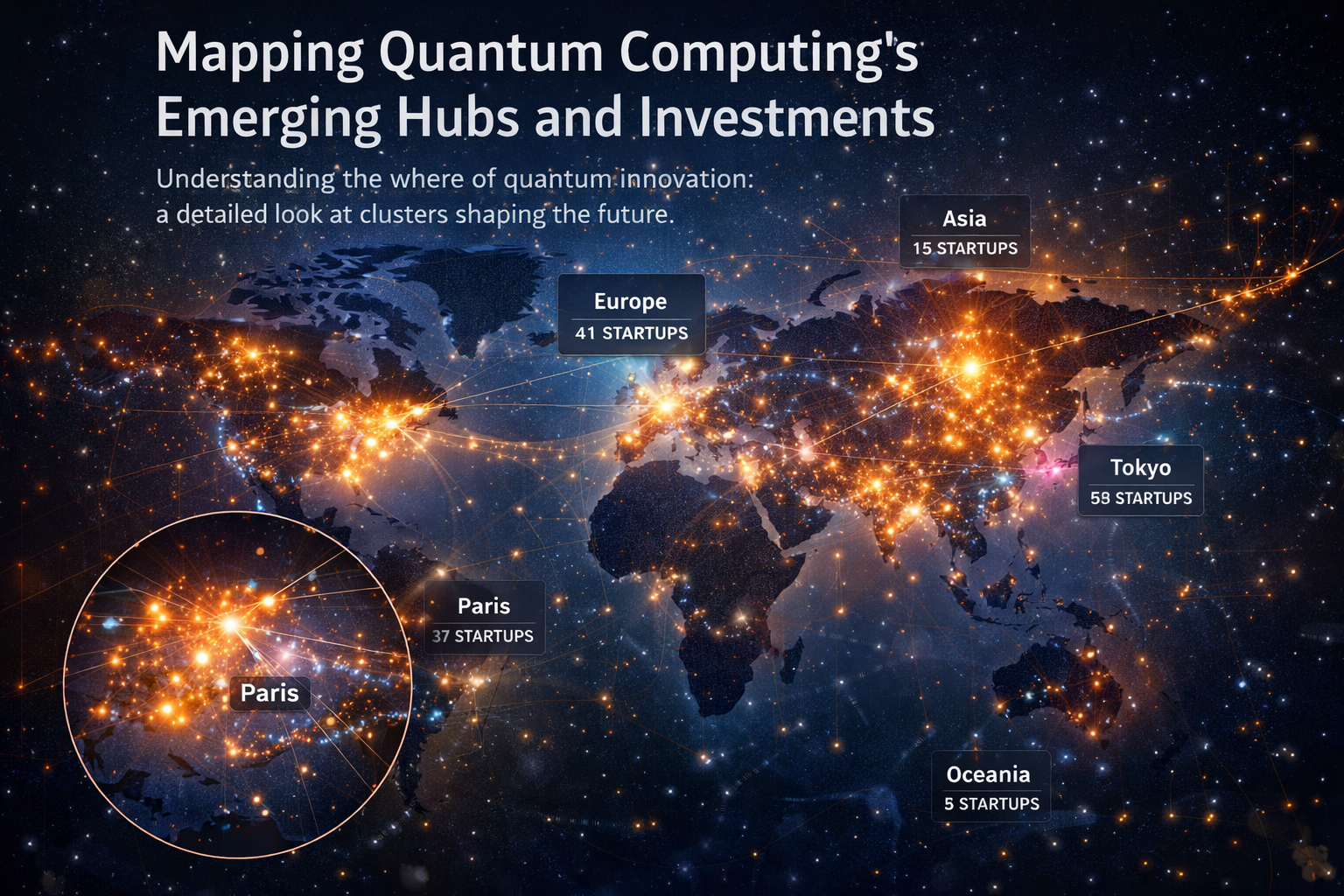
In this snapshot, Europe holds 41 startups. North America follows with 37. Asia sits at 15, with smaller signals in Oceania and South America.
On paper, it reads like a distribution. In practice, it feels like intention.
Europe’s clusters feel layered, almost like sediment. Years of policy, education, and funding are pressed together until something stable forms. You can feel the continuity there. The sense that this wasn’t built quickly but deliberately. A kind of patience that doesn’t rush to prove itself.
North America moves differently, faster, and more elastically. You can almost sense the motion underneath it with partnerships forming, platforms expanding, and things being tested in real time. It feels closer to the surface, but not shallow. Somehow responsive.
And Asia.
Asia feels quieter in the data, but not in potential. More like something coiled. Its nature is selective and focused. The intention is to choose where to place weight rather than spread it thinly.
Different rhythms. Same gravity.
If you zoom in, the countries start to matter less and the cities, like Paris, Boston, and Toronto, as innovation hubs begin to take shape. They are more than locations; they are ecosystems where systems come together long enough for something fragile to become real.
And that’s the part that lingers. Innovation Isabel brilliance but not necessarily centred around a person or one particular idea. But rather a moment where innovation is about proximity.
There’s a kind of relief in seeing it this way.
Especially if your brain tends to scatter across too many inputs at once. If you’ve ever tried to hold the entire quantum landscape in your head and felt it blur at the edges.
A map reframes it. Like pockets of coherence. Places where complexity is allowed to exist without collapsing. And maybe that’s why visualizing it changes something.
Because when information stays abstract, it expands endlessly. It becomes noise. But when it takes shape, something you can trace with your eyes, it starts to settle in your subconscious.
Patterns emerge. Not because they weren’t there before. But because now, you can actually see them. There’s also something more personal hidden in this.
A quieter question. Where do you place yourself in a landscape like this? Not geographically, necessarily. But structurally. Do you embed within a cluster, move between them, or do you try to build one where none exists?
There’s no obvious answer. And maybe that’s the point.
Because what this map reveals is that this ecosystem is dynamically changing. The real risk is only seeing looking at this map at a cursory glance. What we learn, if you stay with it a little longer, is something else entirely.
That the future of quantum innovation isn’t arriving in a single place. It’s being assembled in pockets that are often out of view.but I
And that geography, in this context, isn’t just where something happens. It’s how it happens. If you sit with the map long enough, you start to feel it.
Not urgency, exactly. Something steadier.
Like standing in a room where conversations are happening just out of reach. Close enough to hear the rhythm. Not yet the words.
And realizing that just by being here in this conversation means you’re already part of it.