It’s an idle question posed in the stillness of a solitary night: How does the cacophony of neurons and synapses lead to the soft whisper of consciousness? For years, the reigning perspective has been a world painted in broad strokes of biology—neurons firing, chemicals cascading. Yet, there lays another narrative, one woven deep within the quantum threads of our universe.
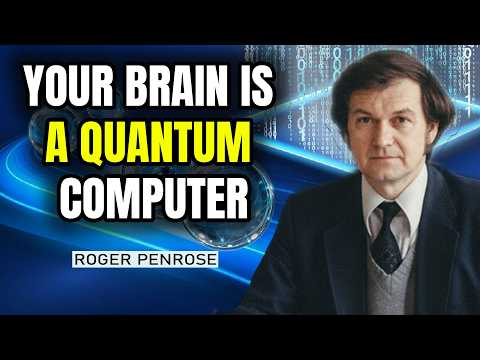
To unravel this tapestry, we turn to the Orchestrated Objective Reduction (Orch OR) theory, an idea that challenges the prevailing wisdom, suggesting our brains might be quantum computers, operating with precision beneath the threshold of classical physics. At the heart of this concept are microtubules, the intricate structures within neurons which were once thought to be mere supporting actors but may, in fact, be the stars of our cerebral symphony.
Based on content from Quantum Cosmos Decoded
Let’s pause for a moment at “The Gap” — that silent chasm between the raw processing of information and the rich world of subjective experience. This gap is where the enigma of consciousness unfolds. Classical physics gives us the mechanics, but falls short of explaining why these processes feel like anything at all. It’s in this gap that the notion of our brains as quantum computers begins to resonate.
Despite the objections—that the warm and noisy nature of biological systems should negate any quantum effects beyond near-instantaneous decoherence—there’s growing evidence suggesting otherwise. Microtubules, with their precise, almost crystalline geometry, might indeed harness quantum processes, with tubulin proteins existing in superposition states. These quantum states orchestrate computations within our neurons, potentially even reaching beyond the physical through the fabric of spacetime.
But why should this matter? Because if consciousness stems from quantum processes, it redefines not just how we perceive ourselves, but our interaction with the universe itself. In this framework, consciousness isn’t a byproduct but a fundamental player at the core of physical reality. It operates with a decisiveness born from objective reduction—a collapse of quantum states not haphazardly, but influenced by intrinsic properties, “Platonic values” perhaps, embedded within the cosmos.
Thinking further, this perspective could offer explanations to phenomena that classical neuroscience struggles with—such as the compelling experiences reported during near-death episodes. Such experiences might not be chaotic hallucinations, as traditionally dismissed, but coherent narratives that challenge our understanding of consciousness bound within biological constraints.
Recent studies, such as those measuring quantum vibrations in microtubules and the effects of anesthetics that bind specifically to these structures, lend credence to this idea. They suggest that consciousness doesn’t flicker out because neural communication ceases, but because these quantum processes within neurons pause.
The counterpoint arrives on the wings of decoherence, that theoretical siren warning that such delicate quantum states should be nullified by the bustling biological environment. Yet, nature has shown us that life has harnessed quantum mechanics cleverly—evident in processes like photosynthesis and bird navigation that exploit quantum coherence and entanglement.
In the quiet reflection of these discoveries, we must ask ourselves: Could it be that consciousness itself rides on these quantum waves, finely tuned by the nature that gave rise to it? Might our understanding of self and universe be on the cusp of a profound redefinition?
The implications of Orch OR are staggering and profound, inviting more questions than they answer. While the theory stands as an open hypothesis, one among many, it beckons a deeper exploration of consciousness, physics, and the universe. Perhaps the boundary between observation and reality is more permeable than we have dared to imagine, and it is at this threshold that we might come to understand not only our minds but the very nature of reality itself.
Ultimately, this inquiry opens myriad paths: What does it mean for the future of neuroscience, of understanding our essence? Orch OR nudges us towards a reflection on our place within the cosmos—are we merely observers, or something more intrinsic, engaging in the symphony of existence at a foundational level?
This conversation, though quietly spoken, resounds through the corridors of science and philosophy. It leaves us with a feeling, much like orchestrated superposition, that what we sense, in life and in self, might just be the universe recognizing its own intricacies through us.
—