Sunlight Can Create Quantum Entanglement?!
What if ordinary sunlight could create one of the strangest phenomena in quantum physics?
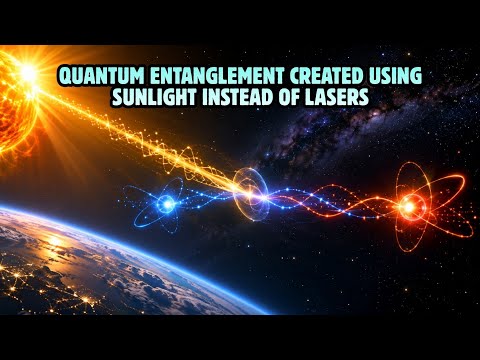
For years, scientists believed that highly organized laser light was necessary to create quantum entanglement between photons. But now, researchers at the University of Ottawa in Canada have challenged that idea.
Based on content from uncover reality
Deep in the dance between light and matter, we often find the universe whispering secrets we scarcely knew to ask about. Taken for granted in our daily life, sunlight turns the world vivid, dapples leaves, and paints fleeting moments. Yet until recently, the gentle rays of sunlight seemed too unruly to participate in the delicate ballet of quantum entanglement—a ballet traditionally orchestrated by the more disciplined light of lasers. At least, that’s what was thought.
Enter researchers from the University of Ottawa, who dared to imagine otherwise. They’ve laid bare an idea that the sun, that vast anarchist of photons, could be coaxed into a realm humans believed was reserved only for the precision of lab-born lasers. Through their work, they’ve shown us that the sun—a symbol of constancy—can also become a player in the quantum theater.
But how, one might wonder, can sunlight, with its riot of frequencies and directions, create quantum entanglement between photons? The process hinges on a nonlinear crystal and the method of spontaneous parametric down-conversion—a mouthful of jargon that essentially means light split and combined within the crystal’s lattice creates photon pairs whose properties intertwine, a sort of coupling every bit as intricate as a tango.
The neat lines and spiraling beams of laser light never faced the chaos sunlight embodies. Organizing sunlight felt like asking a river to be still, yet these researchers embraced the chaos and crafted an experiment that illuminated the potential. They zeroed in on the photons’ polarization, noting with wonder that the entanglement generated was a startling 94% similar to the ideal, neatly entangled state.
From this experiment flows a cascade of implications that could ripple across our technologies. Imagine, for instance, satellites using sunlight rather than energy-intensive lasers to craft secure quantum encryption keys, light poured and shaped from the sky itself into protecting our most vital secrets. It’s a future still gestating, quietly awaiting the innovations to cradle this groundwork build further.
But before we leap too far into the abstract possibilities, let us reflect on the necessity of this innovation. For years, it seemed axiomatic that without lasers, the controlled creation of quantum entanglement would remain impossibly out of reach. But in stepping back to the most primal of energy sources, sunlight sheds light—and indeed, offers power—upon a new era in quantum technology; one that could potentially rethink and retool our energy footprints.
Critics might argue about the practicality of relying on such a variable source as sunlight. Indeed, its very nature changes minute to minute, continent to continent. But therein lies the beauty of this discovery: the indirect revelation that solutions might emerge not solely from overpowering nature’s uncertainties, but by elegantly weaving them into the fabric of our technologies.
It leaves us with a complex, enriching question: if our paradigms are pointillist paintings, compiled from assumptions ever fixed and convincing, how often might we miss what’s right before us? What might we build, not in attempting to defy the natural world, but inviting it to lead?
—