
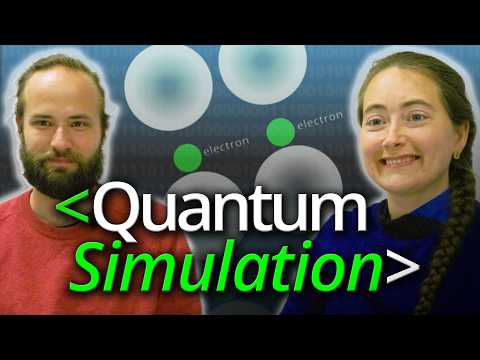
In the quiet corridors of academic inquiry, where the air is filled with speculative possibilities, a new kind of computing is emerging that could radically transform how we understand and simulate the world around us. Quantum computing, often spoken of in tones reserved for science fiction, is inching closer to reality, promising capabilities that outstrip our classical counterparts, particularly when it comes to the daunting complexity of simulating natural phenomena.
Leading these explorations are minds like Dr. Eleanor Crane from King’s College London and Alexander Schuckert from the École Normale Supérieure in Paris. Their work delves into the subtleties of using quantum computing to simulate nature—a realm where classical computers falter. It’s a landscape defined by quantum puzzles, strange and beautiful in their intricacies, awaiting to be unravelled by quantum means.
Based on content from Computerphile
The magic lies in the nuances of quantum mechanics—the dance of probabilities, superposition, and entanglement—concepts that classical computers struggle to emulate due to their binary nature. Imagine, if you will, the process of photosynthesis. Light hits a leaf, and an electron is excited, racing across a leaf damp with potential, similar to solar cells in their operation. Yet, the efficiency with which nature manages this energy transfer remains a mystery. Quantum simulations could illuminate these pathways, helping imitate them or even innovate beyond, making strides in energy technologies.
Batteries, those unassuming storage units of power, also present a challenge amenable to quantum computation. Classical computers can only simulate up to around 20 atoms within a lithium-ion battery, limited by exponential memory growth requiring astronomical computational power. Quantum computers, however, could simulate thousands, leveraging entangled states to model electric currents—those minute electron movements—promising advances in battery technology that could revolutionize electric vehicles and beyond.
Imagine an electron on an atomic lattice, poised like a coiled spring, ready to leap to neighboring atoms, dictating an electric current. Quantum mechanics offers a richer tapestry here—a superposition of possibilities where an electron exists in potential states until observation collapses them into one reality. This is visualized in the Bloch sphere, a theoretical construct allowing us to map these ethereal quantum states onto confined imaginaries of probabilities.
Yet, harnessing these quantum phenomena in practical applications requires intricate orchestration. Entangling gates—tools in quantum computing’s repertoire—allow qubits representing electrons’ possible states to interact, elegantly mapping how electrons might traverse a battery’s atomic structure. In contrast to classical computing’s sequential computations, quantum computers process these multifaceted states simultaneously, promising vast reductions in computational time.
As if conducting a symphony of superpositions, researchers are gradually perfecting the subtle craft of directing these quantum processes. Currently, quantum computers are stepping out of the shadows of theoretical concepts, existing in experimental forms with hundreds of qubits. The race is on; machines cooled to near absolute zero hum beside systems using laser-trapped atoms, edging us closer to the dream of a quantum ledger capable of calculating the unfathomable.
Optimism courses through this nascent field, suggesting that tangible, transformative results might not be decades away but just a couple of years. Perhaps soon, quantum computers will provide the clarity to untangle complex scientific questions and industrial challenges alike, echoing through the fields of physics, cryptography, and beyond.
In the meantime, aspiring quantum pioneers might find their calling in environments like Jane Street—a firm that revels in the numerical dance, offering internships deep in the mechanics of quantum algorithms and trading strategies rich with mathematical intrigue. Their culture of exploration, set against backdrops dotted with mathematical puzzles in art and architecture, echoes the quest to unravel the world’s frenetic order and latent symmetries.
—









Leave a Reply