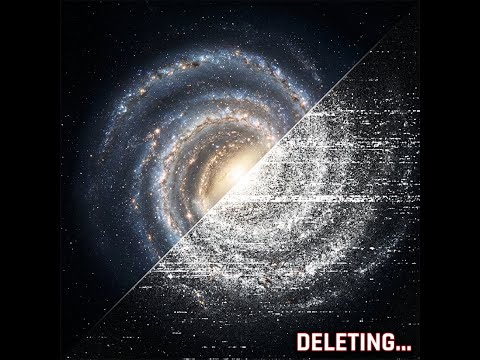
Space looks completely empty and perfectly stable today. It hides a field waiting to delete physics.
Brian Greene outlines in ‘Until the End of Time’ a horrifying phenomenon: quantum tunneling could cause the Higgs field to instantly flip. All known scientific laws would be erased. Atoms would violently tear apart. This apocalypse could happen without any warning.
The universe is standing on a microscopic quantum trapdoor. Every passing second is a massive cosmic gamble.
⚠️ Are you terrified of instantaneous quantum reality deletion?
Based on: Brian Greene & Sean Carroll
#quantumtunneling #briangreene #darkenergy #endoftheuniverse #scaryscience #existentialdread #realityglitch #cosmichorror #apocalypse #shorts
Based on content from NorthLuma
Imagine gazing up at the night sky, a canvas of celestial tranquility speckled with stars, each dot a beacon of consistency in an expansive void. Yet beneath this seemingly timeless tableau, a different truth brews—a bustling, invisible grid of energy, whispered to possess more might than all the bright matter scattered across the universe. This unseen tapestry challenges our senses, insisting that the tangible world, each breath and solid grasp we take for granted, is tentatively suspended in a quantum balance.
Physicist Brian Greene, in his exhausting excavation into cosmic inevitabilities titled Until the End of Time, offers us a peek into an unsettling prospect. Within each second that ticks by in serene repetition, lies the probability of a phenomenon known as quantum tunneling causing an unprecedented upheaval: the flipping of the Higgs field. This isn’t mere scientific abstraction—it’s the quiet backdrop of our lives, the very fabric of existence fraught with tension from unseen forces. Greene, alongside physicist Sean Carroll, provides us with a disquieting reminder: the universe we inhabit is perched precariously on a quantum trapdoor.
To unravel the weight of these cosmological reflections, consider the Higgs field as the underpinning of reality itself—a cosmic molasses through which particles wade, acquiring mass and forming the building blocks of the known universe. Its stability is our lifeline, the silent guarantor of physical laws allowing gravity to anchor celestial bodies and electromagnetism to spark life as we know it. Yet this vital component of existence confronts an eternal adversary: dark energy, a volatile fabric stretching the very tapestries of space.
Dark energy, a relentless force striving outward, is held in check solely by a thin quantum barrier. Picture, if you will, a vast ocean contained by a slender dam; one fracture, one rogue wave, and the controlled chaos resists its bounds no longer. This metaphor captures but a fraction of the delicate dance between dark energy and the Higgs field, whose containment is as much a temporary reprieve as it is a blessing.
Here enters quantum tunneling, the subatomic foil to our solidified norms of cause and effect. In this realm, particles defy expectations; they do not march through barriers but instead appear instantaneously on the other side—an unseen act of cosmic choreography that hints at the surreal. The danger looms should this principle touch the Higgs field; reality no longer conforms to its stability, and the trapdoor swings wide open.
The aftermath, Greene describes, is immediate—or rather, it would be, for we’d witness none of it. In a universe dictated by light-speed travel, any such cosmic cataclysm would reach us simultaneous with the light that illuminates it. No harbinger of destruction, no forewarning star to signify our end; only the quiet, unmarked passage from being to void. As the rules of physics are rewritten in an instantaneous flash, atoms unwind and disband, leaving naught but scattered echoes of their formerly tangible forms.
Our modern existence—steady, seemingly immutable—relies essentially on this intricate yet fragile framework. Each moment comprises a silent wager against the mathematical inevitability of this quantum abyss. The simplicity of everyday life is exposed as an intricate dance above a threshold we cannot see, our feet ever nearing and avoiding the edge.
Such overpowering concepts invite reflection upon our place within this vast, continually evolving cosmos. Do we find solace in the understanding of our transient roles in a greater tapestry? Or does the sheer unpredictability inspire us to sharpen our focus on each fleeting second we’re afforded, living in closer awareness of our possibilities?
In acknowledging our universe’s ephemeral nature, we are called to face the inherent uncertainty not solely with fear but with a deeper appreciation of its complex beauty. As the cosmic question mark lingers, perhaps it provokes within us a newfound respect for the layers of existence we have yet to understand—and a curiosity for what end lies beyond the walls we cannot see.
—