Imagine closing your eyes and feeling the world around you dissolve into a singular, unbroken, whole silence. Yet when you open them, the universe reasserts itself—vibrant and complex. For centuries, our understanding of the universe has oscillated between these two states: the belief in a singular objective reality and the baffling insistence of quantum physics that observation plays a pivotal role in shaping reality.
For a long time, esteemed minds—from Newton’s steadfast mechanics to Einstein’s relentless pursuit of unifying laws—have endeavored to chart the universe as it truly is: a complete, independent entity. Quantum mechanics, however, pokes curious holes into this notion, whispering an enigmatic possibility—that the universe requires an observer to unfurl its myriad possibilities.
Recently, a striking discovery in quantum gravity has surfaced, unsettling the bedrock of traditional physics. In their pursuit to describe the universe’s embryonic state as a seamless, undifferentiated whole, scientists stumbled upon mathematics that refuses to behave, suggesting that perhaps the universe never existed as a perfect singularity, not even in its inception.
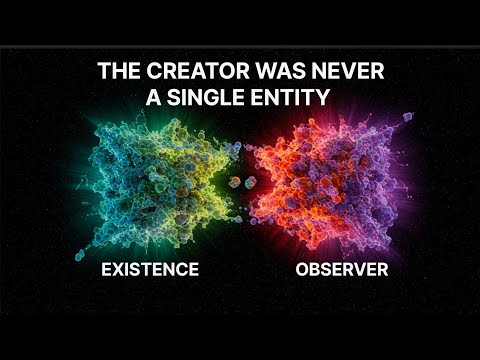
These calculations hint at a foundational truth: that an internal distinction, akin to an observer, might be woven into the very fabric of the cosmos. But this introduction of “observer” doesn’t imply a conscious entity like a human being. Rather, it indicates a subsystem, a slight differentiation that defines the whole.
This realization leads us to a provocative question: if the universe, at its deepest level, cannot exist devoid of observation, can any concept of a creator be envisaged sans an observer, a point of reference? Might this duality be intrinsic to existence itself?
Traditionally, the universe’s origin is depicted as a single, infinitely dense singularity—a pristine start with no separations. This elegant simplicity, suggesting that all of reality blooms from a single point, challenges us once again. Current explorations delve into not just the Big Bang’s manifestation but rather all potential ways the universe could exist. Enter the gravitational path integral—a monumental mathematical venture that attempts to encompass every conceivable version of the universe.
Picture trying to predict a particle’s trajectory; in the trenches of quantum physics, it takes every possible path. By aggregating all potential paths, scientists distill the most probable outcome. This conceptual leap extends to the cosmos—instead of mapping a single trajectory, it integrates potential universes. Mourning the brevity of typical dimensionality, this vastness requires the nuanced canvas of Hilbert space, an abstract realm where all conceivable states reside.
Physicists initially presumed an observer-free universe might still persist as an objective reality, holding numerous potential states. Change, after all, thrives on alternatives. But when applied to a closed universe devoid of observers or reference frames, the Hilbert space unexpectedly collapses to a single state, rendering the universe immutably frozen and incapable of giving rise to the complexity we witness.
This impasse gives rise to the paradox. When researchers reintroduce even a minimal form of an observer—a systemic division—a transformation occurs. The universe’s potential unfolds expansively, with complexity and information flourishing anew. Like unlocking doors hidden in plain sight, structures materialize, governed by the observer’s growth of entropy. Our universe, brimming with structure and life, owes its existence to this primordial distinction.
What if the primeval universe wasn’t an undivided singularity? Quantum fluctuations, horizon-like boundaries, or inherent relational structures could have sown the seeds of early distinction. It’s speculative yet invigorating, challenging the singular origin narrative. And if a creator is bound by these same principles, they too could embody duality, intertwining with an observer to define existence.
These revelations, far from mere philosophical meanderings, arise from the rigor of quantum gravity mathematics. They beckon us to reconsider reality’s fabric, hinting that existence itself might require duality—a quintessential Creator-Observer continuum. As we peer into this quantum dance, is the universe nudging us to glimpse its multifaceted realities just beneath its surface?
—