Quantum computing is often shrouded in mystique and misunderstanding, particularly by the pervasive yet misleading notion that these computers “try all possible answers simultaneously.” This idea, while alluring, is a simplification far divorced from the truth. If quantum computers truly operated this way, the very fabric of computing and cryptography as we know it would have already crumbled. But why hasn’t this happened? The answer lies in understanding the elegant complexity of quantum mechanics, specifically the concept of interference.
Based on content from Improper Integral
Imagine meeting a qubit, a unit that defies the binary constraints of classical bits which are neatly categorized as ones or zeros—like tiny digital soldiers marching to a definitive beat. A qubit, on the other hand, sways with potential. Described by two numbers, or amplitudes, a qubit embodies the probabilities of being a zero or a one, resolved only at the moment of measurement.
This quantum characteristic is harmonized on the Bloch sphere, where a qubit’s state spins not just between zero and one, but anywhere on this spherical surface. It offers a blend of superposition, a concept where possibilities coexist until observation forces a definitive upon them—a moment where quantum uncertainty collapses to a classical certainty.
However, the mere presence of superposition is not enough to grant quantum computers their perceived speed and power. The core advantage of quantum computing comes from interference, a phenomenon that can be visualized by two waves in a pond. As waves pass each other, they may amplify or diminish each other—constructive and destructive interference that manipulates these amplitudes to favor correct answers over incorrect ones.
Take Grover’s algorithm, a triumph of quantum computation, which exemplifies interference’s power. In a database of a million entries, a classical computer must, on average, weed through half the list to find a specific entry. Grover’s algorithm reduces this to approximately a thousand operations, not by trying everything at once but by cleverly arranging destructive interference to sideline incorrect paths, leaving the right path standing tall.
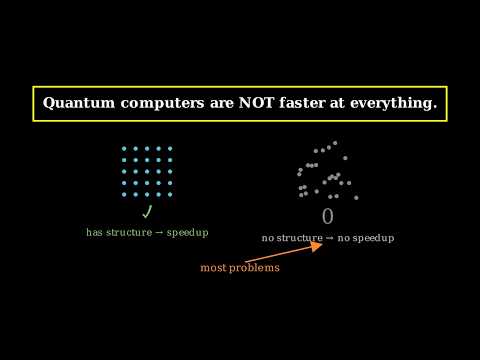
Yet, it’s crucial to dispel the myth that quantum computers outpace their classical counterparts in all tasks. Most problems we encounter daily won’t benefit from quantum speedups. A quantum computer excels where problem structures enable it to craftively exploit interference. On the other hand, tasks like general computing, your email, or streaming videos don’t fit into this special category—areas where the classical computers you know and use thrive without quantum intercession.
Quantum computers should be seen not as the inevitable replacement for classical ones, but as another tool, one adept at tasks with the right structure—like cryptography (Shor’s algorithm in particular) and simulating quantum systems in chemistry. Each domain lends itself to quantum’s forte, reinforcing not the notion of a replacement, but of an additional instrument in our toolkit, much like the specialized graphics processing units (GPUs) we use today.
As we rediscover what quantum computing truly is, the journey unfurls less like technological enchantment and more like a nuanced dance of math and physics. The future may not see quantum processors in our everyday devices, but where they belong, they hold transformative potential, subtly steering certain fields of study towards new horizons.
Where did you first encounter the “tries all answers at once” fallacy? Perhaps a teacher conveyed it as a simplified introduction or a headline optimized for intrigue. We welcome you to revisit these stories and reflect on the true, understated beauty found in quantum computing’s edges and interference.
—