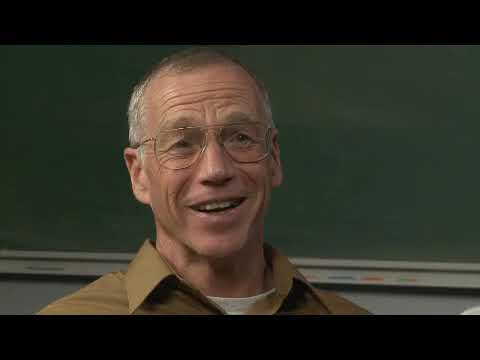
Freedman’s early years were marked by a certain distance from deep mathematical knowledge. He humorously recalls picking up calculus because his teaching duties necessitated it. However, the true turning point came after his remarkable contribution to the four-dimensional Poincaré conjecture, which sparked a quest to delve deeply into mathematics. He embraced the freedom academia offered, allowing him to explore without the constraints of a rigid plan, though he later realized the potential benefits of having one.
Based on content from Simons Foundation
The real shift in Freedman’s trajectory was catalyzed during a semester at Harvard in 1988, where he encountered Edward Witten’s pre-print on topological quantum field theory (TQFT). This new perspective was mesmerizing and challenging, dismantling previous understandings and requiring a re-evaluation of the relationship between mathematics and physics. Freedman was initially skeptical, finding apparent gaps in Witten’s approach. However, Witten’s ability to reinterpret mathematical problems through quantum field theory opened a realm of possibilities that transcended past limitations.
This awakening coincided with breakthroughs in computational complexity, demonstrating that the Jones polynomial’s exact value was intricately tied to problems considered beyond conventional computational reach. The juxtaposition of this discovery with Witten’s work stirred the notion that a new type of computer, founded on quantum physics, could solve these complex problems. Despite initial misconceptions about the necessary physical systems, Freedman’s curiosity propelled him into new theoretical territories.
Freedman’s journey underscores the idea that innovation often sits at the intersection of disparate fields. His early missteps, driven by misunderstanding and skepticism, ultimately led to a deeper recognition of the potential within quantum mechanics to reshape computation as we know it. Though his insights were slow to mature, they paved the way for understanding how theoretical physics, particularly quantum field theory, could revolutionize computational processes.
As we reflect on Freedman’s experiences, we see a narrative of transformation, the importance of interdisciplinary collaboration, and the enduring pursuit of knowledge that defies conventional boundaries. His story is a testament to the power of curiosity and the profound impact it can have when it sees the broader picture, laying the very foundation upon which future quantum computing breakthroughs may rest.
The full interview with Michael Freedman can be viewed on the Simons Foundation website, providing more insights into this fascinating journey.