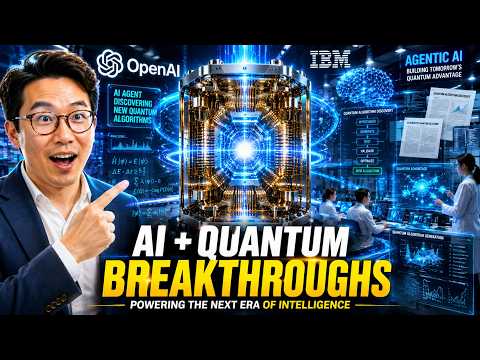
Imagine a future where quantum leaps aren’t just theoretical but actively reshaping global industries. What if the most complex challenges in manufacturing, finance, and healthcare were being solved by a technology you’ve barely heard of? As of today, October 10, 2025, that future is no longer distant. It’s happening right now, powered by a quiet revolution: quantum machine learning.
The Quantum Leap: Beyond Hype
Quantum Machine Learning (QML) sits at the crossroads of two of the most transformative technologies of our time: quantum computing and artificial intelligence. In essence, it’s the art of teaching quantum computers to learn from data. Unlike traditional computers, which store information as bits (0s and 1s), quantum computers use qubits that can exist in multiple states at once. This property, called superposition, along with entanglement, allows them to process and analyze data in profoundly different ways.
That might sound like science fiction, but it’s not. Quantum machine learning is no longer just theoretical. It’s making its way out of research labs and into industry. According to IBM’s 2025 Quantum Progress Report, companies across sectors are already integrating QML algorithms into real-world workflows, achieving results that classical systems cannot match.
And here’s the twist: the most impressive breakthroughs are not happening in distant research facilities. They are emerging quietly in hospitals, banks, and factories today.
Revolutionizing Healthcare & Pharma
Drug discovery has always been a race against time, money, and molecular complexity. Traditional methods rely on massive computational models to predict how molecules will behave, interact, or bind. Even with supercomputers, that process can take months or years. QML changes the game. By simulating molecular behavior at the quantum level, these algorithms can explore billions of potential compounds in a fraction of the time.
This year, researchers at Roche and Quantinuum announced that quantum-enhanced models had successfully identified new candidates for Alzheimer’s treatments, cutting early-stage discovery timelines from years to weeks. The implications for global health are staggering.
Then there’s personalized medicine. Quantum algorithms excel at finding patterns in massive, multidimensional datasets. That makes them ideal for analyzing patient genomes, medical histories, and environmental data simultaneously, pinpointing treatment pathways uniquely suited to each individual.
And in diagnostics, QML models are beginning to identify disease markers invisible to classical systems. In collaboration with MIT’s Jameel Clinic, quantum neural networks have shown a 30% improvement in early cancer detection accuracy over conventional AI approaches (MIT News, 2025). The future of healthcare could become not just reactive but predictive.
Transforming Finance & Logistics
If healthcare is about precision and finance is about foresight, QML is redefining both. Traditional algorithms already optimize portfolios and predict risk, but they often struggle with the sheer volume and volatility of market data. Quantum models can analyze complex interactions among thousands of variables simultaneously, revealing patterns that classical computers overlook.
Goldman Sachs’ Quantum R&D division recently demonstrated a QML system capable of optimizing entire investment portfolios in seconds, reducing risk exposure by 15% compared to the best classical methods. That’s not theoretical; it’s operational.
In logistics, QML is being deployed to strengthen supply chain resilience. The COVID-19 pandemic exposed the fragility of global trade networks. Today, quantum algorithms help companies simulate disruptions and reroute supply chains in real time. Volkswagen and D-Wave, for example, have partnered to optimize delivery routes for large fleets using hybrid quantum systems, reducing fuel consumption and delivery delays.
And when it comes to fraud detection, quantum machine learning may be the new frontier. Because of its ability to detect minute correlations in massive transaction datasets, QML can uncover subtle anomalies and patterns of deceit that evade even the most advanced classical AI. In the world of cybersecurity and fintech, that’s nothing short of revolutionary.
Manufacturing & Energy’s Smart Future
Quantum machine learning is not just transforming data; it’s transforming matter itself. In materials science, QML models are already used to design substances with specific atomic properties. From lighter, stronger alloys for aerospace to high-efficiency solar materials, quantum algorithms are unlocking combinations that would have taken centuries of trial and error to discover.
In manufacturing, QML is driving what some call “quantum lean.” Factories are beginning to use quantum-optimized models to synchronize production lines, predict equipment failures, and minimize waste. Siemens, for instance, has piloted a QML-based optimization system that reduced turbine manufacturing downtime by nearly 20%.
And in the energy sector, the technology is reshaping how we balance power grids. Quantum systems can predict energy demand fluctuations with extraordinary accuracy, integrating renewable sources like wind and solar without destabilizing the grid. By 2026, experts expect QML-driven grid management to save billions in energy waste globally.
The Road Ahead: Challenges & Opportunities
Of course, no quantum journey is without turbulence. Quantum computers are still in their infancy: fragile, expensive, and limited in qubit count. Algorithm development is another challenge. The field needs more specialists who can bridge quantum physics with data science. But the momentum is undeniable.
Over the next three to five years, expect hybrid systems, where classical and quantum computers work together, to dominate the landscape. As accessibility improves and hardware scales, QML will become a standard tool across industries, not just an experimental advantage.
The opportunity is immense, not only for corporations but also for individuals. Universities and companies alike are launching open learning platforms such as IBM’s Qiskit, Google’s Cirq, and the Quantum AI Institute to help curious minds learn the ropes of this new frontier.
If you’ve ever dreamed of being part of the next industrial revolution, now is the time to start. Quantum machine learning is not a distant fantasy. It is the invisible engine already humming beneath the surface of the modern world, reshaping industries, redefining intelligence, and challenging us to think beyond the binary.
Stay Connected
Follow our journey and be part of the conversation:
🔗 Find us on LinkedIn
📬 Join our mailing list
📺 Subscribe to our YouTube channel