Is Hong Kong’s banking sector prepared for the quantum era?
In the quiet hum of Hong Kong’s financial district, the air is filled with a subtle anticipation. Times are changing, not abruptly but with a measured certainty—whispered transformations in the realm of technology that promise to reshape the foundations upon which financial bastions have been built. Quantum computing, like an ephemeral specter of innovation, invokes both curiosity and caution, holding within its complexities a dual promise: to revolutionize and to upend.
Based on content from 香港金融管理局 Hong Kong Monetary Authority
The essence of this quiet revolution lies not just in the power of quantum computing itself but in the preparedness of institutions to harness and protect against its potential. A future where calculations leapfrog current capabilities with breathtaking efficiency offers unparalleled opportunities for risk modeling, optimization, and fraud analytics. Yet, braced against these possibilities is the daunting specter of compromised cryptography—our digital sentinels that guard identities, transactions, and data integrity.
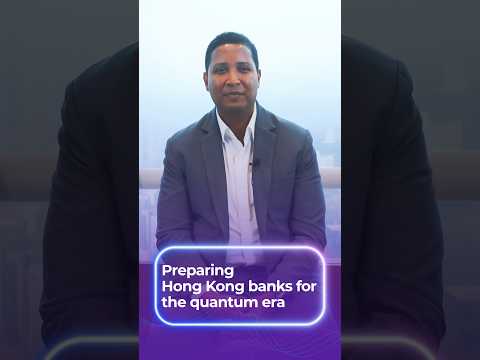
Nitish Koladoo, a Senior Manager in Banking Supervision, articulates this delicate balance. In a recently launched video, he unveils the Hong Kong Monetary Authority’s (HKMA) pioneering initiative: the Quantum Preparedness Index. This index represents not just numbers, but an introspective reflection on the state of vigilance within Hong Kong’s banking sector against the nascent threats posed by quantum advancements.
Koladoo’s analogy of planning the most efficient route through a bustling city paints a vivid picture of quantum’s potential. Traditional computers methodically navigate step-by-step through variables, while quantum systems propose a future where obstacles dissolve, and solutions emerge with uncommon clarity. However, the same computational prowess that deciphers complex financial conundrums could, in the wrong hands, unravel the very fabric of today’s secure communications.
Currently, the threat remains on the horizon—a specter not yet realized, as no quantum apparatus exists with the capacity to dismantle cryptographic defenses at scale. Yet, there lies wisdom in foresight. The transition to quantum-resistant frameworks, encapsulated in the evolving field of post-quantum cryptography (PQC), beckons with urgency. This transition is no simple tweak but a comprehensive overhaul of the cryptographic underpinnings entrenched in our financial infrastructures.
The HKMA’s survey among Hong Kong’s financial institutions paints a landscape of cautious awareness. Although 68% of banks exhibit varying degrees of familiarity with quantum-related initiatives, a significant portion, situated at the basic awareness stage, hints at the journey yet unfinished. Planning for the PQC transition, an endeavor marked by its complexity, remains embryonic for many.
Three pivotal challenges cloud this horizon: the daunting task of cryptographic inventory across multifaceted systems, the inertia of legacy technologies reluctant to embrace new standards, and the interdependent readiness of external vendors. For banks, these are not abstract concepts but tangible obstacles, each a knot demanding patient unravelling.
Addressing these challenges requires a committed leap—from awareness to actionable strategy. The HKMA’s support, through workshops and the co-development of a practical transition toolkit with the Hong Kong University of Science and Technology, underscores a collective intent. Their roadmap offers guidance, urging banks to appoint accountable leaders, map out cryptographic assets, and draft equitable pathways to transition.
This narrative is not merely about survival in an impending quantum era but about seizing a proactive stance. As Koladoo envisions, by 2030, the goal is full sectoral readiness, a beacon toward which efforts are meticulously channeled.
The onus of navigating the quantum frontier extends beyond banks—it beckons regulatory foresight, technological evolution, and an unyielding commitment to security. In this alchemy of progress and preservation, the introspection is clear: early action transforms potential threats into manageable challenges, ensuring that the digital guardians of our age stand resolute in their watch.
—