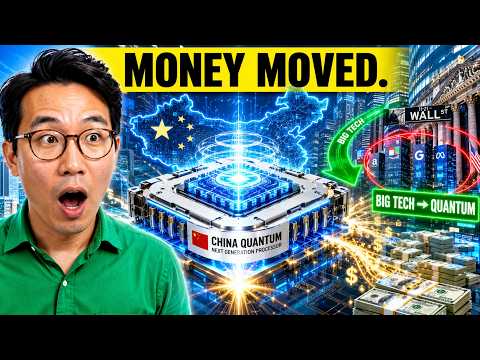
In the quiet hum of financial markets, subtle shifts often whisper of future tectonic changes. Such is the case now, as Wall Street, that perennial titan of global finance, appears to be reorienting its gaze from Big Tech in the United States to the nascent quantum fields flourishing in China. It’s a movement that speaks volumes—not simply of dollars and cents, but of strategic foresight and the deeper dynamics at play in the geopolitical technological landscape.
Based on content from Untold Historian
Let’s contemplate for a moment the evocative figure of $2.3 trillion—an amount that vanished from the market capitalizations of American tech behemoths in June. While the broader public saw this as a distress signal, many institutional investors were quietly reshaping their portfolios. The once unshakable conviction in the ‘Magnificent 7’ faded, replaced by the allure of Chinese technological enterprises with their burgeoning quantum capabilities at the core.
This strategic pivot is as much about anticipated future gains as cost efficiencies. In the realm of artificial intelligence, the economic math is stark. A leading American AI model, like OpenAI, imposes operational costs exponentially higher than its Chinese counterparts, such as Deepseek—and investors have taken notice. This isn’t simply about a race in raw technological merit but about who can deliver quantum breakthroughs sustainably and efficiently.
So why is quantum computing pivotal in this transcontinental redeployment of capital? It’s more than speculation; it’s a calculated response to innovative realities. China’s acceleration in the quantum domain is underscored by systematic government support and a strategic vision that places quantum technology at the core of national development. Beijing’s substantial financial commitments to quantum research are not a mere reaction to Western competition—they represent an ongoing, deeply rooted strategy.
American investments haven’t been dormant; significant funding, including those earmarked by the Chips and Science Act, indicates serious domestic commitment. Yet the market’s reaction tells a story of its own: not a nationalistic loyalty but recognition of parallel ambitions shaping the global quantum race. Shares in U.S. companies spiked in response to domestic funding, mirrored acutely by growth in China’s quantum stocks, revealing the intertwined destiny of these technological superpowers.
As this grand contest unfolds, what remains crucial are the developments on the ground in China—milestones no longer just academic deliberations but tangible economic realities. China’s industry demonstrates real-time commercialization, and breakthroughs with companies such as Origin Quantum highlight a maturation beyond aspirations into accessibility—their technologies deployed as practical solutions not only for future promise but current necessity.
The narrative unwinds further when considering the impact of geopolitical tensions, notably restrictions imposed by the U.S. on Chinese technologies. These actions intended to stymie Chinese advancements have, counterintuitively, spurred an internal innovation drive—accelerating China’s self-sufficiency in critical quantum technologies. It underscores a recurrent theme: that when pressure is applied, the reaction often yields results not initially expected by those applying it.
For investors and observers alike, the lesson is clear: Transformations are seldom singular events. They are tangled in a web of policy, innovation, competition, and human ingenuity. As capital flows increasingly acknowledge China’s quantum ascent, perhaps there’s a lesson here—about the unpredictability of progress and the wonders that emerge when we dare to peer just beneath the surface.
This ongoing evolution leaves us with a resonant question: Will this shift merely be a footnote in the voluminous history of tech investments, or is it heralding a new epic chapter where quantum potentials redefine the boundaries of competitive advantage? Only time, and perhaps further shifts in the silent dance of capital, will reveal the complete story.
—