Europe’s Quantum Moment Isn’t Coming. It’s Here.
For years, Europe’s role in quantum computing felt familiar: world-class research, brilliant academic institutions, and groundbreaking papers that too often translated into commercial wins somewhere else. The talent was here. The infrastructure? Less so.
That narrative is changing fast.
Over the first weeks of May 2026, a wave of funding rounds, strategic expansions, and industrial-scale initiatives made one thing clear: Europe is no longer building quantum science projects. It is building a quantum economy.
And perhaps more importantly, Europe is approaching quantum differently than Silicon Valley ever did.
From “Proof of Concept” to Industrial Strategy
What stands out across the recent announcements is not just the size of the investments, although they are substantial. It’s the shift in mindset.
The conversation has evolved from Can quantum work? to How do we scale it for real-world industry?
That distinction matters.
We are seeing an ecosystem emerge that prioritizes manufacturing capacity, open architectures, interoperability, and enterprise deployment from the beginning. In other words, Europe is thinking less like a collection of isolated startups and more like a coordinated industrial network.
That’s a very European strength.
Germany’s Bet on Enterprise-Ready Hardware
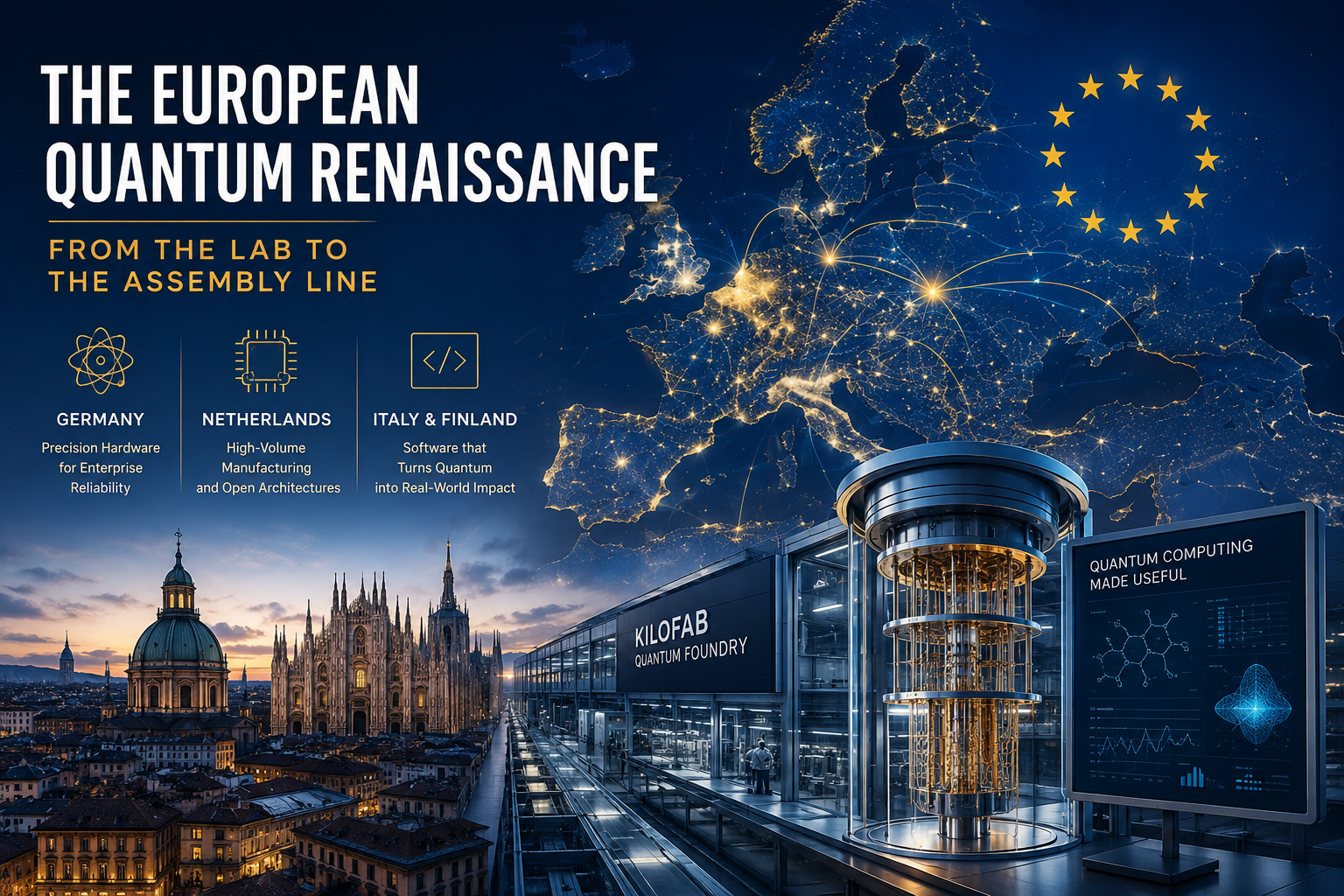
Germany-based eleQtron recently closed a €57 million Series A round, signaling growing confidence in trapped-ion quantum systems.
While superconducting approaches from companies like Google and IBM tend to dominate headlines, trapped-ion architectures are increasingly gaining attention for their stability and precision — two factors that matter enormously for industrial applications.
But the more interesting signal may be who invested.
The lead investor was Schwarz Digits, the technology arm of the Schwarz Group, parent company of Lidl. When a global retail powerhouse begins placing strategic bets on quantum infrastructure, it tells us something important: quantum is no longer being viewed solely as experimental physics. It is entering conversations around logistics, optimization, supply chains, and operational resilience.
That is a major shift.
Even EleQtron’s MAGIC technology, which replaces complex laser systems with microwave-based qubit control, reflects a broader trend toward simplification and maintainability. These companies are not designing machines for laboratory demos. They are designing systems intended to survive enterprise environments.
The Netherlands and the Rise of Quantum Manufacturing
Then came the announcement from QuantWare.
The Dutch company secured a $178 million Series B round alongside plans for KiloFab, an open-architecture quantum fabrication facility.
This may ultimately become one of the most important developments in Europe’s quantum ecosystem.
Why?
Because the industry cannot scale if every company has to reinvent fabrication infrastructure independently. QuantWare appears to understand that the future of quantum may not belong exclusively to companies building the “best machine” but to those enabling an entire ecosystem to build faster.
It’s a model that resembles what Taiwan Semiconductor Manufacturing Company did for semiconductors: create scalable infrastructure that powers everyone else’s innovation.
That kind of open manufacturing philosophy could fundamentally reshape the competitive landscape.
Milan’s Growing Influence in Quantum Software
Hardware alone will never define the quantum era.
The companies that succeed will be the ones that translate quantum capability into business outcomes — whether in pharmaceuticals, finance, materials science, or energy systems.
That’s where Algorithmiq enters the story.
The company recently raised €18 million and announced the relocation of its headquarters from Helsinki to Milan.
This is bigger than a geographic move.
It reflects the growing gravitational pull of Europe’s emerging DeepTech corridors and a recognition that quantum advantage will depend as much on software orchestration as on hardware breakthroughs.
As quantum systems mature, the market will increasingly reward companies capable of making these machines useful, not simply impressive.
That distinction is where Europe may be carving out a meaningful edge.
Europe’s Quiet Competitive Advantage
What is emerging across Germany, the Netherlands, Italy, and Finland is not a fragmented collection of startups.
It is the early framework of a vertically integrated quantum ecosystem:
- Germany refining enterprise-grade hardware
- The Netherlands is scaling its manufacturing infrastructure
- Southern Europe is accelerating the application of quantum software
- EU institutions coordinating long-term policy and investment support
Europe’s advantage may not come from trying to out-Silicon-Valley Silicon Valley.
It may come from building something fundamentally different: an open, collaborative, industrial-scale quantum network designed for interoperability and long-term resilience.
And in many ways, that model feels more sustainable.
The Real Question Ahead
The biggest question now is not whether Europe can compete in quantum.
It’s whether the rest of the world is underestimating how quickly Europe’s industrial strategy could reshape the global market.
If open-architecture fabs and shared-infrastructure models succeed, they could weaken the dominance of vertically integrated giants by lowering barriers to entry for the next generation of quantum innovators.
The quantum race is no longer just about who builds the most qubits.
It’s about who builds the ecosystem everyone else depends on.